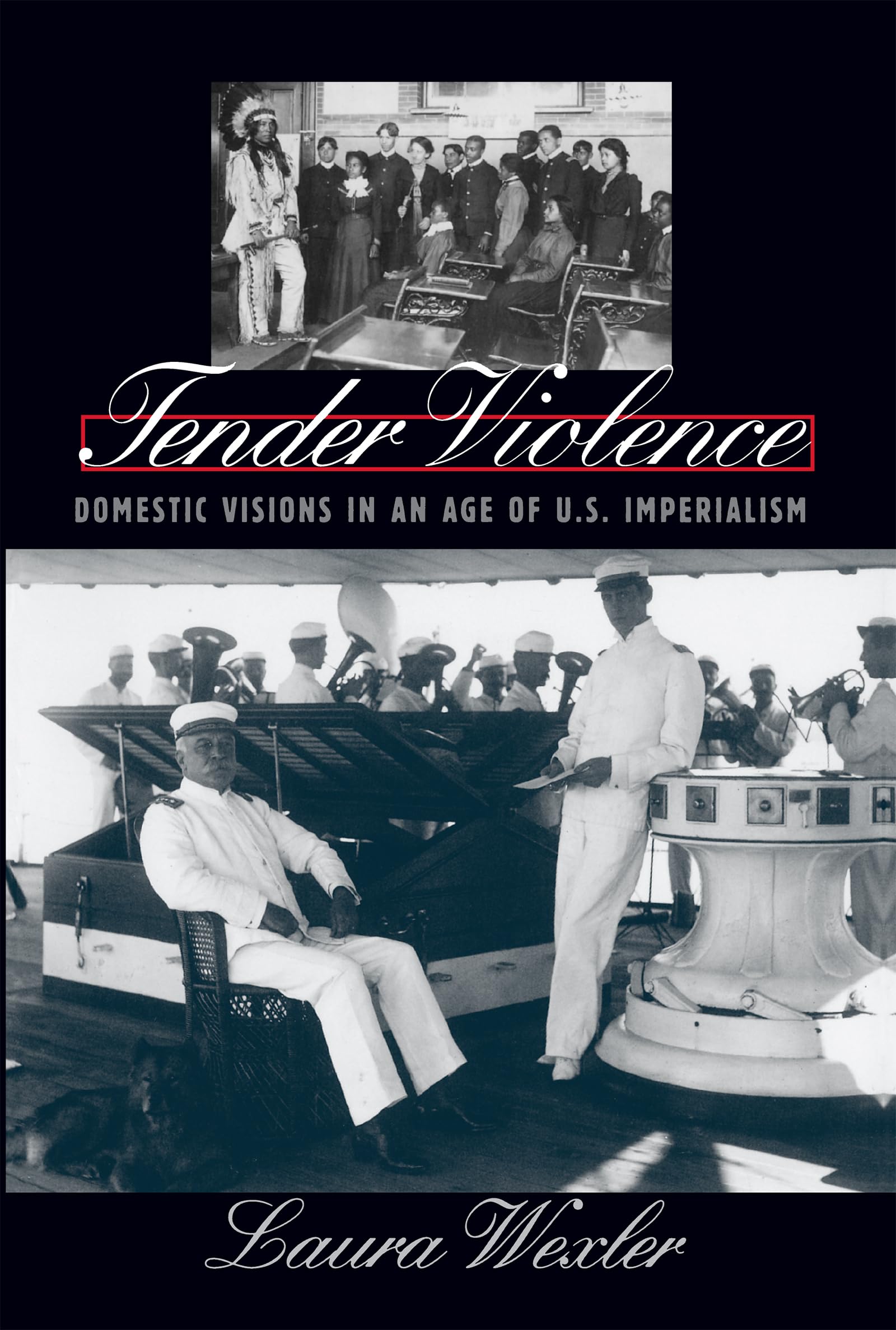
Tender Violence: Domestic Visions in an Age of U.S. Imperialism (Cultural Studies of the United States)
$32.00
by Laura Wexler



Laura Wexler presents an incisive analysis of how the first American female photojournalists contributed to a "domestic vision" that reinforced the imperialism and racism of turn-of-the-century America. These women photographers, white and middle class, constructed images of war disguised as peace through a mechanism Wexler calls the "averted eye," which had its origins in the private domain of family photography. Wexler examines the work of Frances Benjamin Johnston, Gertrude Kasebier, Alice Austen, the Gerhard sisters, and Jessie Tarbox Beals. The book includes more than 150 photographs taken between 1898 and 1904, such as photos Johnston took aboard Admiral Dewey's flagship as it returned home from conquering Manila, Austen's photos of immigrants at Ellis Island, and Beals's images of the St. Louis World's Fair of 1904. In a groundbreaking approach to the study of photography, Wexler raises up these images as "texts" to be analyzed alongside other texts of the period for what they say about the discourses of power. Tender Violence is an important contribution not only to the fields of history of photography and gender studies but also to our growing understanding of U.S. imperialism during this period. " Tender Violence lays bare the symbiotic ties between domestic vision and U.S. imperialism and reveals with painful precision how what these women did with their cameras served to impose and fortify social hierarchies. Wexler's readings of photographs are astute: stunning examples of how attention to formal details can open into social narrative. This is one of the most beautifully architected academic books I know. Its portraits of early photographers and discussions of individual images build upon each other to produce a rich and ample sense of time and place so that reading it has often felt like inhabiting a world." -- Karen Sánchez-Eppler, author of Touching Liberty: Abolition, Feminism, and the Politics of the Body "[Shows] extraordinary scholarly imagination and acumen. . . . Wexler provides 'a means of seeing' photography that is so productive of insight as to almost reach past or out from the putative frames of her study. All those interested in a 'means of seeing' photography, domestic sentiment, imperialism and reform and seeing them as linked will be reading and rereading her wonderful book." -- American Quarterly "A politically sophisticated analysis of photographs as portrayal and betrayal. . . . [Reveals] the necessity of theory that goes beyond the discrete deployments of gender, race, class, and ethnicity formulas." -- Journal of American History "A remarkable book that skillfully interweaves the traditionally separate realms of domesticity and foreign policy. Wexler's brilliant analyses of photographs and texts reveal how women's work of producing domestic images contributes to the production of national power at home and abroad. Tender Violence will profoundly change the way we see photographs through the lens of gender and the way photographs yield an intimate vision of imperial power." -- Amy Kaplan, Mt. Holyoke College "In this fascinating study, [Wexler] probes the imperial logic lurking behind the domestic surfaces of over 150 photographs taken in the decades surrounding the turn of the twentieth century. . . . Removing the benign mask of these images by situating them within the discourses of racism, imperialism and eugenics, Wexler offers a groundbreaking account of how some of America's first women photojournalists became complicit with America's imperialistic project." -- Women's Review of Books "Superb." -- Feminist Studies "This book is a rigorous and outstanding examination of gender as a key contributor to specific visual outcomes. Tender Violence is a most welcome addition to the literature and is highly recommended for upper-division undergraduates, graduate students, faculty, and interested general readers." -- CHOICE "Wexler has forged a genuinely new method for the use of photographic images as primary resource material. This book is a true landmark in the field of American studies." -- Technology and Culture How images created by women photographers reinforced the racism and imperialism of turn-of-the-century America Laura Wexler presents an incisive analysis of how the first American female photojournalists contributed to a "domestic vision" that reinforced the imperialism and racism of turn-of-the-century America. The images vary from Jessie Tarbox Beals' s pictures of the World's Fair of 1904 in St. Louis to Alice Austen's photos of immigrants at Ellis Island. Wexler also examines other women photographers of this period including Gertrude Kasebier, Frances Benjamin Johnston, and the Gerhard sisters. Laura Wexler presents an incisive analysis of how the first American female photojournalists contributed to a "domestic vision" that reinforced the imperialism and racism of turn-of-the-century America. The images vary from Jessie T