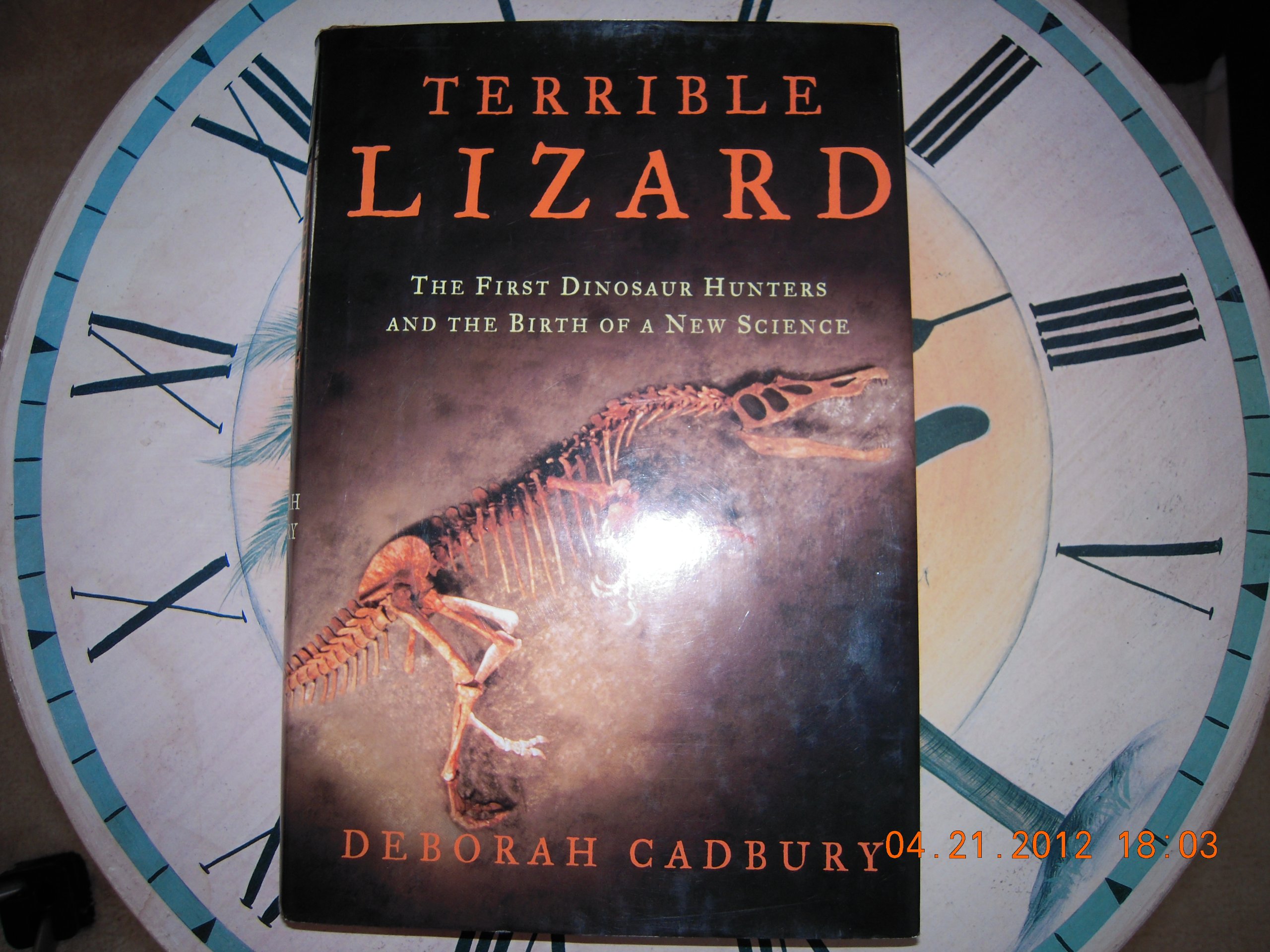
Terrible Lizard: The First Dinosaur Hunters and the Birth of a New Science
$69.00
by Deborah Cadbury



The dramatic story of the discovery that forever changed man's perception of his place in the universe. In 1812, the skeleton of a monster was discovered beneath the cliffs of Dorset, setting in motion a collision between science and religion and among scientists eager to claim supremacy in a brand-new field. For Rever William Buckland, an eccentric naturalist at Oxford University, the fossil remains of a creature that existed before Noah's flood inspired an attempt to prove the accuracy of the biblical record. Gideon Mantell, a naturalist who uncovered giant bones in a Sussex quarry, also became obsessed with the ancient past, risking everything to promote his vision of the lost world of reptiles. Soon the eminent anatomist Richard Owen entered the fray, claiming the credit for the discovery of the dinosaurs. In a fast-paced narrative, Terrible Lizard reveals a strange, awesome prehistoric era and the struggle that set the stage for Darwin's shattering theories-and for controversies that still rage today. Not long ago my friend George, who recently celebrated his second birthday, put some of his vocabulary on display for me. "Tee-wex," he said, and roared. "Tie-say-watops," he said, and roared again. "Apatosaw-us." Roar number three. It is a remarkable thing that children today can speak Latin, but more remarkable still that the only Latin words they speak are the names of dinosaurs. I have yet to hear George or any other child say "Hallucigenia," or "Ambulocetus," or "Acanthostega"-although they were as remarkable as any velociraptor. Dinosaurs have such a powerful grip on the public consciousness that it is easy to forget just how recently humans became aware of them. A two-year-old boy today may be able to rattle off three dinosaur names, but in 1824 there was only one dinosaur to be named, period. The word "dinosaur" didn't even exist until 1842. Those confused early years, when the world was baffled by the discovery of absurdly enormous reptiles, represent one of the most fascinating stories in the history of science. One reason is that its cast is so extraordinary. On the south coast of England, Mary Anning, a poor and uneducated beachcomber, spent 30 years digging up giant marine reptiles and pterosaurs. Gideon Mantell, a shoemaker's son turned doctor, discovered the first dinosaur; he thought dinosaurs would make him rich, but they ultimately destroyed his life. William Buckland, an Oxford geologist who tried to reconcile giant extinct reptiles with Genesis, had a raft of eccentricities, including a penchant for keeping live hyenas and jackals in his college rooms. The time is ripe for a book for the general public about these early paleontologists, and now we have not one but two. The Dragon Seekers is the work of a practicing paleontologist (Christopher McGowan is a senior curator at the Royal Ontario Museum and teaches at the University of Toronto). The book is therefore filled with historical details that matter to a fossil hunter: the methods the early fossilists used to extract bones from cliffs, the squabbles over naming new species, the staffing of museums. It is brief and pleasant, but for sheer narrative pleasure, I'd have to recommend Deborah Cadbury's Terrible Lizard instead. Cadbury, a BBC television producer, turns what could have been just a string of anecdotes into high drama. Much of her success comes from her depth of research: she has scoured diaries, letters and newspaper archives and can tell her story in the words of the people who lived it. For Cadbury, Gideon Mantell is the tragic hero of the early days of dinosaur hunting. Scrounging one quarry after another, he built up one of the finest private fossil collections in the world at the time. Even when he had just a few scraps of dinosaur bones, Mantell knew that he had found the remains of giant reptiles. He didn't back down when the leading scientists of his day told him he had found nothing but fish teeth and rhino horns. But Mantell's obsession with his fossils eventually left him bankrupt and alienated from his wife and children. And just when he began to earn scientific respect, he crossed paths with the ruthless Sir Richard Owen. Owen didn't know how to dig up fossils, but he did know how to pluck the strings of academic power. He managed to make himself England's authority on all life, both living and dead. It was Owen, not Mantell, who in 1838 was appointed by the British Association for the Advancement of Science to survey the giant extinct reptiles of England. In his report, he gave them the name "dinosaurs" but mentioned Mantell only in scorn. The dinosaurs lifted Owen on their colossal backs to heights of fame and wealth. Mantell meanwhile faded into obscurity, his fossils dispersed and forgotten. Owen used dinosaurs as an argument against evolution: if life progressed through time, it made no sense that the extinct dinosaurs were so much more impressive that today's reptiles. He thought that life