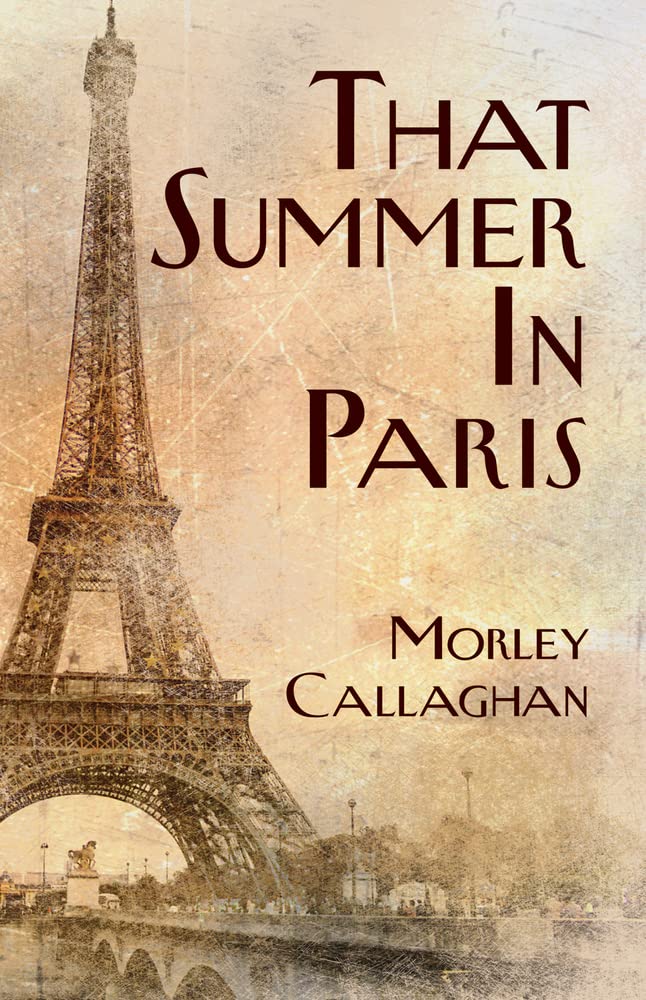
That Summer in Paris: A New Expanded Edition (Exile Classics series)
$23.95
by Morley Callaghan



It was the fabulous summer of 1929 when the literary capital of North America moved to La Rive Gauche—the Left Bank of the Seine River—in Paris. Ernest Hemingway was reading proofs of A Farewell to Arms , and a few blocks away F. Scott Fitzgerald was struggling with Tender Is the Night . As his first published book rose to fame in New York, Morley Callaghan arrived in Paris to share the felicities of literary life, not just with his two friends, Hemingway and Fitzgerald, but also with fellow writers James Joyce, Ford Madox Ford, and Robert McAlmon. Amid these tangled relations, some friendships flourished while others failed. This tragic and unforgettable story comes to vivid life in Callaghan's lucid, compassionate prose. Also included in this new edition are essays by Callaghan on Hemingway, Joyce, Fitzgerald, and McAlmon, as well as the author's look back to those days in Paris and when he revisited 60 years later. The texts are followed by questions for discussion and related readings. "If there is a better story writer in the world, we don't know where he is." — New York Times CA That Summer in Paris By Morley Callaghan Exile Editions Ltd Copyright © 2013 Estate of Morley Callaghan and Exile Editions All rights reserved. ISBN: 978-1-55096-361-8 CHAPTER 1 One September afternoon in 1960 I was having a drink with an old newspaper friend, Ken Jonstone, when unexpectedly he told me he had a message to pass on from Ronnie Jacques, the well-known New York photographer. Jacques had been in Sun Valley taking some pictures of Hemingway, and they had got to talking about me. After a while, Hemingway, really opening up, had become warm and jovial. In the old days in Paris he used to box with me, he said. It had all been rather wonderful and amusing, Hemingway assured Ronnie, and there had been one ridiculous occasion when Scott Fitzgerald had acted as timekeeper, and everybody had been full of wine. Anyway, Hemingway sent his warmest regards. But what had really happened? Ken Jonstone wanted to know. Shrugging, I made some light-hearted comment and didn't answer. Since I hadn't heard from Hemingway for years, I was surprised. I suppose it made me meditative. Of course it wasn't true that we had all been full of wine that afternoon in Paris in 1929; yet come to think of it, maybe Ernest, even years ago, had determinedly chosen to regard it in that light. He could have made himself believe it, too. As I sat at the bar with my friend hearing how Ernest had recalled our Paris afternoons, I wondered why I wasn't more deeply touched. No man had meant more to me than Ernest. But in the years since those days he had gone far along another path. He had gone right out of my life. The Ernest I had known so well had been the author of A Farewell to Arms, The Sun Also Rises, and the early stories. Though I had gone on reading his books he had become a public figure, a man of legends, and I could hardly recognize in those legends the man I had once known who had all my affection. As for Fitzgerald, that charming and talented man, memories of him had always aroused in me a half-guilty regret, a twinge of shame. So the second-hand greeting from Ernest only made me wonder and smile. It didn't put me in a sentimental mood. Anyway, I was now feeling confident and sure of myself. In the last ten years I had written The Loved and the Lost, The Many Coloured Coat, and was finishing A Passion in Rome. What Hemingway might have thought of any of these books, or whether he had even read one of them, had ceased to matter to me. It was the following summer when a man from one of the wire services telephoned and told me that Hemingway was dead. I couldn't believe it. After a pause I said, "Don't worry, he'll turn up again." The newspaperman insisted that Hemingway had blown his head off with a shotgun. Walking out to my wife I said, "Hemingway is dead." "Oh, no," she said. "He can't be." Even though we hadn't really talked about him for years we assumed that he would always be secure in some place in some other country strutting around, or making a fool of himself, or writing something beautiful. Now it was like hearing that the Empire State Building had fallen down – a nine-day wonder; but at the time I was shocked rather than sorrowful and I went around saying, "If that was the way he wanted it ..." or, "If he knew he was sick and dete-riorating it would have been unbearable to him." No man could have sounded more objective than I. A month passed, I would be out walking with my wife and suddenly I would remember something Hemingway had said in the Paris days. Or something Fitzgerald had said about Hemingway. One night she said to me, "Do you know you're talking about Fitzgerald and Hemingway all the time now? Why is it?" "Well, isn't it strange that only last year he should have been talking to Ronnie Jacques in Sun Valley about those times with Fitzgerald and me in Paris in the summer of '29." That night I could