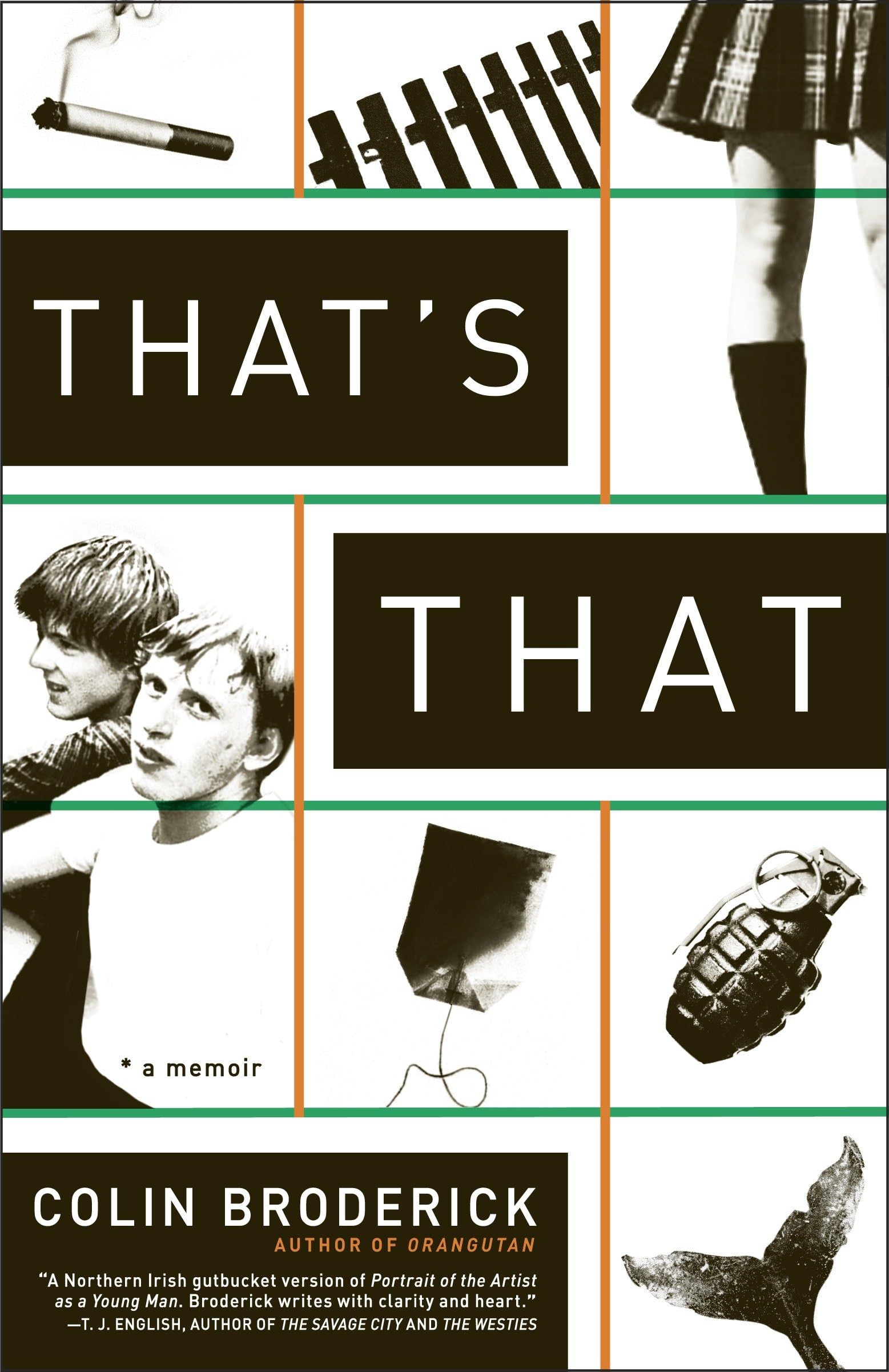



How can we know who we are if we do not understand where we came from? Colin Broderick grew up in Northern Ireland during the period of heightened tension and violence known as the Troubles. Broderick's Catholic family lived in County Tyrone --the heart of rebel country. In That’s That, he brings us into this world and delivers a deeply personal account of what it was like to come of age in the midst of a war that dragged on for over two decades. We watch as he and his brothers play ball with the neighbor children over a fence for years, but are never allowed to play together because it is forbidden. We see him struggle to understand why young men from his community often just disappear. And we feel his frustration when he is held at gunpoint at various military checkpoints in the North. At the center of his world—and this story—is Colin’s mother. Desperate to protect her children from harm, she has little patience for Colin’s growing need to experience and understand all that is happening around them. Spoken with stern finality, "That's that" became the refrain of Colin's childhood. The first book to paint a detailed depiction of Northern Ireland's Troubles, That’s That is told in the wry, memorable voice of a man who's finally come to terms with his past. An Essay by Colin Broderick It was my agent who suggested I tackle my Northern Irish childhood. I said, “No.” She said, “I think you should.” I said, “No.” At the time, I was newly sober, interred in a small cottage in Northern Ireland with wife number three. It was cold, wet, and gray, in a way that only Northern Ireland can be. We were expecting a baby, our first. I was back living in County Tyrone, a stone’s throw from my parent’s house, after twenty years away in New York. Being back “home” had resurrected in me all the old ghosts of the past throwing my internal compass wildly off kilter. I was in no mood for revisiting childhoods. But my agent had planted a seed, and that seed took root. I started writing That’s That the same month my daughter Erica was born an Irish citizen. We moved back to New York a few months later and I became consumed with getting to the heart of what had happened to me as a boy. I’d already chronicled the madness of my addiction and alcoholism in my memoir Orangutan . It was time to get at the “why”. I needed to go back into my childhood and look for answers. I had nowhere to turn but inward for the answers, so I dug. The digging was hell. My wife left to avoid the dark. I dug some more. I went a bit mad. I dug some more. I had to. My daughter’s future depended upon it. I could see that if I were to rid myself of the shadows that followed me I had to dig on, for clarity, for her. So I dug. What does it mean to be from Northern Ireland? What was the war, The Troubles, all about? How did religion define our nationality? In That’s That I have used my own childhood as the focal point to paint a vivid portrait of Northern Ireland and The Troubles as a whole. This is a story of a war and a family who survived in the midst of that war. Does it matter to you that this book has already been successful for me? I am indebted to my agent and to the editors who pushed and carried me on through this process. War inevitably robs children of their innocence. This book has helped me finally come to terms with that loss. Northern Irish hunger striker Bobby Sands said famously, “Our revenge will be the laughter of our children.” My daughter is the happiest little girl I know. *Starred Review* Broderick probably does himself a disservice by making his memoir so effortlessly readable: it almost disguises the artfulness of this vivid recollection of growing up in Northern Ireland in the 1970s and ’80s. As one of six children in a Catholic family, he faces an overprotective mother (whose “I said no, and that’s that” was the enraging refrain of his youth); sadistic teachers; and a fear that his stupendous discovery of sexual pleasure is sending him straight to hell. Unless the British get to him first, which seems more and more likely to a community both appalled and unified by police brutality. Broderick becomes a wild young man, throwing over his parents’ traditional values for drinking and fighting, and he ultimately must choose between his growing attraction to IRA violence and his love of family. Broderick brings the reader deep into the experience of his community: the absolute segregation of Protestants and Catholics, the suspicion toward strangers, the way disputes are handled when the police are no longer trusted. Best of all, we hear the much-celebrated but still-miraculous wonders of Irish people talking. Broderick’s voice is alternately funny, charming, and soulful as he struggles with his personal demons and the meaning of his identity as an Irishman during the Troubles. --Lynn Weber Praise for That's That "Colin Broderick is in the front rank of Irish storytellers. In this memoir he walks us through Irish