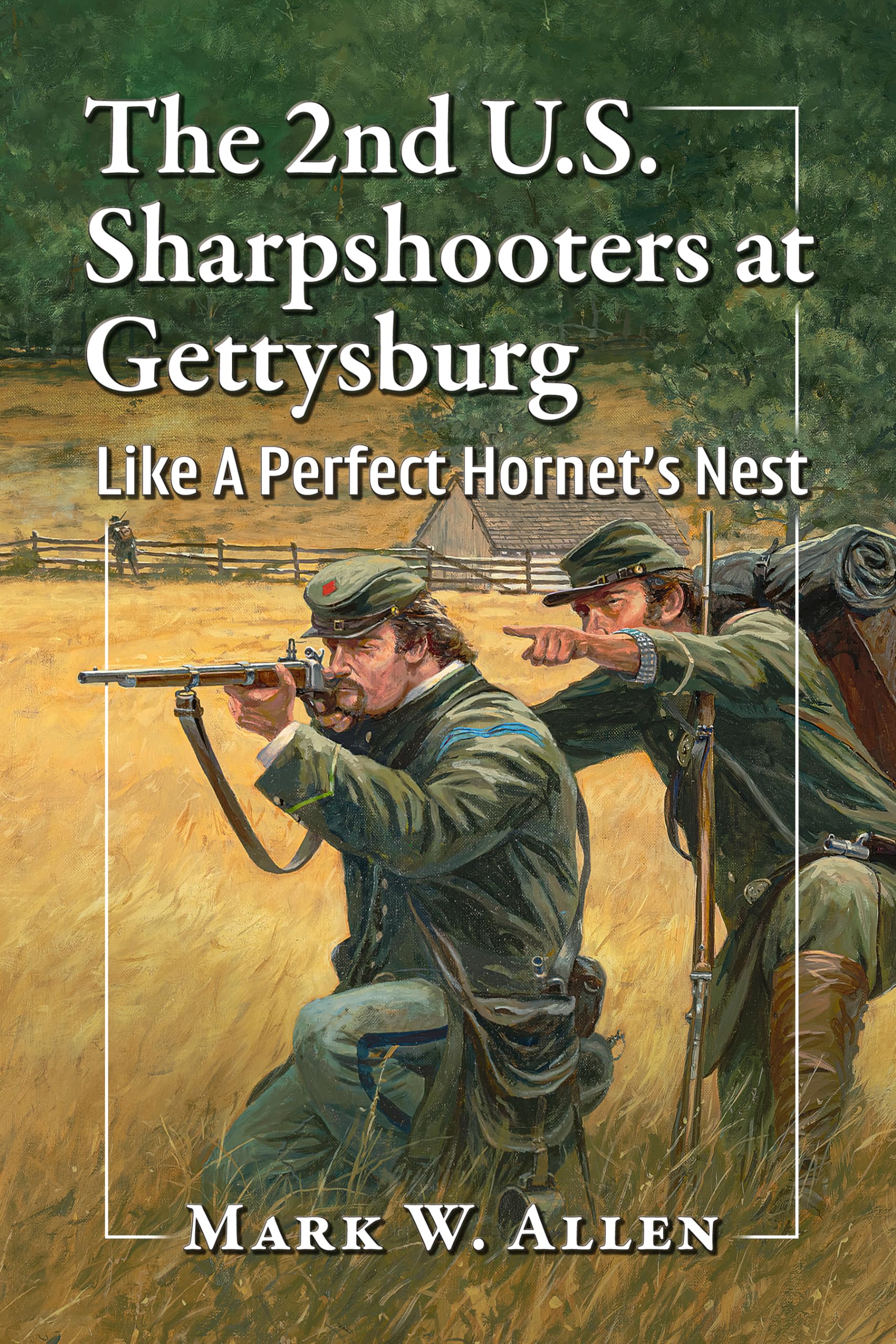
The 2nd U.S. Sharpshooters at Gettysburg: Like A Perfect Hornet's Nest
$29.95
by Mark W. Allen



The many works on the Battle of Gettysburg have neglected the role of the 2nd U.S. Sharpshooters, known for their extensive training and specialized tactics. This history is the first to explore the actions on July 2, 1863, of this Union Army regiment largely composed of men from Maine, Michigan, Minnesota, New Hampshire, Pennsylvania, and Vermont. Drawing on newly discovered primary sources, this book seeks to clarify mysteries such as the identity of the non-commissioned officer who met with Company B of the 20th Maine and the location of Major Homer R. Stoughton during the battle. Following the understrength regiment as it confronts two Confederate brigades, this thorough historical narrative presents a long untold story of the Battle of Gettysburg. I wanted to compliment you on your SUPERB book. I just finished reading it tonight and am beside myself. Your diligent research and analysis have clarified so many standing questions I had, even after half my life studying the USSS and their actions. Adjutant Norton's accounts were wholly new to me and added a lot to my understanding of Sgt. Scribner's patrol and their disposition after the regiment fell back to the main Federal line. Also your details regarding the split platoons of Company B was interesting. I was not aware that part of B accompanied F, and later deployed to suppress confederate sharpshooters in Devil's Den in support of Hazlett's Battery. Incredible stuff. Thank you for the excellent study! And thank you doubly for including me by way of sharing photos from my collection. This book is, I believe, the definitive and final subject on the matter of the sharpshooters' participation of July 2nd. Brian T. White, an American Civil War researcher and collector with a discipline focusing on Berdan's U.S. Sharpshooters. This book is excellent. It's well-written, meticulously researched, and tightly focused on the subject at hand. For those interested in Gettysburg, particularly in the actions on the Union left on July 2nd, this book is a must-read. Allen has written a detailed (yet still very readable) account of the actions on the Union flank that day. Popular history likes to make it seem like the 20th Maine was all alone at the end of the line, which is simply not true. Not that the stand of the 20th Maine wasn't gallant, but the attacking Confederates had been under intense fire from almost the moment they stepped off, breaking up their formations, and targeting their officers. The book quotes from a wide range of primary source material, both Union and Confederate. There are ample maps, that show the dynamic movements of the action, which make it easy to visualize the evolution of the engagement and how the 2nd's actions effectively shaped the fight for Little Round Top that was to come. rubikscanopener on Reddit Gettysburg is one of the most written-about subjects in American history, but Allen's meticulous and engaging study proves that there remain important aspects of this pivotal battle to be explored. The actions of the 2nd US Sharpshooters during the pivotal second day of the battle had an impact far beyond their modest numbers, and this work contributes a small but vital piece to the understanding of this battle. Dr. Thomas J. Goetz, Associate Professor, American Military University Mark Allen tells an engaging and detailed story of how the use of sharpshooters, primarily the 2nd U.S. Sharpshooters, played a pivotal role in the Battle of Gettysburg. The book portrays the step-by-step movements and decisions on both sides of the conflict through narrative and maps informed and supported by an impressive array of first-hand accounts, ranging from the official reports and personal correspondence of the commanding officers to letters home from front-line solders. The book clearly delineates how the actions of the sharpshooters contributed greatly to the decisive conclusion of the battle that many historians regard as the turning point of the war. Dr. David E. Allen, Texas Christian University Impeccably researched and chock full of details, Allen's deep dive in the Union's 2nd Sharpshooters role in the Battle of Gettysburg uncovers the fragile hinge point in this defining battle that would sway the victory to the Union - the nick-of-time race to the top of Little Round Top. Ryan Fairfield, Host of the Warrior Next Door Podcast Mark W. Allen is the former military historian at the War Memorial Park in Muskogee, Oklahoma, home of the World War II fleet submarine U.S.S. Batfish (SS310). He lives near Tulsa, Oklahoma.