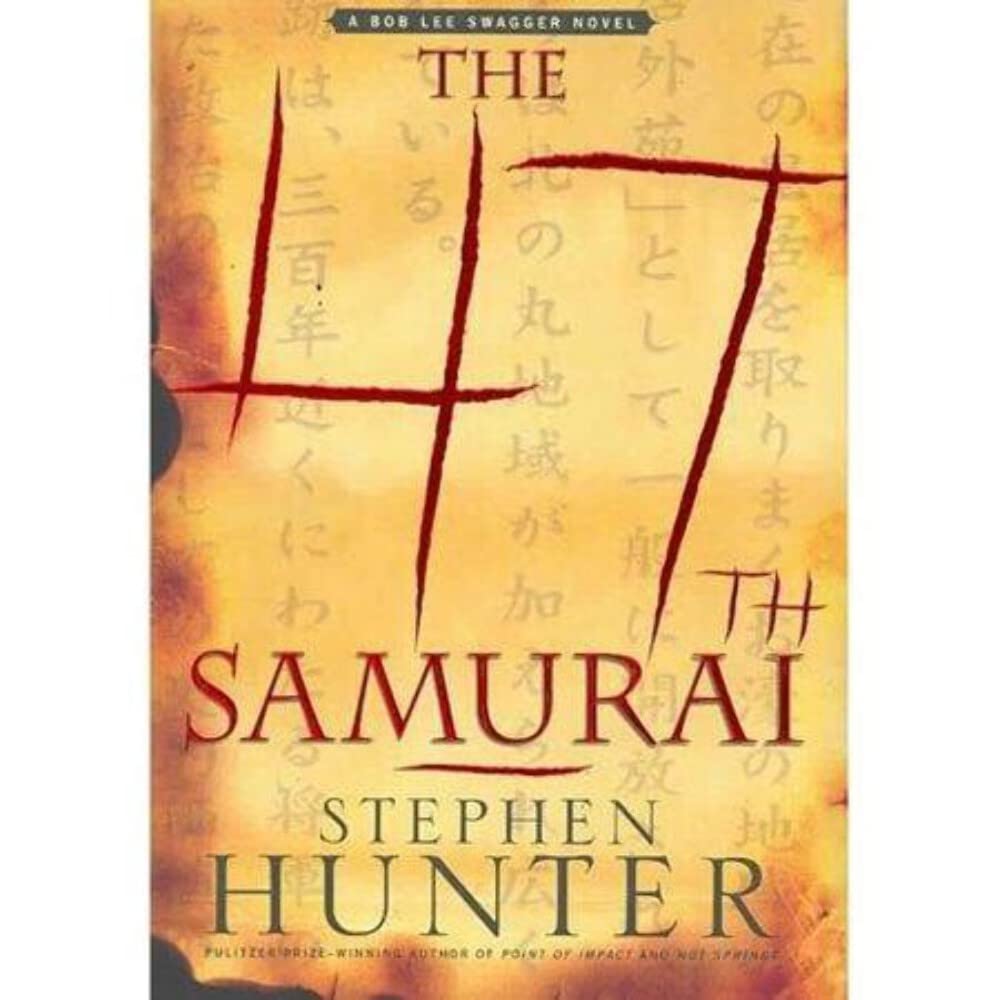



Bob Lee Swagger and Philip Yano are bound together by a single moment at Iwo Jima, 1945, when their fathers, two brave fighters on opposite sides, met in the bloody and chaotic battle for the island. Only Earl Swagger survived. More than sixty years later, Yano comes to America to honor the legacy of his heroic father by recovering the sword he used in the battle. His search has led him to Crazy Horse, Idaho, where Bob Lee, ex-marine and Vietnam veteran, has settled into a restless retirement and immediately pledges himself to Yano's quest. Bob Lee finds the sword and delivers it to Yano in Tokyo. On inspection, they discover that it is not a standard WWII blade, but a legendary shin-shinto katana, an artifact of the nation. It is priceless but worth killing for. Suddenly Bob is at the center of a series of terrible crimes he barely understands but vows to avenge. And to do so, he throws himself into the world of the samurai, Tokyo's dark, criminal yakuza underworld, and the unwritten rules of Japanese culture. Swagger's allies, hard-as-nails, American-born Susan Okada and the brave, cocaine-dealing tabloid journalist Nick Yamamoto, help him move through this strange, glittering, and ominous world from the shady bosses of the seamy Kabukicho district to officials in the highest echelons of the Japanese government, but in the end, he is on his own and will succeed only if he can learn that to survive samurai, you must become samurai. As the plot races and the violence escalates, it becomes clear that a ruthless conspiracy is in place, and the only thing that can be taken for granted is that money, power, and sex can drive men of all nationalities to gruesome extremes. If Swagger hopes to stop them, he must be willing not only to die but also to kill. *Starred Review* This is the novel Hunter's fans have been waiting for, the book that brings together his father-and-son protagonists: Earl Swagger, World War II hero and hard-nosed cop, and Bob Lee Swagger, Vietnam sniper and, like his father, the kind of guy who can't say no to righteous violence. Until now, Earl and Bob have each starred in their own books, but this time, ingeniously, Hunter brings them together when Bob is contacted by a retired Japanese soldier, Philip Yano, who believes that his father's samurai sword may have wound up in Earl's hands after the war. Bob tracks down the sword, travels to Japan, and presents it to Yanoafter which the Yano family is slaughtered. Bob could walk away, but, of course, he doesn't. Throwing himself into samurai culture, he learns swordsmanship from a master and sets off to avenge the Yanosand, in a sense, his father. Sure, this sounds clichéd, but much of Hunter's genius comes from his ability to manipulate archetypesespecially the classic western scenario of the lone avengerdrawing on the almost subconscious pull these themes exert on the reader but always infusing them with multiple layers of complexity. As Bob is drawn into the samurai world, and tension builds to the inevitable confrontation with his adversarya modern samurai seduced by the dark sideHunter simultaneously fuels our need for bloody resolution and reveals the horrors wrought by devotion to honor and duty. But this time he does it with parallel narrativesjuxtaposing the story of Earl Swagger and Philip Yano's father against the contemporary drama and playing off the same themes across generations. This is probably Hunter's most violent noveland that's saying somethingbut violence may have never been more integral to story than it is here. Hunter celebrates the samurai soldier while showing the appalling underside of the samurai way of life and the ideals that drive it. Ott, Bill Stephen Hunter has written 16 novels. The retired chief film critic for The Washington Post , where he won the 2003 Pulitzer Prize for Distinguished Criticism, he has also published two collections of film criticism and a nonfiction work, American Gunfight . He lives in Baltimore, Maryland. 1 Island Showa Year 20, Second Month, 21st Day 21 February 1945 A quiet fell across the bunker. Dust drifted from the ceiling. The burnt-egg stench of sulfur lingered everywhere. "Captain?" It was a private. Takahashi, Sugita, Kanzaki, Asano, Togawa, Fukuyama, Abe -- who knew the names anymore? There had been so many names. "Sir, the shelling has stopped. Does this mean they're coming?" "Yes," he said. "It means they're coming." The officer's name was Hideki Yano and he was a captain, 145th Infantry Regiment, 2nd Battalion, under Yasutake and Ikeda, attached to Kuribayashi's 109th Division. The blockhouse was low and smelled of sulfur and shit because the men all had dysentery from the tainted water. It was typical Imperial Army fortification, a low bunker of concrete, reinforced over many long months, with oak tree trunks from what had been but was no longer the island's only oak forest, the sand heaped over it. It had three firing slits and behind each slit sat a Type 96 g