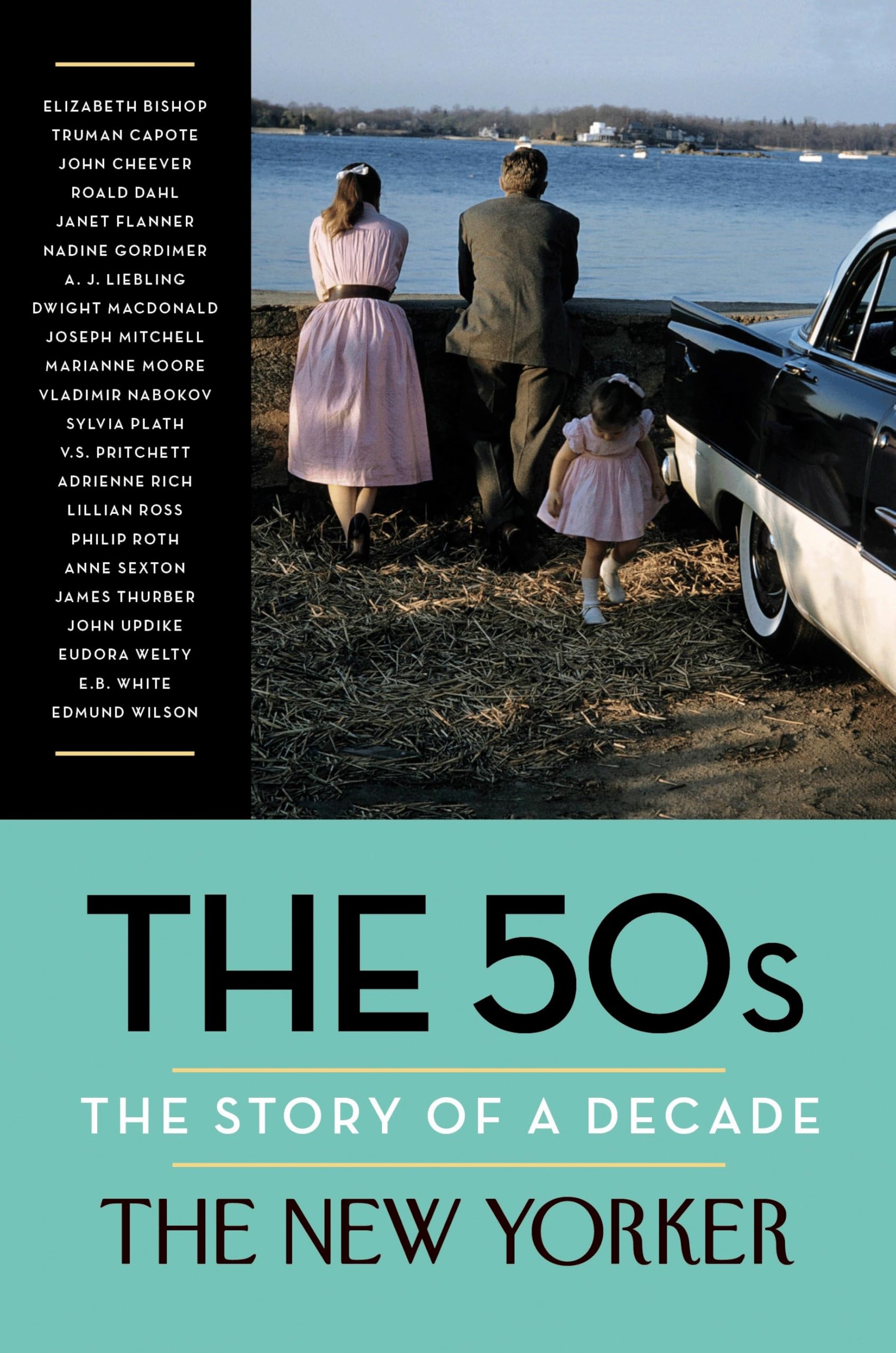
The 50s: The Story of a Decade (New Yorker: The Story of a Decade)
$21.00
by The New Yorker Magazine



This engrossing anthology assembles classic New Yorker pieces from a complex era enshrined in the popular imagination as the decade of poodle skirts and Cold War paranoia—featuring contributions from Philip Roth, John Updike, Nadine Gordimer, and Adrienne Rich, along with fresh analysis of the 1950s by some of today’s finest writers. The New Yorker was there in real time, chronicling the tensions and innovations that lay beneath the era’s placid surface. In this thrilling volume, classic works of reportage, criticism, and fiction are complemented by new contributions from the magazine’s present all-star lineup of writers. The magazine’s commitment to overseas reporting flourished in the 1950s, leading to important dispatches from East Berlin, the Gaza Strip, and Cuba during the rise of Castro. Closer to home, the fight to break barriers and establish a new American identity led to both illuminating coverage, as in a portrait of Thurgood Marshall at an NAACP meeting in Atlanta, and trenchant commentary, as in E. B. White’s blistering critique of Senator Joe McCarthy. The arts scene is recalled in critical writing rarely reprinted, including Wolcott Gibbs on My Fair Lady, Anthony West on Invisible Man, and Philip Hamburger on Candid Camera. Also featured are great early works from Philip Roth and Nadine Gordimer, as well as startling poems by Theodore Roethke and Anne Sexton, among others. Completing the panoply are insightful and entertaining new pieces by present-day New Yorker contributors examining the 1950s through contemporary eyes. The result is a vital portrait of American culture as only one magazine in the world could do it. Including contributions by Elizabeth Bishop • Truman Capote • John Cheever • Roald Dahl • Janet Flanner • Nadine Gordimer • A. J. Liebling • Dwight Macdonald • Joseph Mitchell • Marianne Moore • Vladimir Nabokov • Sylvia Plath • V. S. Pritchett • Adrienne Rich • Lillian Ross • Philip Roth • Anne Sexton • James Thurber • John Updike • Eudora Welty • E. B. White • Edmund Wilson And featuring new perspectives by Jonathan Franzen • Malcolm Gladwell • Adam Gopnik • Elizabeth Kolbert • Jill Lepore • Rebecca Mead • Paul Muldoon • Evan Osnos • David Remnick Praise for The 50s “Superb: a gift that keeps on giving.” — Kirkus Reviews (starred review) “[A] magnificent anthology.” — Literary Review “Superb: a gift that keeps on giving.” — Kirkus Reviews (starred review) “[A] magnificent anthology.” — Literary Review The New Yorker began publishing in 1925. chapter 1 Success John Graham and Rex Lardner January 7, 1950 (On Jackie Robinson, TV Salesman) On learning that Jackie Robinson, the Brooklyn Dodgers’ second baseman, is spending Monday, Wednesday, and Friday evenings each week as a television-set salesman in the Sunset Appliance Store in Rego Park, Queens, we hurried over to the place to see how he is making out. From a talk we had with Joseph Rudnick, president of Sunset, just before Robinson appeared, we learned that he is making out fine. Rudnick, a small, alert-looking man, graying at the temples, whom we found in an office on a balcony at the rear of the store, informed us that the accomplished young man had been working there, on a salary-and-commission basis, for five weeks, and that if he liked, he could work there forever, the year around. “Business booming like wildfire since Jackie came,” Rudnick told us, looking down at a throng milling about among television sets, washing machines, and refrigerators. “Sports fans flocking in here,” he said with satisfaction. “Young persons, curious about the National League’s Most Valuable Player and one of the best base-stealers since Max Carey. Jackie signs baseballs for them and explains about the double steal. Since he’s been here, he’s sold sets to Joe Louis and Sugar Ray Robinson, among others. The newsreel people shot him selling a set to a customer. He’s a natural salesman, with a natural modesty that appeals to buyers. The salesman wrapped up in himself makes a very small package. Campanella, Hodges, and Barney dropped by to wish him luck. Campanella’s his roomy. There’s Jackie now! With his business agent.” Robinson and a bigger, more strapping man with a florid face were making their way along the floor, the big man in the lead. “He’ll be right up,” Rudnick said. “Hangs his coat here. One other thing we do,” he went on, “when a bar buys a television set, we send Gene Stanlee over to the bar—the wrestler. Mr. America.” Robinson and his manager for radio and television appearances came up, and we were introduced, learning that the latter’s name is Harry Solow. “Jackie don’t have to lay awake nights worrying about his condition, bucking that mob three times a week,” Solow said. Rudnick told us that Solow also manages Joe Franklin and Symphony Sid, and Solow explained that they are radio personalities. “Jackie’s all lined up for his own radio program,” he continued. “He’s mostly in