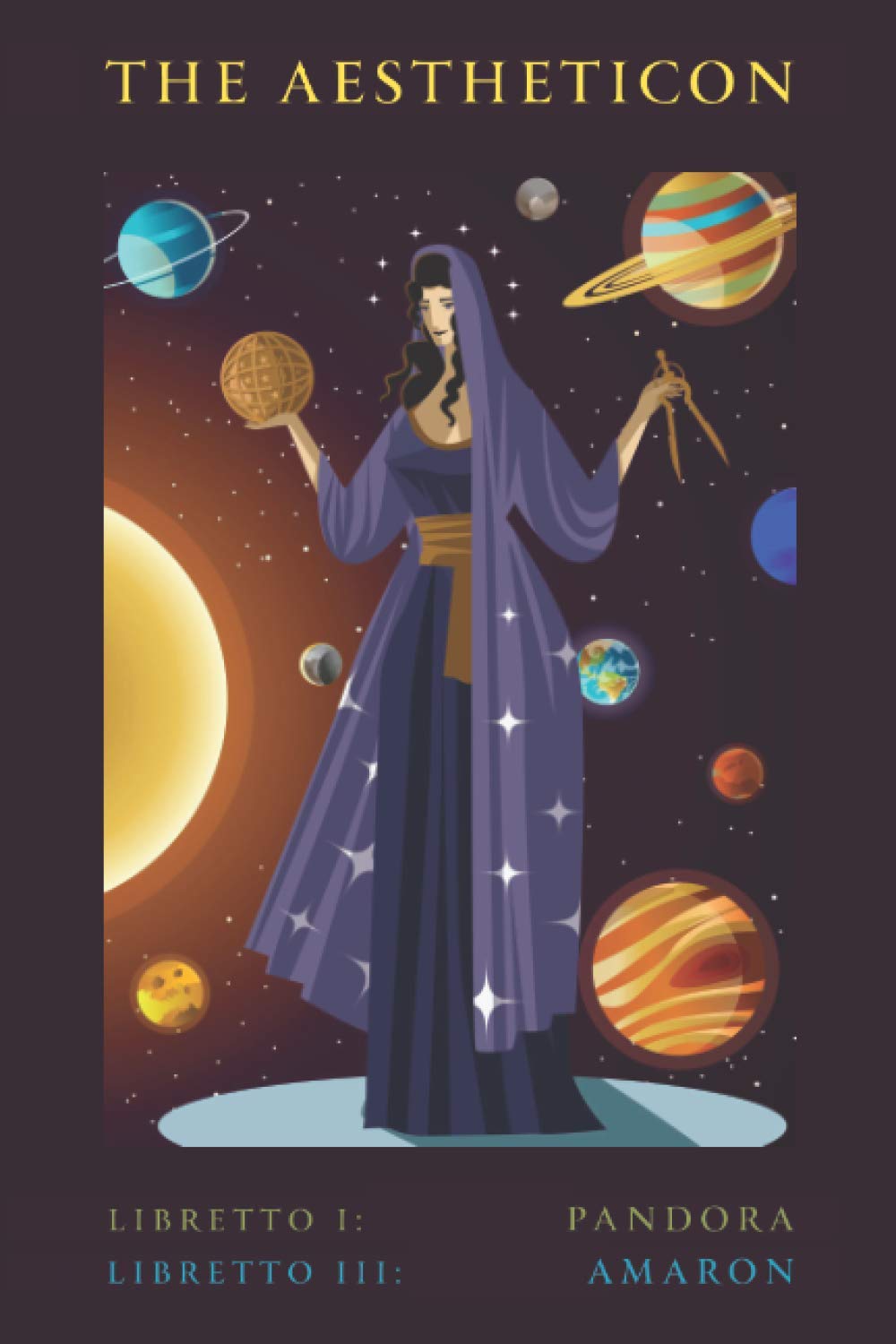
The Aestheticon, Libretti I & III: Pandora, Beyond Hope & Amaron the Silly Muse
$16.75
by Michael Curtis



You will recall Pandora, elder sister to Eve, child of Zeus rather than of Yahweh; the first of our type, sinless: she closed the jar on Hope (that most deadly of spirits), skipped along and married Epimetheus (hindsight). Our story concerns the calculated creation of Pandora (meaning, “all gifts”), her romance and her marriage to Epimetheus, that hopeful titan who looked forward, blindly.Our second story, the third in the tetralogy of libretti, “The Aestheticon”, coins a new, Classive goddess, “Amaron”. Amaron, in the first instance, is named for an extinct Greek flower; for a picture, “Amron”, painted by the most remarkable, least know artist of the XXth Century, William Girard. To improve the name so that it might better scan, to be more lovely and poetic, an “a” was added (Amaron). This new goddess … hum, what might be her realm, her power. Here, the irrepressible, silly (in the archaic, angelic sense), personal aesthetic, a force of innocence that might stand against all the world.THE AESTHETICON is a single work, a tetralogy of libretti, of verse plays which tell of aesthetic generation, each generation personified in a goddess, Pandora, Galatea, Amaron, Nyx: Pandora, the fanciful origination of Man; Galatea, the sensual propagation of Art; Amaron, the imaginary genesis of the Artist; Nyx, the sterile breeding of Style. Greek-like, the Aristotelian form is by nature observed: id est, each libretti, each play, each section assumes the mythical persona of a goddess; then, amending Aristotle, each section compasses time, as is suitable to each in the mounting of time historically; each, a comedy composed in that meter suitable to human, English breath, to the human heartbeat, iambic pentameter. Pandora: iambic tetrameter; one day; mythical past; comedy Galatea: iambic pentameter; one week; antiquity; comedy Amaron: variable; one lifetime; recent past; comedy Nyx: iambic tetrameter; real time; near future; tragic-comedy