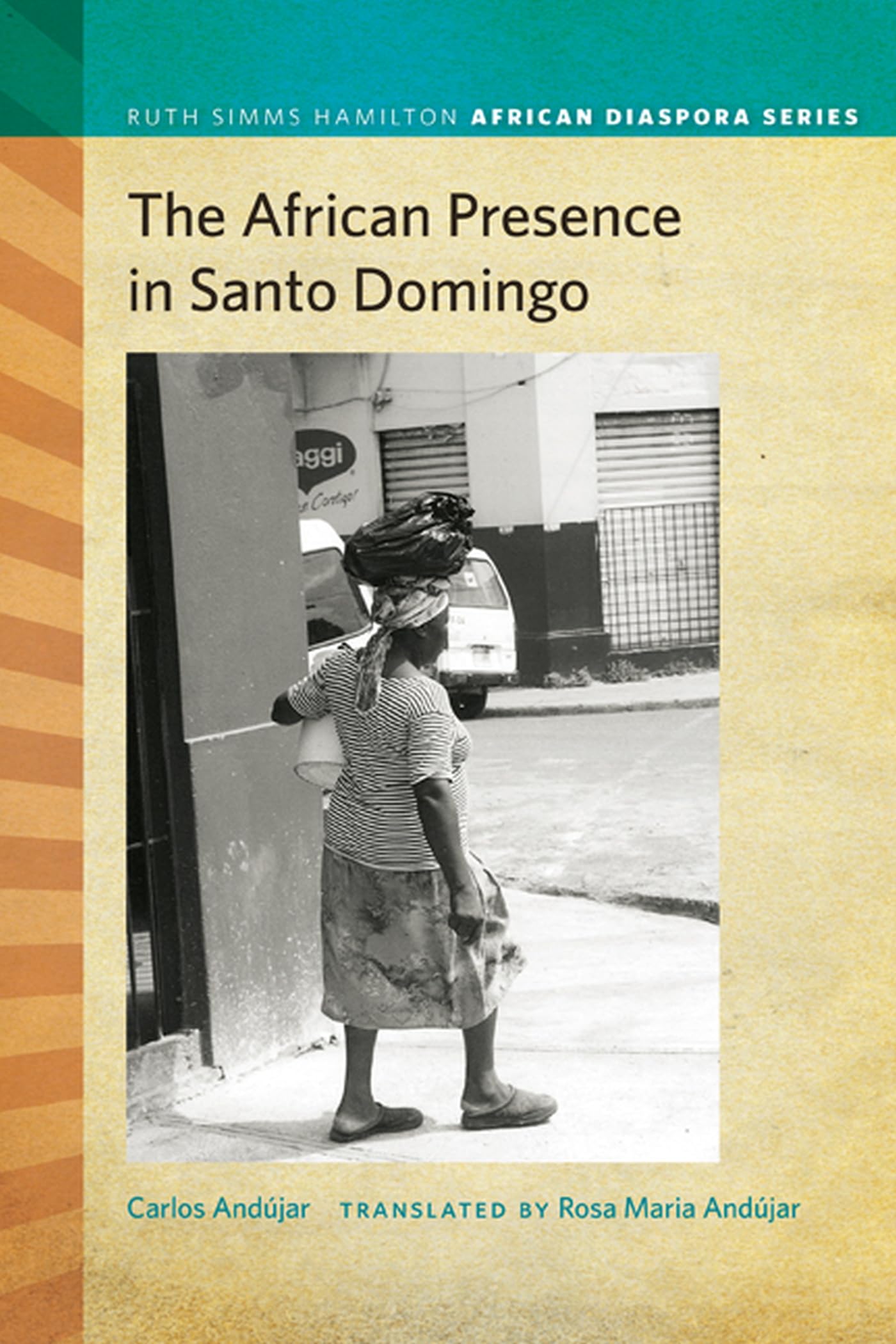
The African Presence in Santo Domingo (Ruth Simms Hamilton African Diaspora)
$18.67
by Carlos Andujar



Throughout its long and often tumultuous history, “La Hispanola” has taken on various cultural identities to meet the expectations―and especially the demands―of those who governed it. The island shared by the Dominican Republic and Haiti saw its first great shift with the arrival of Spanish colonists, who eliminated the indigenous population and established a pattern of indifference or hostility to diversity there. This enlightening book explores the Dominican Republic through the lens of its African descendants, beginning with the rise of the black slave trade in fifteenth- and sixteenth-century West Africa, and continuing on to slavery as it existed on the island. An engaging history that vividly details black life in the Dominican Republic, the book investigates the slave rebellions and evaluates the numerous contributions of black slaves to Dominican culture. Born in Santo Domingo, Dominican Republic, Carlos Andújar is a humanist socially engaged with his country’s future. The African Presence in Santo Domingo By Carlos Andújar Michigan State University Press ISBN: 978-1-61186-042-9 Contents SERIES EDITOR'S FOREWORD, Kimberly Eison Simmons.............................viiFOREWORD, C.E. Deive.........................................................xiPREFACE......................................................................xvIntroduction.................................................................3West Africa during the Fifteenth and Sixteenth Centuries.....................7The Slave Trade..............................................................15The Origins of Slaves........................................................19Slavery in Santo Domingo.....................................................29Black Rebellions.............................................................37Contributions of Black Culture to Dominican Culture..........................51Conclusions..................................................................61NOTES........................................................................63BIBLIOGRAPHY.................................................................69 Chapter One West Africa during the Fifteenth and Sixteenth Centuries For many people, including social scientists, the degree of development of African peoples at the moment of the encounter between Africa and the Americas is surprising. The similarities in behavior make one consider the first the ancestor of the second, but especially the ancestor of the Caribbean. Two major factors at this point are crucial in history: (1) the "discovery" of the continent by Christopher Columbus and the subsequent process of colonization and slavery, and (2) the initiation and development of the slave trade in the fifteenth century. The splendor and contributions to society characteristic of sub-Saharan or negroid African cultures are barely known. The illiteracy of most of them, among other elements, was long considered by traditional historians as a constraint for study. There is almost no knowledge, for instance, about the magnificence of black African peoples. Consider the large empires, kingdoms, and states, as well as the rise of science, commerce, arts, urbanization, strong military and economic power, that stand out in the study of the Mali Empire, for instance. In order to overcome these false beliefs, our impressions of Africa need to be rethought, as does the belief that Africa's material backwardness is due to biological "backwardness." Fortunately, sponsored by UNESCO, eight volumes are being written on the general history of Africa, which will help unfold the truth about Africa and its magnificent past. By the time of the arrival of Europeans to the African continent, major civilizations had already been developed. Blacks who came to the Americas—according to Herskovits—came primarily from the west coast and surrounding areas (an average of 200 kilometers inland), and shared a similar social development, that is, the same cultural patterns. However, black slaves came from different places, and their religious practices varied from black animism to polytheism and Islam. Similar differentiation occurs when studying the characteristics of the social structures of these peoples. First in line would be those from tribal societies, organized under the rules of descent, like some located on the western coasts, as opposed to those coming from centralized states, many of which became kingdoms or empires, such as the strip of Sudan. This outstanding development is, for many authors, linked to the expansion of Islam in black Africa, which began in the twelfth century, and whose philosophical-religious platform was open to "Africanization," as some call the process of accommodation and flexibility of Islam to the African culture. The main impact, however, of Islam on sub-Saharan cultures was the development of the market and its opposition to black slavery. Although trade routes throug