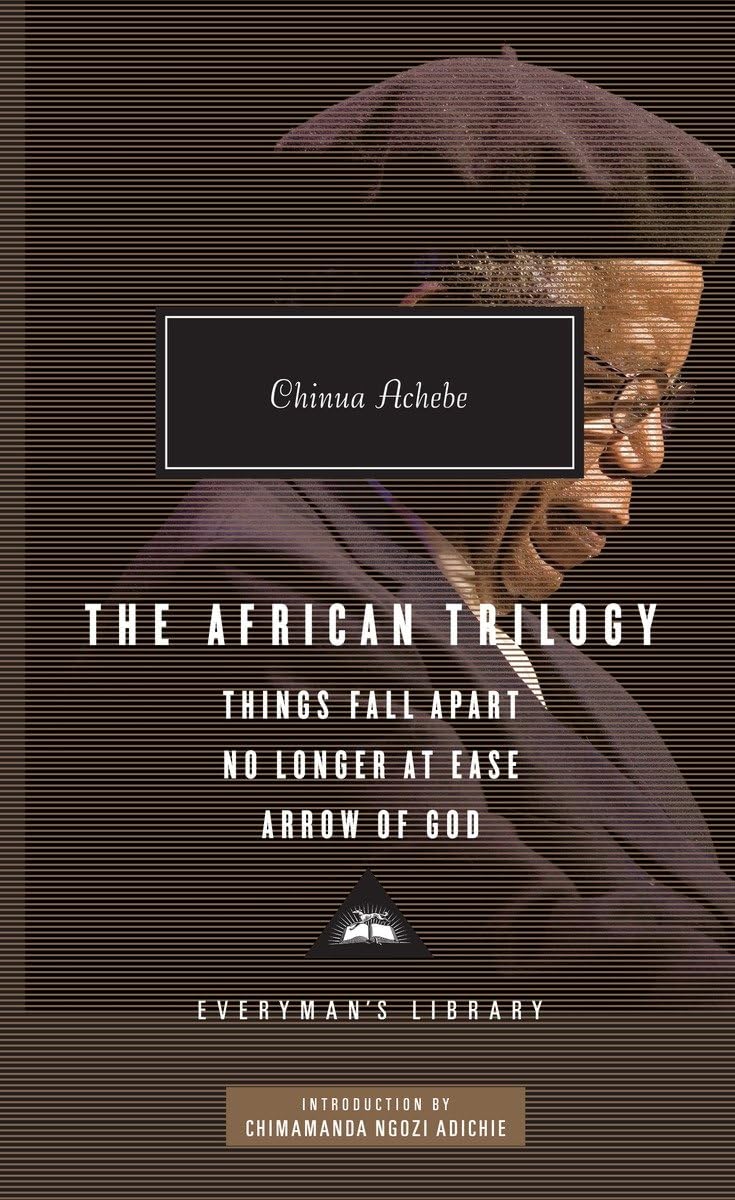
The African Trilogy: Things Fall Apart, No Longer at Ease, and Arrow of God; Introduction by Chimamanda Ngozi Adichie (Everyman's Library Contemporary
$20.41
by Chinua Achebe



Here, collected for the first time in stunning Everyman’s Library hardcover, are the three internationally acclaimed classic novels that comprise what has come to be known as Chinua Achebe’s “African Trilogy.” With an intorduction by Chimamanda Ngozi Adichie. Beginning with the best-selling Things Fall Apart —on the heels of its fiftieth anniversary— The African Trilogy captures a society caught between its traditional roots and the demands of a rapidly changing world. Achebe’s most famous novel introduces us to Okonkwo, an important member of the Igbo people, who cannot adjust as his village is colonized by the British. In No Longer at Ease we meet his grandson, Obi Okonkwo, a young man who was sent to a university in England and has returned, only to clash with the ruling elite to which he now believes he belongs. Arrow of God tells the story of Ezuelu, the chief priest of several Nigerian villages, and his battle with Christian missionaries. In these masterful novels, Achebe brilliantly sets universal tales of personal and moral struggle in the context of the tragic drama of colonization. Everyman's Library pursues the highest production standards, printing on acid-free cream-colored paper, with full-cloth cases with two-color foil stamping, decorative endpapers, silk ribbon markers, European-style half-round spines, and a full-color illustrated jacket. Everyman’s Library Classics include an introduction, a select bibliography, and a chronology of the author's life and times. CHINUA ACHEBE was born in Nigeria in 1930. His first novel, Things Falls Apart , became a classic of international literature and required reading for students worldwide. He also authored four subsequent novels, two short-story collections, and numerous other books. He was the David and Marianna Fisher University Professor and Professor of Africana Studies at Brown University and, for over 15 years, was the Charles P. Stevenson Jr. Professor of Languages and Literature at Bard College. In 2007, Achebe was awarded the Man Booker International Prize for lifetime achievement. He died in 2013. CHIMAMANDA NGOZI ADICHIE grew up in Nigeria. Her work has been translated into more than fifty-five languages. She is the author of the novels Purple Hibiscus, which won the Commonwealth Writers’ Prize; Half of a Yellow Sun, which was the recipient of the Women’s Prize for Fiction “Best of the Best” award; Americanah, which won the National Book Critics Circle Award; the story collection The Thing Around Your Neck and the essays We Should All Be Feminists and Dear Ijeawele, or A Feminist Manifesto in Fifteen Suggestions . Her most recent work is an essay about losing her father, Notes on Grief, and Mama’s Sleeping Scarf, a children’s book written as Nwa Grace-James. A recipient of a MacArthur Fellowship, she divides her time between the United States and Nigeria. I N T R O D U C T I O N BY CHIMAMANDA NGOZI ADICHIE —— When, in 1958, the London publishers William Heinemann received a manuscript of Chinua Achebe’s Things Fall Apart , they were unsure whether to publish it. The central question, according to editor Alan Hill, was this: ‘Would anyone possibly buy a novel by an African?’ Not only were there a mere handful of examples of African writing in English at the time – such as Amos Tutuola’s surreal The Palm-Wine Drinkard and Cyprian Ekwensi’s novel of contemporary Lagos, People of the City – but none of them had the ambition, the subtlety, or the confidence of Things Fall Apart. Chinua Achebe had initially conceived it as a story of three generations: a man in pre-colonial Igboland who struggles against the changes brought by the first European missionaries and administrators; his son who converts to Christianity and receives some Western education; and his grandson who is educated in England and is living the life of the new elite on the cusp of independence. Achebe later scaled down the novel, focusing only on the first generation, to produce a carefully observed story of the African European colonial encounter set among the Igbo people of south-eastern Nigeria in the 1890s, with the tragic hero Okonkwo at its center. Achebe’s second novel, No Longer at Ease, would skip a generation and tell the story of Okonkwo’s grandson, Obi, a civil servant in 1950s Lagos. His third novel, Arrow of God, about an Igbo priest and a British district officer in 1920s Igboland, can be read as representative of the times of Okonkwo’s son. All three novels, taken together as Achebe’s ‘African Trilogy’, create a full and beautifully nuanced arc, a human chronicle of the cultural and political changes that brought about what is now seen as the modern African state. After William Heinemann overcame their reservations and published Things Fall Apart in June 1958, it became a critical success. Achebe, the Times Literary Supplement wrote, had ‘genuinely succeeded in presenting tribal life from the inside.’ A novelty indeed. Thin