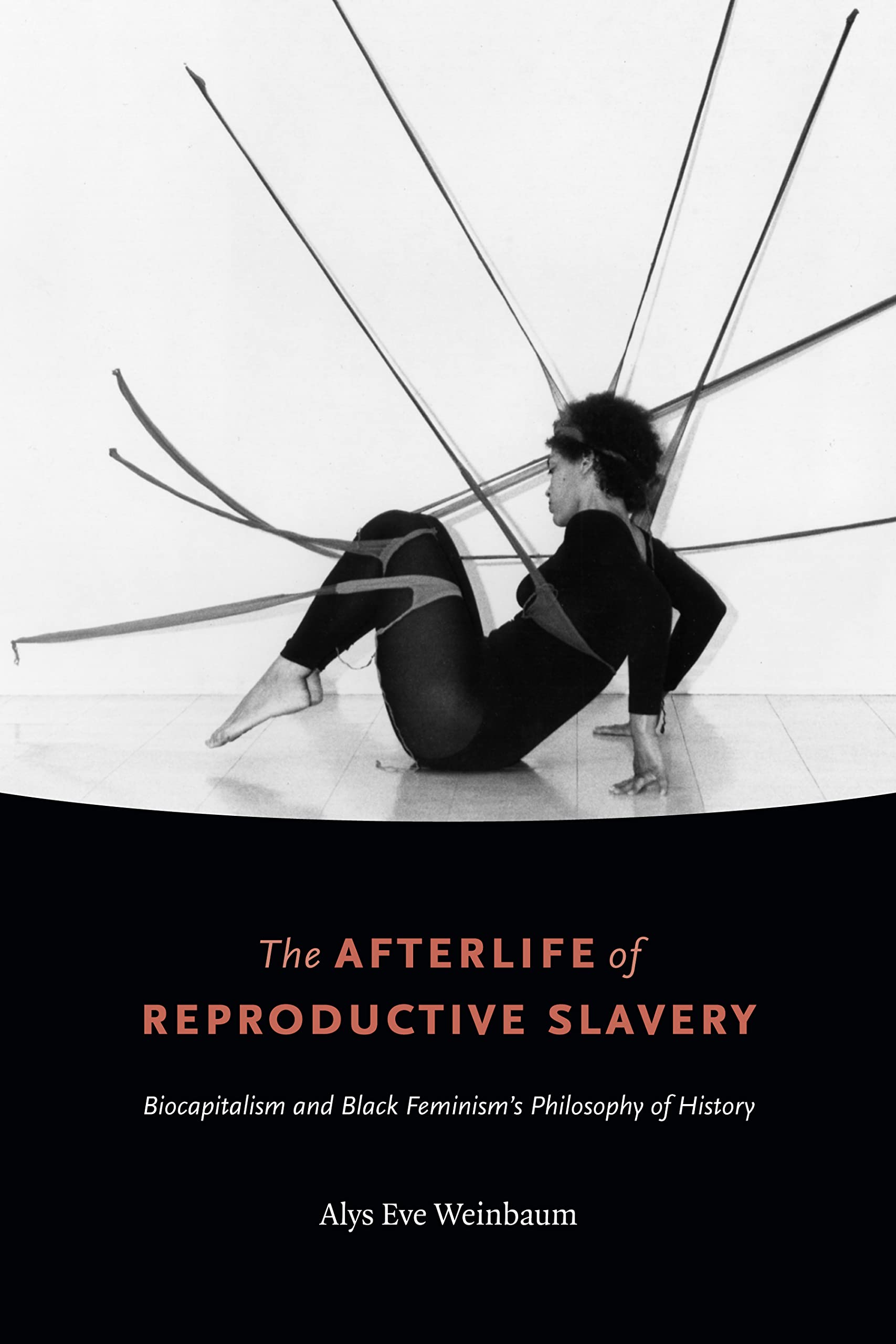
The Afterlife of Reproductive Slavery: Biocapitalism and Black Feminism’s Philosophy of History
$29.60
by Alys Eve Weinbaum



In The Afterlife of Reproductive Slavery Alys Eve Weinbaum investigates the continuing resonances of Atlantic slavery in the cultures and politics of human reproduction that characterize contemporary biocapitalism. As a form of racial capitalism that relies on the commodification of the human reproductive body, biocapitalism is dependent upon what Weinbaum calls the slave episteme—the racial logic that drove four centuries of slave breeding in the Americas and Caribbean. Weinbaum outlines how the slave episteme shapes the practice of reproduction today, especially through use of biotechnology and surrogacy. Engaging with a broad set of texts, from Toni Morrison's Beloved and Octavia Butler's dystopian speculative fiction to black Marxism, histories of slavery, and legal cases involving surrogacy, Weinbaum shows how black feminist contributions from the 1970s, 1980s, and 1990s constitute a powerful philosophy of history—one that provides the means through which to understand how reproductive slavery haunts the present. "Weinbaum's book is both a contribution to a rich Black feminist theoretical archive on reproductive politics and a celebration of work by Black feminist scholars—particularly Black feminist legal scholars, including Dorothy Roberts and Anita Allen—who have long considered the intersections of surrogacy, slavery, and logics of property.… Weisenbaum's original and incisive text gives us new tools to think about reproductive freedom and reminds us that any idea of reproductive freedom requires Black feminist theoretical innovation and imagination." -- Jennifer C. Nash ― Modern Language Quarterly "Ultimately, The Afterlife of Reproductive Slavery does not disappoint. It does the job of demonstrating the complex connections between the gendered and racialised reproductive exploitation and extraction during the historical Atlantic slave trade period and today exceedingly well." -- Gina Marie Longo ― Feminist Encounters "The book offers much-needed critical perspectives on the racializing processes at the center of reproductive labor and commodification. . . . Ulitmately, Weinbaum's analysis shows the importance of thinking historically and offers insights into the ways in which gendered, racialized, and sexualized forms of oppression that have roots in slavery continue to motivate biocapitalism today." -- Daisy Deomampo ― Catalyst “In this sophisticated and erudite study Alys Eve Weinbaum demands her readers engage with the history of slavery, new reproductive technologies, dystopian literatures, and black feminist theory in ways that render them all both as unsettling and as generative food for thought. This work's political urgency will call out to a wide audience of scholars and students.” -- Jennifer L. Morgan, author of ― Laboring Women: Reproduction and Gender in New World Slavery Alys Eve Weinbaum is Professor of English at the University of Washington, author of Wayward Reproductions: Genealogies of Race and Nation in Transatlantic Modern Thought , and coeditor of The Modern Girl Around the World: Consumption, Modernity, and Globalization , both also published by Duke University Press. The Afterlife of Reproductive Slavery Biocapitalism and Black Feminism's Philosophy of History By Alys Eve Weinbaum Duke University Press Copyright © 2019 Duke University Press All rights reserved. ISBN: 978-1-4780-0284-0 Contents Acknowledgments, INTRODUCTION Human Reproduction and the Slave Episteme, ONE The Surrogacy/ Slavery Nexus, TWO Black Feminism as a Philosophy of History, THREE Violent Insurgency, or "Power to the Ice Pick", FOUR The Problem of Reproductive Freedom in Neoliberalism, FIVE A Slave Narrative for Postracial Times, EPILOGUE The End of Men and the Black Womb of the World, Notes, Bibliography, Index, CHAPTER 1 The SURROGACY/SLAVERY NEXUS Capital comes [into the world] dripping from head to toe, from every pore, with blood. — KARL MARX, CAPITAL, VOLUME 1 (1867) The Africanist character [acts] as a surrogate. ... Africanism is the vehicle by which the American self knows itself as not enslaved, but free; not repulsive, but desirable; not helpless, but licensed and powerful; not history-less, but historical; not damned, but innocent; not a blind accident of evolution, but a progressive fulfillment of destiny. — TONI MORRISON, PLAYING IN THE DARK (1992) When Marx wrote in the latter half of the nineteenth century about the birth of capitalism as a bloody bodily process he relied on the metaphor of childbirth to convey the violence of so-called primitive accumulation — the process by which the commons were seized, enclosed, and privatized, people subdued and forced to labor, and natural resources extracted from the land. As Marx argued, from a decidedly teleological standpoint, these three events needed to happen in order for European feudalism to give way to modern capitalism, and thus for capital to be born into the world "dr