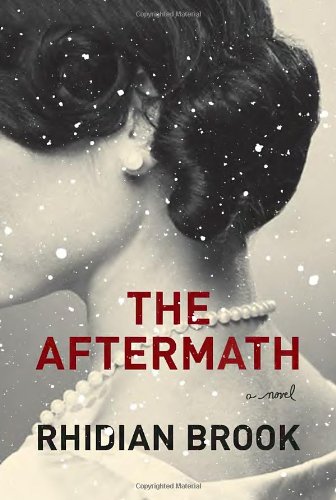



1946, post-World War II Hamburg. While thousands wander the rubble, lost and homeless, Colonel Lewis Morgan, charged with overseeing the rebuilding of this devastated city and the denazification of its defeated people, is stationed in a grand house on the River Elbe. He is awaiting the arrival of his wife, Rachael—still grieving for their eldest son—and their only surviving son, Edmund. But rather than force the owners of the house, a German widower and his rebellious daughter, out onto the streets, Lewis insists that the two families live together. In this charged atmosphere, both parents and children will be forced to confront their true selves as enmity and grief give way to passion and betrayal, to their deepest desires, their fiercest loyalties, and the transforming power of forgiveness. This courageous new novel from award-winning author Rhidian Brook tells an emotionally riveting story of two families, one house, and love grown from hate. This precisely written novel is loosely based on events in which the English author’s forebears were involved. In the immediate aftermath of WWII, as the victorious Allies partition and independently administer a Germany in ruins, English Army Colonel Lewis Morgan, joined by his wife, Rachael, and young child, Edmund, is assigned to take over the luxurious Hamburg home of Stefan Lubert and his teenage daughter, Freda. Rather than displacing them, Morgan generously, though inexplicably, encourages them to stay on and live upstairs, sharing the capacious residence. This is an uneasy arrangement, exacerbated by domestic stress and war-related bitterness: Rachael and Freda still harbor deep resentments, having lost in the bombings, respectively, a son and a mother. Further, the devastated North Sea city is home not only to the occupying British and the defeated, not always “clear” (of Nazi taint) Germans, but also to feral children roaming the streets, and members of a group ironically characterizing itself as the Resistance, “those who have not yet admitted defeat.” In this unique historical novel, Brook plays these elements out dramatically and, for the most part, credibly. --Mark Levine “Rhidian Brook’s arresting novel brings vividly to life a little-told aspect of World War II: its aftermath. His story—energetically and authoritatively told—is unsettling and compelling, suffused with suffering and, mercifully, some hope.” —Claire Messud, author of The Woman Upstairs “Brook’s masterly novel . . . wrings every drop of feeling out of a gripping human situation, and his vignettes of war-ravaged Hamburg are superb.” — The Mail on Sunday “Brook’s beautifully written novel ponders issues of decency, guilt, and forgiveness . . . Profoundly moving.” — The Independent “Reading The Aftermath, one can’t help but wonder if this is the sort of literary memorialization (albeit from a British author) that Sebald might have wished for.” — Washington Post “Superb . . . Conjuring surprise after surprise as it shows how the forces of politics and history penetrate even the most intimate moments of its characters’ emotional lives . . . The house on the Elbe [is] akin to Hamlet ’s Elsinore.” — The Guardian “A moving, always enthralling journey into the dark and light of history. Rhidian Brook has written a brilliant novel.” —Joseph O’Neill, author of Netherland “Brook is wonderful at evoking the atmosphere of this forgotten time and place . . . There is much to think about here.” — The Times (London) “Brook’s excellent novel [is] a captivating tale of love among the ruins but also of treachery and vengeance . . . It does what all good novels should do: it poses many complex questions and resists neat, topped-and-tailed answers.” — Literary Review “Brook addresses weighty themes—forgiveness, familial loss—with a light touch . . . Brings to mind no less a novel than J.G. Ballard’s Empire of the Sun. ” — Financial Times “Rhidian Brook takes a piece of history I thought I knew well and breaks it open; The Aftermath is a compelling, surprising, and moving novel.” —Sadie Jones, author of The Uninvited Guests Rhidian Brook is an award-winning writer of fiction, television, and film. His debut novel, The Testimony of Taliesin Jones, won the Somerset Maugham Award, a Betty Trask Award, and the Authors’ Club Best First Novel Award. His stories have appeared in The Paris Review and New Statesman. He lives in London with his wife and two children. “We’ve found a house for you, sir.” Captain Wilkins stubbed out his cigarette and placed his yellowed finger on the map of Hamburg that was pinned to the wall behind his desk. He traced a line west from the pinhead marking their temporary headquarters, away from the bombed-out districts of Hammerbrook and St. Georg, over St. Pauli and Altona, towards the old fishing suburb of Blankenese, where the Elbe veered up and debouched into the North Sea. The map—pulled from a pre-war