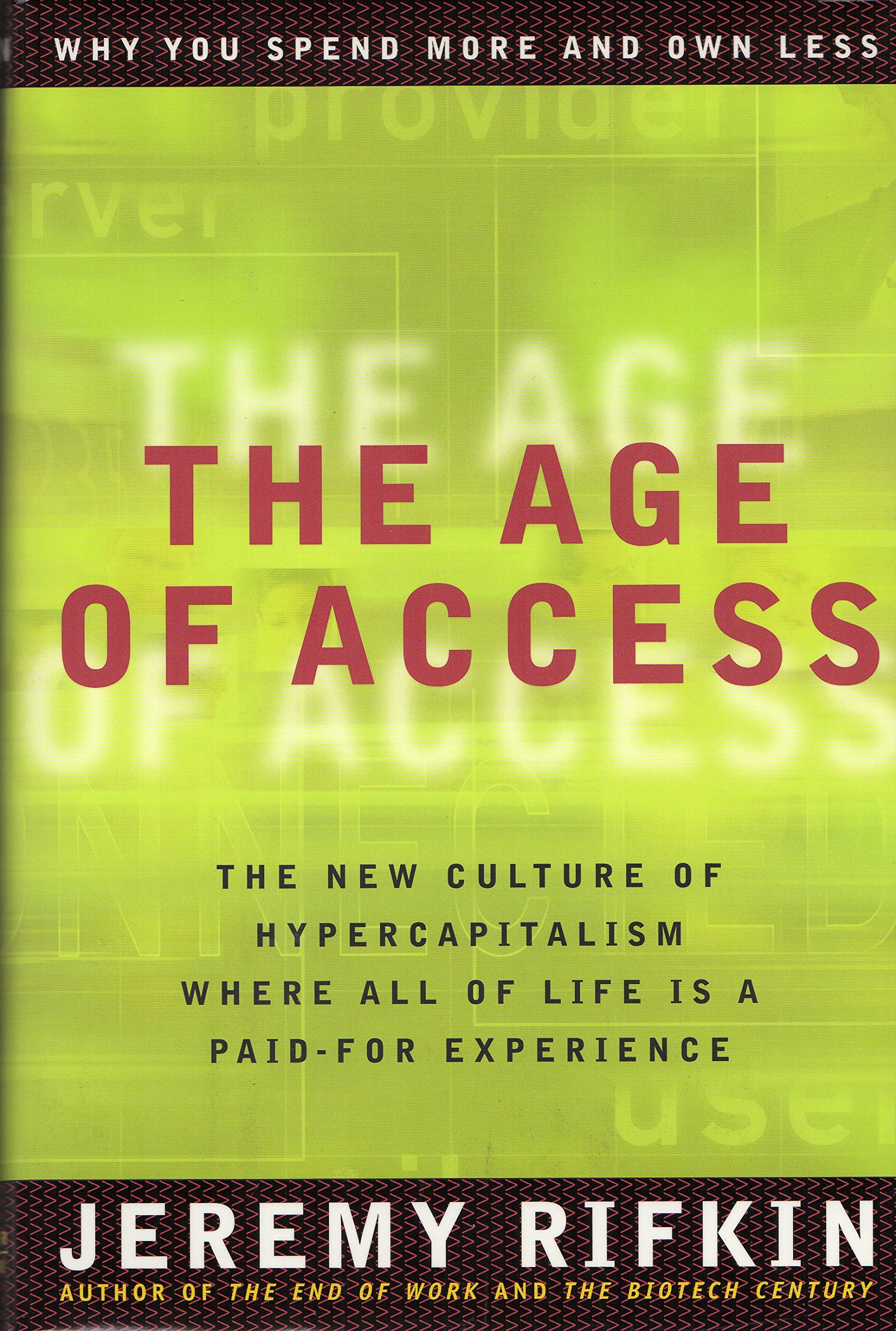
The Age of Access: The New Culture of Hypercapitalism, Where All of Life Is a Paid-For Experience
$13.55
by Jeremy Rifkin



Identifying and explaining the paradigm shift in American business, the author of The End of Work and The Biotech Century shows how ownership of property is giving way to accessing experiences as the key to power in business. 50,000 first printing. He's been called the postmodern Chicken Little, but it happens that the sky really is falling. Jeremy Rifkin pulls the plug on the trend away from property ownership and free public life in The Age of Access: The New Culture of Hypercapitalism Where All of Life Is a Paid-For Experience . As usual, he's a bit ahead of the curve--most of us aren't fully immersed yet in the sea of leased products and packaged experiences that he sees awaiting us. Still, his eerie vision of a world of gatekeepers paying each other for access to nearly every aspect of human life brings a chilling new meaning to the phrase "pay to play" and should spark some debate over our new cultural revolution. Using examples from business and government experiments with just-in-time access to goods and services and resource sharing, Rifkin defines a new society of renters who are too busy breaking the shackles of material possessions to mourn the passing of public property. Are we encouraging alienation or participation? Can we trust corporations with stewardship of our social lives? True to form, the author asks more questions than he answers--a sign of an open mind. If property is theft, leased access is extortion, and The Age of Access warns us of the complex changes coming in our relationships with our homes, our communities, and our world. --Rob Lightner The author of 14 previous books, including The End of Work and The Biotech Century, Rifkin is a noted social critic and president of the Foundation on Economic Trends in Washington, DC. In this important work, he examines the trends that underlie our transition from a service-based economy to one based on the convergence of commerce and culture. Specifically, he notes a broad range of structural changes, including the shift from markets to networks and from ownership to access, the reduced value of physical property and the rise of intellectual property, and the increased marketing of human relationships where culture has become the ultimate commercial resource. His most riveting assertion is that these developments are in sharp contrast to the situation in the rest of the world, in which, as Rifkin states, over 50 percent of the people have never made a phone call, much less been connected to the emerging global information network. Recommended for both public and academic libraries. -Norman B. Hutcherson, Kern Cty. Lib., Bakersfield, CA Copyright 2000 Reed Business Information, Inc. Rifkin's many books include Beyond Beef: The Rise and Fall of the Cattle Culture (1992) and The Biotech Century: Harnessing the Gene and Remaking the World (1998). He has been dismissed as a gadfly and an alarmist by those who do not agree with him, but what he does do most successfully is popularize the debate over the ethical and moral dilemmas posed by the information revolution, genetic engineering, and other scientific advances. For years, Rifkin has been asking what the ultimate price will be that we pay for all our "progress." Now he turns to the "weightless" economy in which products are becoming indistinguishable from services, experiences (not things) are marketed and sold, and consumers own "access" instead of property. Rifkin calls this phenomenon "hypercapitalism," and he sees examples everywhere: outsourcing, theme parks, virtual reality games, automobile leasing, etc. In his freewheeling, wide-ranging discussion, Rifkin raises concerns yet again about what all this means. David Rouse An internationally renowned social critic, Jeremy Rifkin is the bestselling author of The End of Work and The Biotech Century , which was translated into sixteen languages. He is president of the Foundation on Economic Trends in Washington, D.C., and is a fellow at the Wharton School of Finance and Commerce Executive Program. He lives in Washington, D.C.