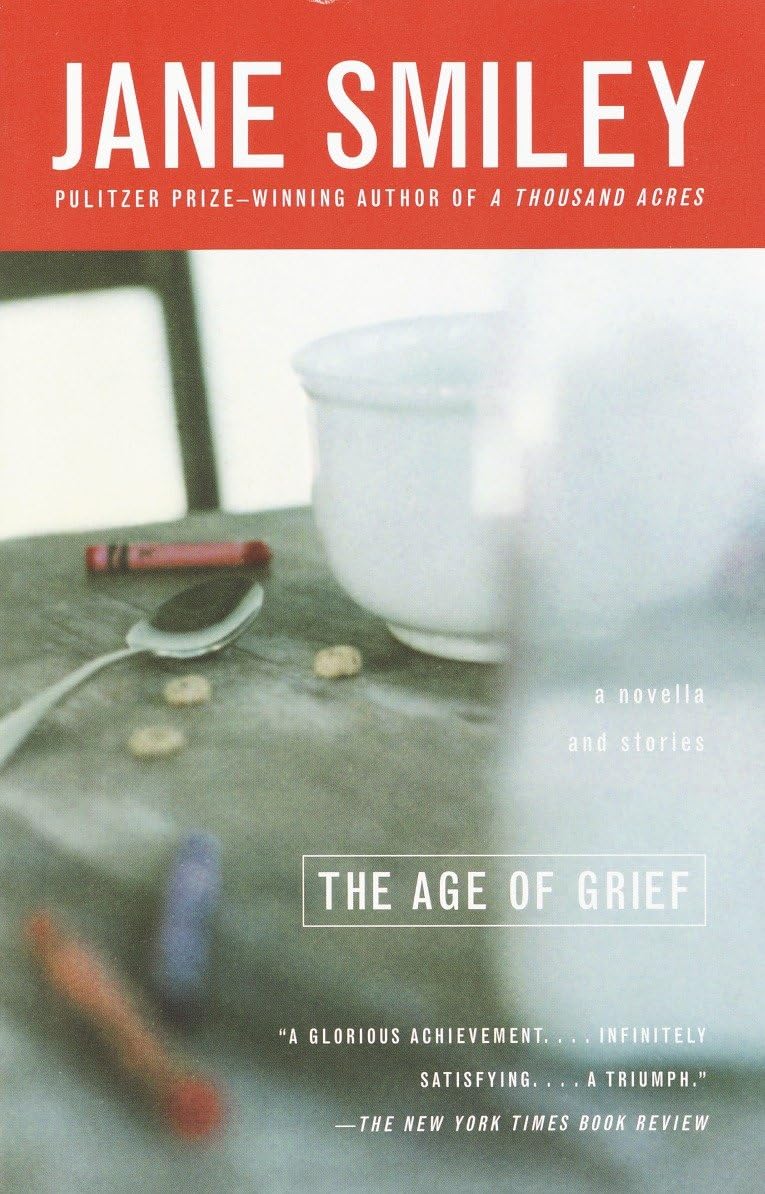



From the Pulitzer Prize-winning author of A Thousand Acres —a luminous novella and short stories that explore the vicissitudes of love, friendship, and marriage. • “A glorious achievement….. Infinitely satisfying….. A triumph.” — The New York Times Book Review In “The Pleasure of Her Company,” a lonely, single woman befriends the married couple next door, hoping to learn the secret of their happiness. In “Long Distance,” a man finds himself relieved of the obligation to continue an affair that is no longer compelling to him, only to be waylaid by the guilt he feels at his easy escape. And in the incandescently wise and moving title novella, a dentist, aware that his wife has fallen in love with someone else, must comfort her when she is spurned, while maintaining the secret of his own complicated sorrow. Beautifully written, with a wry intelligence and a lively comic touch, The Age of Grief captures moments of great intimacy with grace, clarity, and indelible emotional power. “A glorious achievement. . . . Infinitely satisfying. . . . A triumph.” — The New York Times Book Review “A fine collection, with a resonating and particularly rewarding novella.” — San Francisco Chronicle “Impressive . . . brilliant . . . engrossing. . . . This is a book that will last and last.” — The Philadelphia Inquirer “Thrilling to read. . . . The prose has about it the effortlessness only effort can produce.” — USA Today “Thoroughly familiar moments are captured by Ms. Smiley with such immediacy and precision that we are left with a sense of having participated in her characters’ lives.” — The New York Times novella and stories in The Age of Grief explore the vicissitudes of love, friendship, and marriage with all the compassion and insight that have come to be expected from Jane Smiley, the Pulitzer Prize winning author of A Thousand Acres . In The Pleasure of Her Company, a lonely, single woman befriends the married couple next door, hoping to learn the secret of their happiness. In Long Distance, a man finds himself relieved of the obligation to continue an affair that is no longer compelling to him, only to be waylaid by the guilt he feels at his easy escape. And in the incandescently wise and moving title novella, a dentist, aware that his wife has fallen in love with someone else, must comfort her when she is spurned, while maintaining the secret of his own complicated sorrow. Beautifully written, with a wry intelligence and a lively comic touch, The Age of Grief captures moments of great The luminous novella and stories in The Age of Grief" explore the vicissitudes of love, friendship, and marriage with all the compassion and insight that have come to be expected from Jane Smiley, the Pulitzer Prize--winning author of A Thousand Acres." In "The Pleasure of Her Company," a lonely, single woman befriends the married couple next door, hoping to learn the secret of their happiness. In "Long Distance," a man finds himself relieved of the obligation to continue an affair that is no longer compelling to him, only to be waylaid by the guilt he feels at his easy escape. And in the incandescently wise and moving title novella, a dentist, aware that his wife has fallen in love with someone else, must comfort her when she is spurned, while maintaining the secret of his own complicated sorrow. Beautifully written, with a wry intelligence and a lively comic touch, The Age of Grief captures moments of great intimacy with grace, clarity, and indelible emotional power. JANE SMILEY lives in Northern California. When Florence comes up the sidewalk toward her duplex, she can see that the large Victorian house just to the south has new owners. It is the one lovely place on her otherwise undistinguished block--porched, corniced, many-peaked, and recently painted Nordic blond with pique white trim. Each of these last few evenings she has admired, as she does tonight, how neatly the trim glows in the twilight. She threads her way past boxes and pieces of furniture the owners have left on the sidewalk. There are two piles of women's clothing. Dishes and cutlery are stacked beside the curb, and a slender-legged plant stand supports two ferns and a grape ivy. A brown box, its lid agape, contains the Oxford English Dictionary, abridged edition, and two Mexican cookbooks. Draped over the back of a kitchen chair is a white dress, perhaps a wedding dress, its bodice shaped into fullness with blue tissue paper. One of its stiff lace cap sleeves has fallen off the hanger. As Florence notices this, a breeze lifts the skirt. She rearranges the sleeve on the hanger and, shy of being caught, hurries the rest of the way home. In the morning when she turns with her coffee cup to gaze out the window of her kitchen, the items are still on the lawn. The dress has fallen off the chair and lies spread on the green grass like a snow angel. While she is at work, everything disappears, and that night, at last, there are lights in the