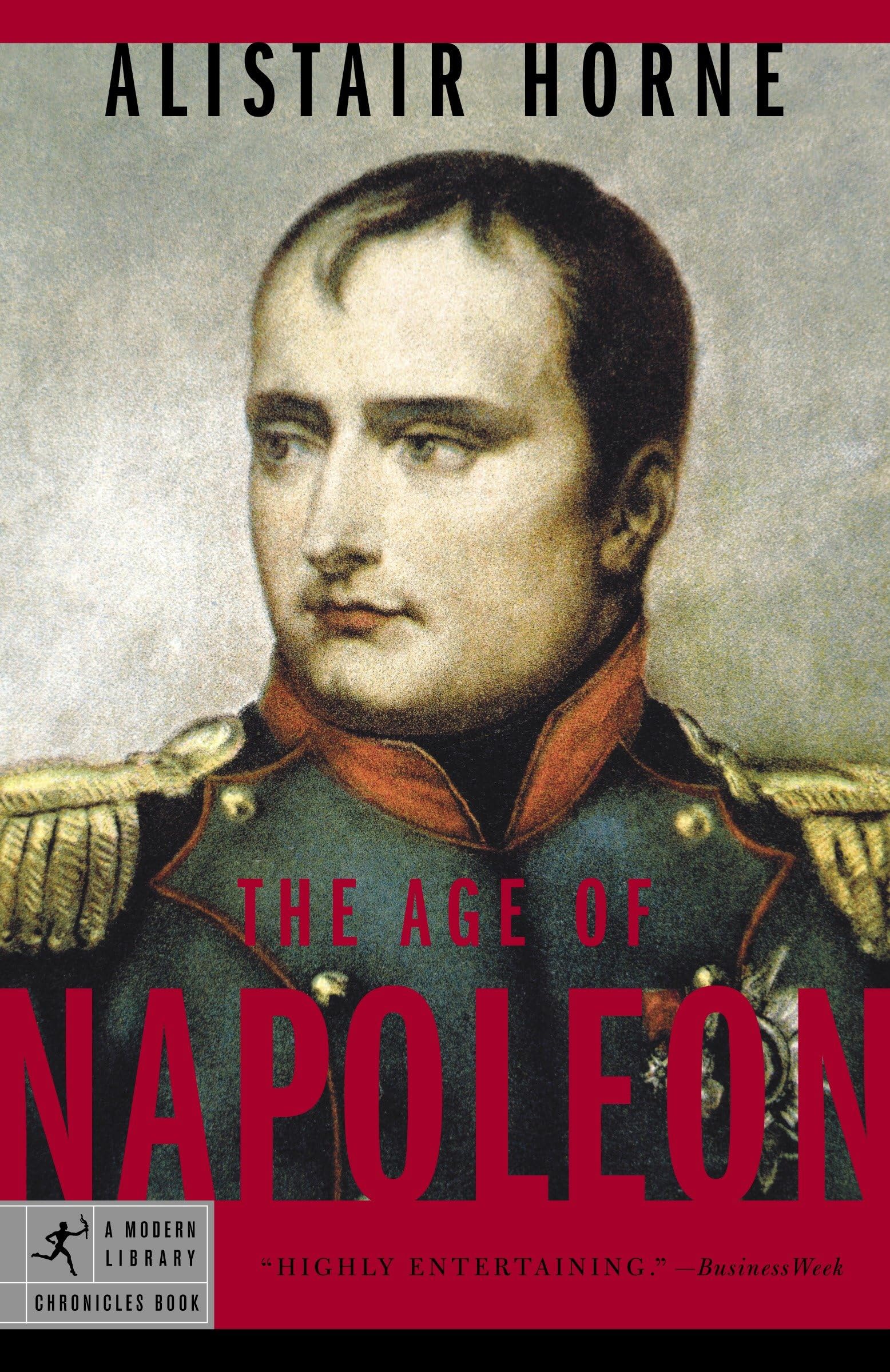



The age of Napoleon transformed Europe, laying the foundations for the modern world. Now Alistair Horne, one of the great chroniclers of French history gives us a fresh account of that remarkable time. Born into poverty on the remote island of Corsica, he rose to prominence in the turbulent years following the French Revolution, when most of Europe was arrayed against France. Through a string of brilliant and improbable victories (gained as much through his remarkable ability to inspire his troops as through his military genius), Napoleon brought about a triumphant peace that made him the idol of France and, later, its absolute ruler. Heir to the Revolution, Napoleon himself was not a revolutionary; rather he was a reformer and a modernizer, both liberator and autocrat. Looking to the Napoleonic wars that raged on the one hand, and to the new social order emerging on the other, Horne incisively guides readers through every aspect of Napoleon’s two-decade rule: from France’s newfound commitment to an aristocracy based on merit rather than inheritance, to its civil code (Napoleon’s most important and enduring legacy), to censorship, cuisine, the texture of daily life in Paris, and the influence of Napoleon abroad. At the center of Horne’s story is a singular man, one whose ambition, willpower, energy and ability to command changed history, and continues to fascinate us today. ALISTAIR HORNE is the author of numerous books, including The Price of Glory , How Far from Austerlitz, and Seven Ages of Paris . A fellow of St. Anthony’s College, Oxford, he was educated at the Millbrook School in New York. He lives in England. Chapter 1 The Will to Power At the age of six I wanted to be a cook. At seven I wanted to be Napoleon. And my ambition has been growing steadily ever since. -Salvador Dalí How, first of all, was it possible for a poor Corsican boy, born with limited horizons, to scale such heights? By the time he had reached Tilsit in 1807, dictating terms to the Tsar of All the Russians, which represented the peak of his military successes, he was still only thirty-seven. Because of his youth at the conclusion of that most famous run of victories, one tends to forget that he was born under the reign of Louis XV and started his military career under Louis XVI. If he was a child of the ancien régime, he was also very much a product of that event dubbed by Thomas Carlyle "the Death-Birth of a World." He was steeped in the French revolutionary heritage, without which he would surely never have gotten as far as Tilsit. Commissioned as a second lieutenant in 1785 at the age of sixteen, from the harsh military academy of Brienne, somewhat derided as a "skinny mathematician," this scion of the lesser Corsican nobility made his first real mark on military affairs some eight years later, at the Siege of Toulon in 1793. The key naval base was then held by an English fleet under the command of Admiral Hood; Napoleon, as a twenty-four-year-old artillery captain, was brought in to advise the not very distinguished commander of the French revolutionary forces besieging it. With his genius for the swift coup d'oeil, which was later to stand him in such good stead, young Napoleon Bonaparte's strategy succeeded, and the British were driven out. He became a hero in the ranks of the incompetent revolutionary army (though still unknown outside it), and was promoted to the dizzy rank of général de brigade when still only twenty-four, and made artillery commander to the Army of Italy. After a brief, fallow period of considerable frustration, his next opportunity came when, by chance, he happened to be in Paris on sick leave during the autumn of 1795. A revolt was pending against the Convention, and Napoleon was called in by his friend and protector Paul Barras (one of the five members of the governing Directoire) to forestall it. He positioned a few guns (brought up at the gallop by a young cavalry captain called Murat) on the key streets leading to the Tuileries Palace. Three years previously he had witnessed the mob storm the same palace, and the weakness of the King on that occasion had made a lasting impression on him. "If Louis XVI had shown himself on horseback, he would have won the day," Napoleon wrote to his brother Joseph. He was determined not to repeat the same error and showed no hesitation in giving the order to fire. Discharged at point-blank range, the historic "whiff of grapeshot" of the Treizième Vendémiaire put the mob convincingly to flight. For the first time since 1789 the Paris "street," which had called the tune throughout the Revolution, had found a new master whom it would not lightly shrug off. Barras, grateful but also nervous at having Napoleon so near the center of power, now appointed him-at the age of twenty-seven-commander in chief of the French Army of Italy. Ever since 1792, France had been at war with the First Coalition of her enemies, who were bent upon reversing the revolutionary t