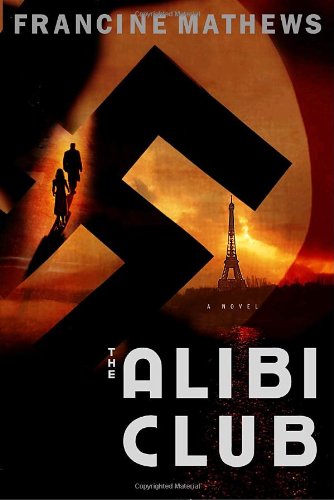



It’s the city’s most infamous after-hours haunt—a glittering hotbed of deals and debaucheries. The sordid death of Philip Stilwell sends shock waves through the Alibi Club...for there’s much more to Stilwell’s untimely end than a sex game gone wrong. His murder and the desperate attempt to keep a deadly weapon out of German hands will bring together the strands of a twisted plot of betrayal, passion, and espionage—one connected to the Alibi Club...and to the most explosive secret of the war. As the Nazis march on Paris and the crisis escalates, four remarkable characters are swept into the maelstrom. Their courage will change the course of history. Epic and yet intimate, a seamless blend of fact and fiction based on a little-known episode of the war, The Alibi Club is a thriller of fierce and complex suspense by a writer whose own life in the spy world makes espionage come uniquely alive. “What a movie The Alibi Club would make.”— Chicago Tribune "Imagine the impeccable period details of Alan Furst's novels about Paris during WWII mixed with a cast straight out of Casablanca and you begin to get some idea of the pleasures on tap in Mathew's new thriller."— Publishers Weekly , starred review "A unique portrait of life on the edge of horror... [with] a remarkable cast of characters."— San Francisco Chronicle Francine Mattews has worked as a foreign-policy analyst for the CIA. She is the author of The Cutout , which has been purchased for a major motion picture by Warner Bros.; The Secret Agent ; and Blown . Under the pseudonym Stephanie Barron, she is the author of eight bestselling Jane Austen mysteries. She lives in Colorado, where she is at work on her next novel of historical suspense. Chapter One Later, they would remember that spring as one of the most glorious they'd ever known in Paris. The flowering of pleached fruit trees and the scent of lime blossom crushed underfoot, the chestnuts unfurling their leaves in ordered ranks along the Champs-Elysees, the women's silks rustling like wings as they hurried to dinner—all had a perilous sweetness, like absinthe. Sally King, who had lived in the city for nearly three years now and might be acknowledged as something of an expert, maintained that even when it rained Paris was ravishing. The streets shone in the sudden torrents regardless of grime or automobile petrol or the piss in the open urinals; they glistened with a brilliance that was consumptive and suicidal. She was surging against the tide of people on the Pont Neuf that night, across the narrowest point of the little island that sat like a raft in the middle of the Seine, having already fought her way past the shuttered bookstalls of the Quai de la Tournelle. She did not move swiftly, because the French heels of her evening sandals caught in the cracks between the paving stones. It was dark, blackout dark, and she would have liked a taxi but there were none to be found. She could sense the panic in the hunched shoulders and too-rapid steps of the Parisians, some of whom turned despite their fear and stared at her openly: Sally King, tall and angular, all her beauty in the impossible length of her legs, the clarity of her frame beneath the candy-wrapper gown. She had been living among them long enough now to perfect her schoolgirl French and she understood the spattering of rumor and fear. They've broken through the line. The Boches are through at Sedan. The army is in retreat — The news from the Front had blown through the city like a boiling wind. A whisper on the northern outskirts. The report of a friend of a friend. The streets were blazing with half-truths and exaggeration under the deep blue dusk of the shaded lights, and most people were milling south. Sally pushed north, toward the Right Bank and the exquisite little flat fronting on the Louvre. Philip Stilwell's place. He had left her waiting at a table with a splendid view of Notre-Dame, conspicuously alone at La Tour d'Argent, not her favorite restaurant in Paris but certainly the most expensive. It was unusual for a woman to arrive without an escort but Gaston Masson, La Tour's manager, was accustomed to the peculiarities of Americans. If the rest of his diners chose to speculate on the cost of Sally's dress, her probable immorality, her purpose in waiting nearly an hour for a man who never showed up—she was at least decorative, and hence valuable against the backdrop of the Seine. Her face, with its high cheekbones and too-wide smile, was said to be famous. She was freakishly tall. She carried a gas-mask case instead of a purse and wore last year's Schiaparelli--an economical gesture in time of war. Shocking pink silk, embroidered with acid green bugs. "Perhaps M. Stilwell is delayed," Masson observed apologetically. "If the Germans have broken our line . . . if they have crossed the Meuse and even now are on the march through Belgium . . . a lawyer might have much to do . . ." But not tonight , Sally thought as s