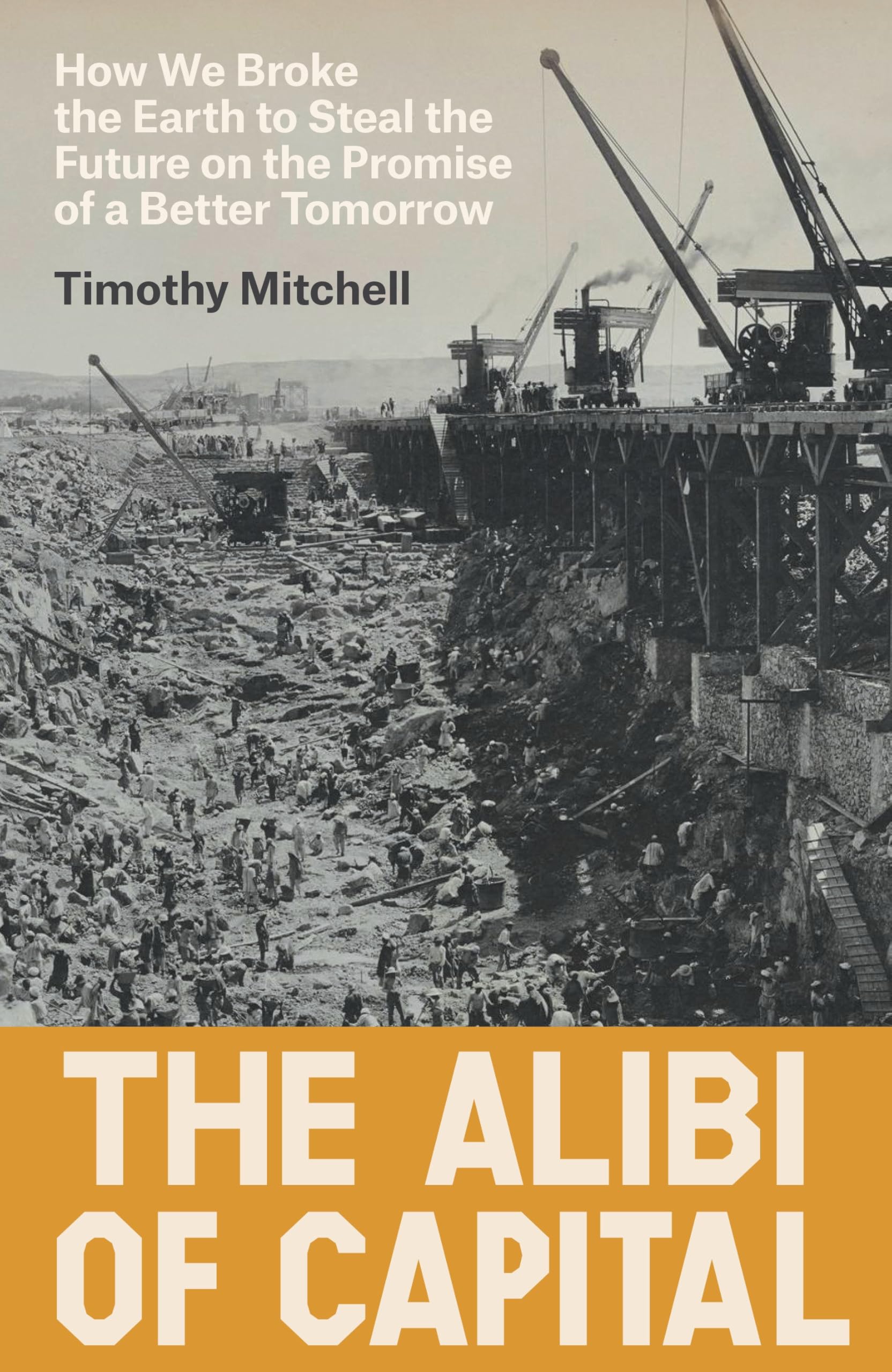
The Alibi of Capital: How We Broke the Earth to Steal the Future on the Promise of a Better Tomorrow
$34.95
by Timothy Mitchell



The author of the acclaimed Carbon Democracy argues that capitalism has always operated by consuming the future—and concealing its theft. We live in an age in which extraordinary wealth seems to arrive from unfathomable sources, such as when tech firms that have never made a profit are valued at billions of dollars. While seeming extraordinary, this mode of acquiring unearned wealth is, in fact, commonplace. It is a key to understanding how capitalism came into being and a clue to grasping why the catastrophe of climate collapse has come upon us. The value is created by consuming the future. The Alibi of Capital asks how we came to organize collective life on the principle of capturing the future, explores the development of this principle in the imperial expansion of the West, and examines how lives today are encumbered by the repayment of earlier extractions. The book identifies the forms of capitalisation, credit, and coercion that turn prospective assets into present income. Rejecting the common idea that claims on the future create only financial or fictitious capital, it traces the terraforming projects—the destruction of rivers, the colonizing of territory, the expansion of infrastructures, and the burning of carbon—through which consuming the future has operated. Arguing that terms like finance, technology, the economy and its growth provide alibis that conceal this mode of extraction, it develops a new approach for understanding how the impoverishment operates. "In this path-breaking critique of the science of economics, Mitchell traces the roots of modern capitalism to the hundreds of new joint stock companies that sprang up in the late 19th century to capitalise the future so that stockholders could enjoy their unearned incomes in the present from new enterprises at home and in the empire. In the course of this magisterial demonstration, he traces the transformation of political economy into economics, shows how the economy and the market are in fact the effects of certain technical and computational tools that homogenise an immense variety of actual transactions and create the supposed distinction between a real economy and the fictive world of stocks and bonds. This book is an outstanding achievement of conceptual rethinking combined with deep historical scholarship." —Partha Chatterjee, author of The Black Hole of Empire: History of a Global Practice of Power "Alibi is a novel theory and history of capital, crafted from Mitchell’s extraordinary erudition, theoretical imagination, and discernment of entire constellations of power in what others pass over as minor details. His argument that capital preys on the future—encumbering, impoverishing, indebting, depleting, discounting and building it—is essential to grasping why capitalism is incompatible with both thriving planetary life and meaningful democracy." —Wendy Brown "Stock prices, interest rates, the advance of technology, and the economized concept of growth have privatized time, blinding us to the relationship between present and future forms of life. Timothy Mitchell shatters this blindness, shining a light on the distractions, obfuscations, disruptions, and commandments that have colonized territory and our sense of historical time. With a brilliance, a depth, and an urgency born of and responding to our age of catastrophes, he offers a political and material conception of time that rejects suffering, debt, and foreclosure." —Sherene Seikaly, author of Men of Capital: Scarcity and Economy in Mandate Palestine Timothy Mitchell is a political theorist and historian who has written about the place of colonialism in the making of modernity, the development politics of the Middle East, the role of economics and other forms of expert knowledge in the government of collective life, and the history and politics of energy. His previous books include Carbon Democracy: Political Power in the Age of Oil , Rule of Experts: Egypt, Techno-Politics, Modernity , and Colonising Egypt . His writings have been translated into many other languages, including French, Spanish, Polish, Turkish, Arabic Persian, Japanese and Chinese. He is the William B. Ransford Professor of Middle Eastern, South Asian and African Studies at Columbia University in New York.