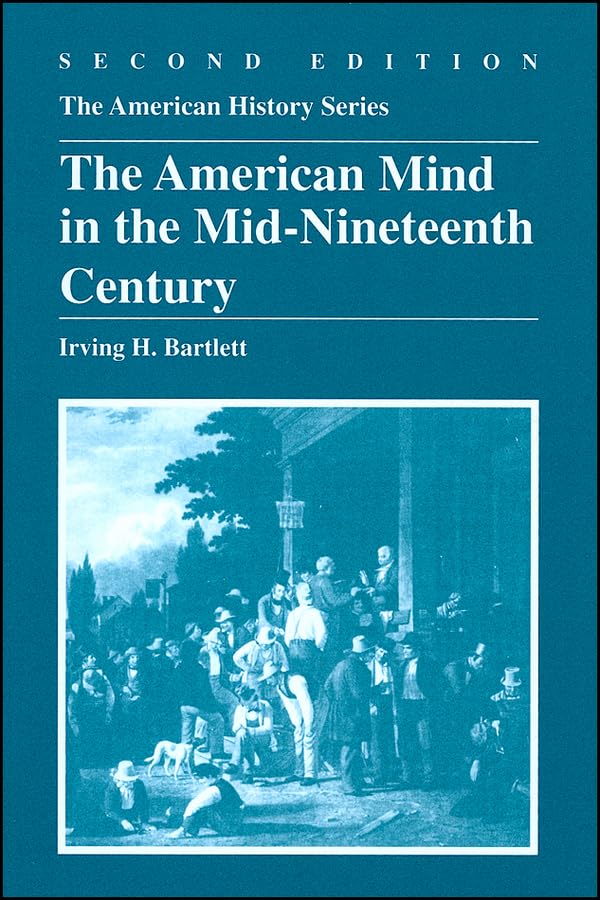
The American Mind in the Mid-Nineteenth Century (The American History Series)
$32.95
by Irving H. Bartlett



EXCERPT: "The half century between the War of 1812 and the Civil War was above all an age of expansiveness in America. Whether measured in terms of population, territory, urbanization, economic growth, technological development, democratization, or nationalism, American society was transformed quantitatively and qualitatively at a spectacular rate. What Americans thought about themselves, their country, and their universe was always tightly linked to the changes they confronted, and the ideas they shared and disputed were both a product of and a commentary upon the expanding political, social, and economic democracy of the period. Strictly speaking, of course, there was no "American mind" during this period, since Americans were then, as they are now, of many minds. Child and adult, man and woman, native and foreign born, Northerner and Southerner, slave and citizen-everyone who lived in America lived in a world of ideas and values shaped in part by a particular history and particular circumstances. However, as Tocqueville observed after visiting America in the 1830s, the citizens of any vigorous society are usually "rallied and held together by certain predominant ideas." Except for the chapter on the slave-holding South, we will be concerned here with the dominant ideas and values most Americans shared and identified with their new nation during the years from 1815 to 1860." Irving Henry Bartlett was an American historian. After graduating from Ohio Wesleyan University, Bartlett obtained his master's and doctoral degrees at Brown University. "The half century between the War of 1812 and the Civil War was above all an age of expansiveness in America. Whether measured in terms of population, territory, urbanization, economic growth, technological development, democratization, or nationalism, American society was transformed quantitatively and qualitatively at a spectacular rate. What Americans thought about themselves, their country, and their universe was always tightly linked to the changes they confronted, and the ideas they shared and disputed were both a product of and a commentary upon the expanding political, social, and economic democracy of the period. Strictly speaking, of course, there was no "American mind" during this period, since Americans were then, as they are now, of many minds. Child and adult, man and woman, native and foreign born, Northerner and Southerner, slave and citizen--everyone who lived in America lived in a world of ideas and values shaped in part by a particular history and particular circumstances. However, as Tocqueville observed after visiting America in the 1830s, the citizens of any vigorous society are usually "rallied and held together by certain predominant ideas." Except for the chapter on the slave-holding South, we will be concerned here with the dominant ideas and values most Americans shared and identified with their new nation during the years from 1815 to 1860." Used Book in Good Condition