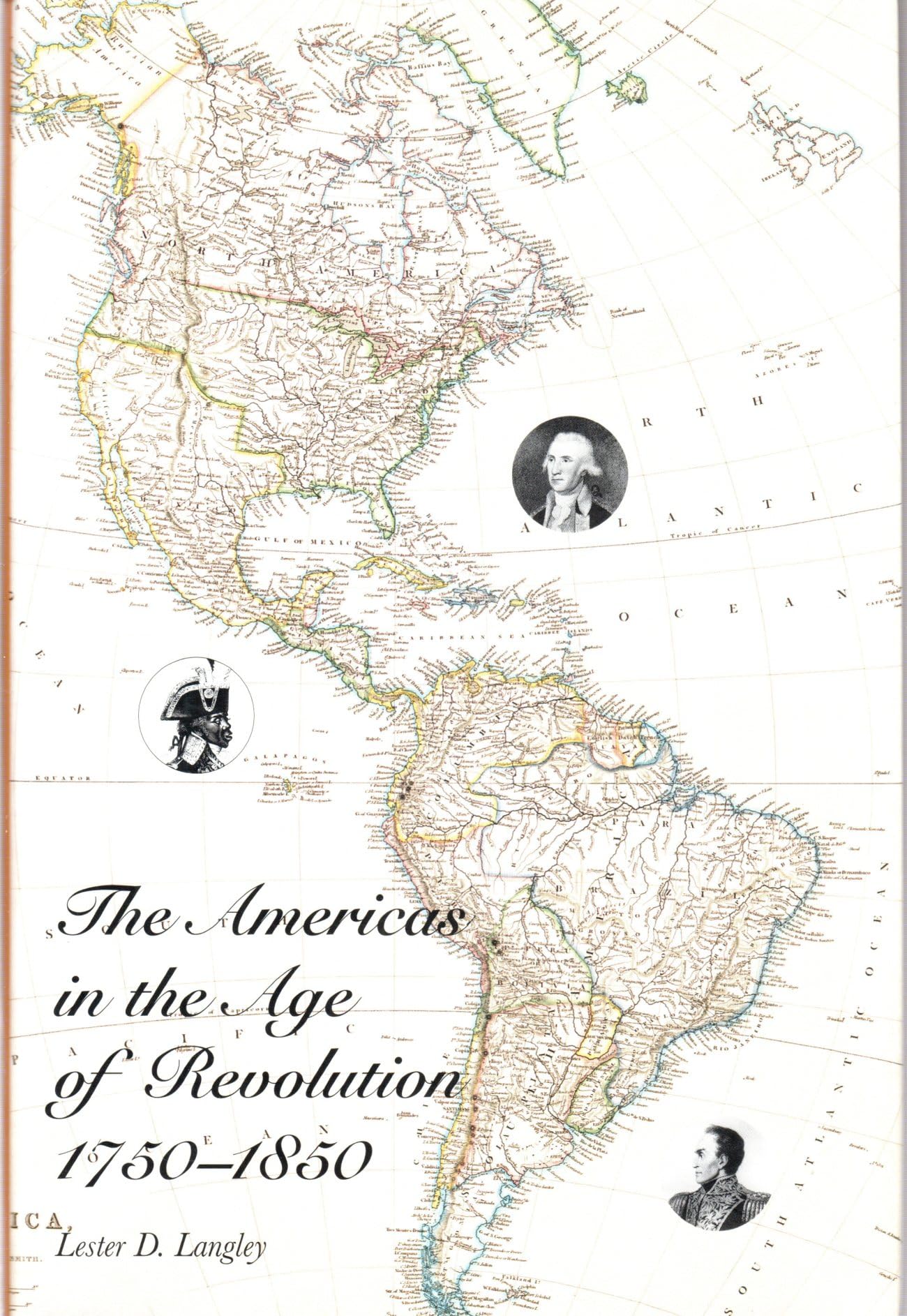



Describes the causes and consequences of the American, Haitian, and Spanish American revolutions. Within half a century, three European empires fell to American movements for independence. In this innovative and sophisticated account of comparative history, Lester D. Langley considers the revolutions in the American colonies, Saint Domingue (later Haiti), and the "Iberoamerican" independence movements in South America. He compares class leadership, racial factors, and the relative violence of each movement. His study alters the typical framework for analyzing American independence as he considers revolution from a dynamic or systemic perspective. Eschewing questions of causation such as "Why did the revolutions occur?" or "What did they achieve?" he explores instead the importance of place and location as well as what the revolts brought in terms of industrialization, militarization, and material progress. Professor Langley's arguments are based in an intriguing understanding of chaos theory, which he applies to the interpretation of historical experience in order to draw out the roles of probability and randomness as constraints on and conditions for the various revolutionary movements. In this sophisticated comparative history, Langley (The Banana Men, Univ. of Kentucky, 1994) examines the causes, character, and consequences of the American, Haitian, and Spanish American revolutions. Because the nature of the revolts varied, he explains, it is only logical that their legacies differ. While British American revolutionary leaders proclaimed lofty principles of liberty and refused to install a centralized, dominating revolutionary government, their Spanish American counterparts were unwilling to follow their lead. Consequently, the democratic achievements of the revolutionary era tended to be retained in America but reversed in Latin America. For these reasons, Langley calls these two revolts respectively, the "revolution from above," and the "revolution denied." His well-documented and readable work effectively distinguishes between independence movements and true revolutions. A nice complement to any academic collection; highly recommended. Raymond J. Palin, St. Thomas Univ., Miami, Fla. Copyright 1996 Reed Business Information, Inc. Lester D. Langley's formidable book cautions us against self-congratulation by comparing our Revolution . . . with other American revolutions--in the Caribbean and Latin America. His readers may never see the formative years of the United States in quite the same way. . . . This dense, complex book is difficult, but no one who perseveres to its end will continue to make easy assumptions about the American revolution. -- The New York Times Book Review, Fred Anderson