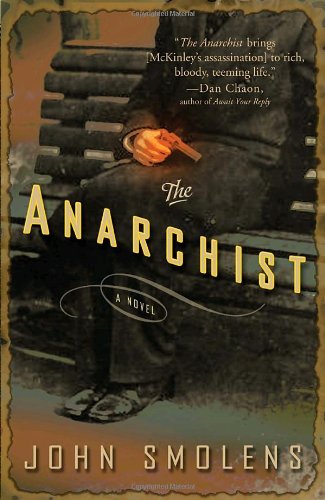



On a stifling, hot afternoon in September 1901, a young anarchist, Leon Czolgosz, who has been stalking President William McKinley, waits in line to meet the president, his right hand wrapped in a handkerchief and held across his chest as though it were in a sling. But the handkerchief conceals a .32-caliber revolver. When the president greets him, Czolgosz fires two shots. The nation quickly plummets into fear and anger. A week later, rioting mobs attempt to lynch McKinley’s assassin, and across the country, political dissidents such as the notorious Emma Goldman are tracked down and arrested. Driven by a sense of duty and by his love for a beautiful Russian prostitute, Czolgosz’s confidant, Moses Hyde, infiltrates an anarchist group as it sets in motion a deadly scheme designed to push the country into a state of terror. The Anarchist brilliantly renders a haunting and belligerent twentieth-century landscape teeming with corrupt politicians, kind-hearted prostitutes, dissidents, and immigrants eager for a fresh start. It is an America where every allegiance is questioned, and every hope and aspiration comes at a price. On September 6, 1901, President McKinley was shot twice by a young, unbalanced anarchist, Leon Czolgosz; McKinley died a week later. The weeks preceding and following the assassination are the subject of this intense, moody, and engrossing novel. Smolens is the author of five previous novels, and he is a professor of English at Northern Michigan University. He provides an excellent portrait of the seamier side of the Gilded Age. He captures the virulence of class hatred and the aura of violence that hung over various radical groups. There are finely drawn characters, including a Russian Jewish whore with a heart of gold and corrupt policemen and politicians. At the center of the narrative are two contrasting men drawn together by events: Norris is a hard-nosed Pinkerton detective with contempt for working-class activists; Hyde is his informer with ambivalent feelings toward the anarchist movement. He is sympathetic with their demands for social justice but repelled by their violent tendencies. This is a well-written novel that works as both a political thriller and as a depiction of a tumultuous era in our history. --Jay Freeman "Thrilling...the subtlety and vigor with which Smolens evokes this turbulent era makes The Anarchist far more than a superior adventure." -- Boston Globe “Intense, moody, and engrossing.” -- Booklist "John Smolens has written a historical novel with the quick-beating heart of a thriller . Written in crisp, cinematic prose, The Anarchist has echoes of the best noir, while at the same time invoking a terrifyingly empathetic portrait of the young assassin Leon Czolgosz, who, in Smolens hands, has a kind of Dostoyevskian complexity. Before reading this book, the McKinley assassination existed in my mind as only a dry fact. The Anarchist has brought these events to rich, bloody, teeming life." -- Dan Chaon , author of Await Your Reply "Fiction so shapely and finely wrought: dark history inexorably bound to repeat itself -- The Anarchist is another gem from a master of the storyteller's arts." -- Thomas Lynch , author of The Undertaking "If you have ever been fascinated by the name and deed of one Leon Czolgosz, John Smolens's The Anarchist will be a good friend to you. If you have never heard of the name and deed of one Leon Czolgosz, John Smolens's The Anarchist will likely be a revelation. With his portrait of a bygone America both out for blood and at its own throat, Smolens has written an intelligent, often troubling warning disguised as a first-rate thriller, as though Sinclair Lewis has fused with Alan Furst ." -- Tom Bissell , author of The Father of All Things Democracy, by its very nature, cannot be defeated by political assassination. From The Washington Post's Book World/washingtonpost.com Reviewed by by Ron Charles Alleged White House party crashers Michaele and Tareq Salahi never posed any threat to the president, but they reached him so easily at a time of heightened security that the parallels to a tragic encounter 100 years ago are truly frightening. In 1901, as today, America was suffering economic turmoil while battling shadowy zealots trying to destabilize Western governments with acts of terror and assassination. These early-20th-century anarchists disrupted markets and kept political leaders in a state of constant anxiety. Given the threat level, the rumors about plots against the president's life and the unprecedented security arrayed to protect him, how could a young man walk up to President William McKinley and murder him? That shocking breach of security is the subject of John Smolens's smart and compelling historical thriller. Although the story takes place in Buffalo, it's at a time when the influence of Washington, D.C., is flooding over that city. Newly reelected President McKinley is coming in a mo