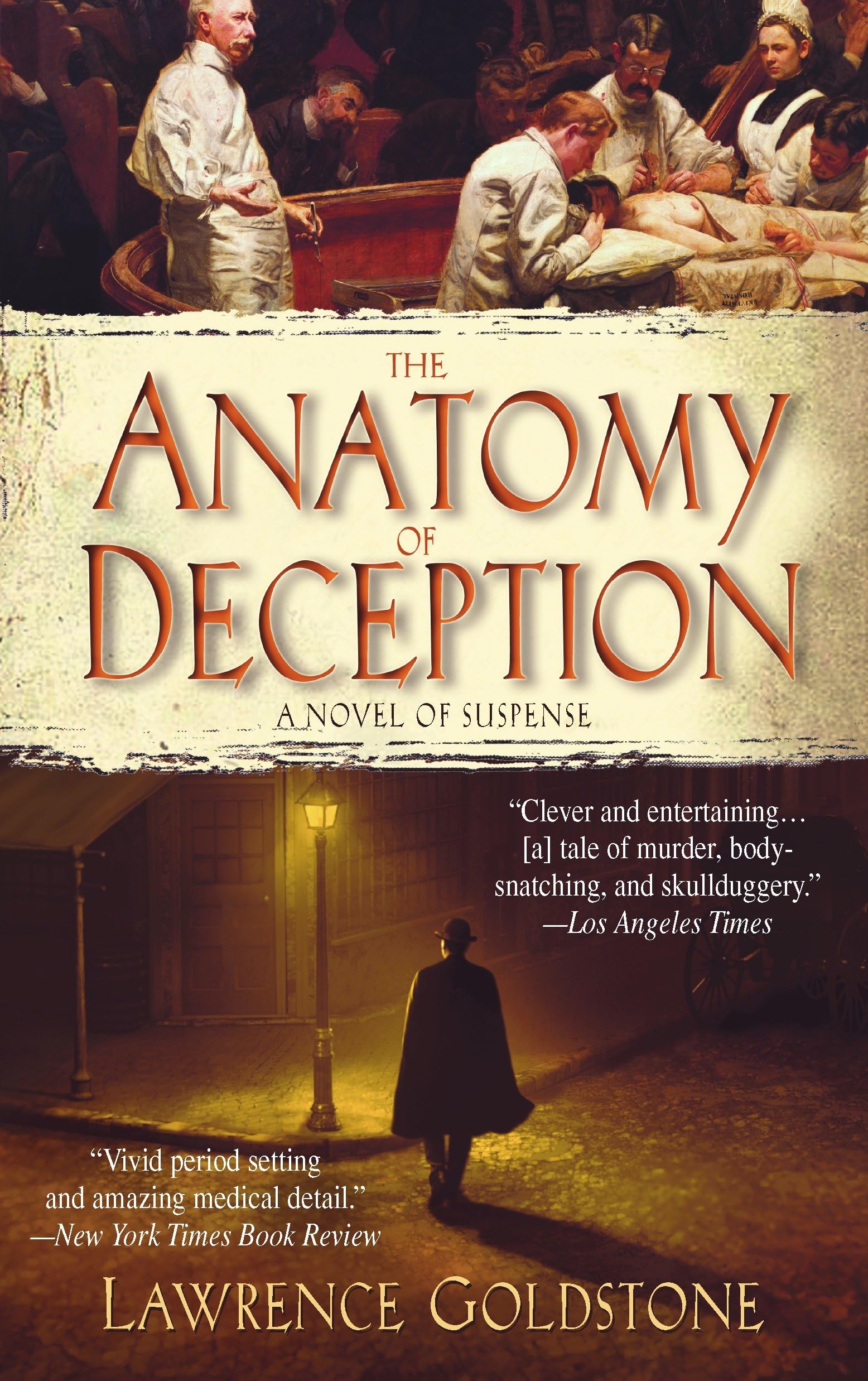



The year is 1889. In the morgue of a Philadelphia hospital, physicians uncover the corpse of a beautiful young woman. What they see takes their breath away. Within days, one doctor, Ephraim Carroll, strongly suspects that he knows the woman’s identity…and the horrifying events that led to her death. Dr. Carroll came to Philadelphia to study with a leading professor, the brilliant William Osler, believing that he would gain the power to save countless lives. But Carroll and his mentor are at odds over what they glimpsed that morning in the hospital’s Dead House. And when a second mysterious death is determined to have been a ruthless murder, Carroll can feel the darkness gathering around him—and he ignites an investigation of his own. Soon he is moving between the realm of elite medicine, Philadelphia high society, and a teeming badlands of criminality and sexual depravity along the city’s fetid waterfront. With a wealthy, seductive woman clouding his vision, the controversial artist Thomas Eakins sowing scandal, and the secrets of the nation’s powerful surgeons unraveling around him, Carroll is forced to confront an agonizing moral choice—between exposing a killer, undoing a wrong, and, quite possibly, protecting the future of medicine itself. "You’ll be gripped by this haunting and atmospheric thriller.” —Tess Gerritsen “Compelling…. [A] top-notch historical page-turner.”— Publishers Weekly , starred review “What makes his book so fascinating is the attention to the medical procedures and innovations of the time ... Readers who enjoy Anne Perry’s and Caleb Carr’s psychological thrillers will welcome Goldstone’s brooding, paranoiac addition to the genre.”— Booklist “Packed with historical asides and real-life figures.”— Entertainment Weekly “A clever and entertaining tale…. set in the surgical theaters and medical research halls of late-19th century Philadelphia and Baltimore.”— Los Angeles Times Book Review "Colorful and highly informative.... Evokes the evolving medical profession and the art world in late-19th-century America."— USA Today “Long before CSI, the dead were offering up their clues…. will thrill lovers of history, medicine, forensics and, of course, a good mystery.”— Parade “Goldstone weaves history, atmosphere, medical procedures, and forensic details into a fascinating story.…” — Boston Globe “An entertaining page-turner.” — Richmond Times-Dispatch Lawrence Goldstone, with his wife Nancy, is the author of two critically acclaimed narrative histories of science. He has written for the Boston Globe, Los Angeles Times, Chicago Tribune, and Miami Herald. He lives in Westport, Connecticut. Chapter One At Christmas 1887, fifteen months before this story began, the world was introduced to a fictional character destined for such immeasurable acclaim that he would overwhelm his creator’s efforts to be done with him. The essence of this character’s appeal was not derring-do, as in the dime novels of Beadle & Adams, but rather in his uncanny ability to unravel a set of data that had stumped lesser men and proceed to a logical and incisive conclusion. He was so coldly rational that he was often compared to a machine, the Analytical Engine of Charles Babbage. His name, of course, was Sherlock Holmes. To those of us engaged in medical research, however, the remarkable methods of Conan Doyle’s consulting detective were not at all revolutionary—they were merely a popularization of the modus operandi we employed in our quotidian efforts to alleviate human misery. The connection of analytic detection to medicine was unmistakable. Doyle himself was a physician, as were both Joseph Bell, widely considered the model for the character, and Oliver Wendell Holmes, the man for whom the detective was named. And while Sherlock Holmes may have trod the back alleys of Victorian London to ply his trade, the scenes of our crimes were no less exotic and often even more grisly. To make sense of nature’s felonies against the human body, you see, physicians are compelled to study not only the living, but also those who have succumbed. Our clues lie in internal organs, blood vessels, skin, hair, and fluids, and we need as much access to these as Holmes needed to footprints, handwriting, or hotel records. It is only through painstaking examination of the data wrung from this evidence that deductions may be made as to what has caused illness and death, which, in turn, aids immeasurably in the care and treatment of those who might still be saved. As Holmes’ popularity soared, it thus became sport among physicians to match wits with the fictional detective, eager to demonstrate that if they applied themselves to murder, theft, and mayhem, they would achieve similarly sterling results. Although for most in the medical field, this exercise was nothing more than a diverting parlor amusement, for me, the game was to be all too real. It started early on a mid-March Thursday in 1889, when I strode through t