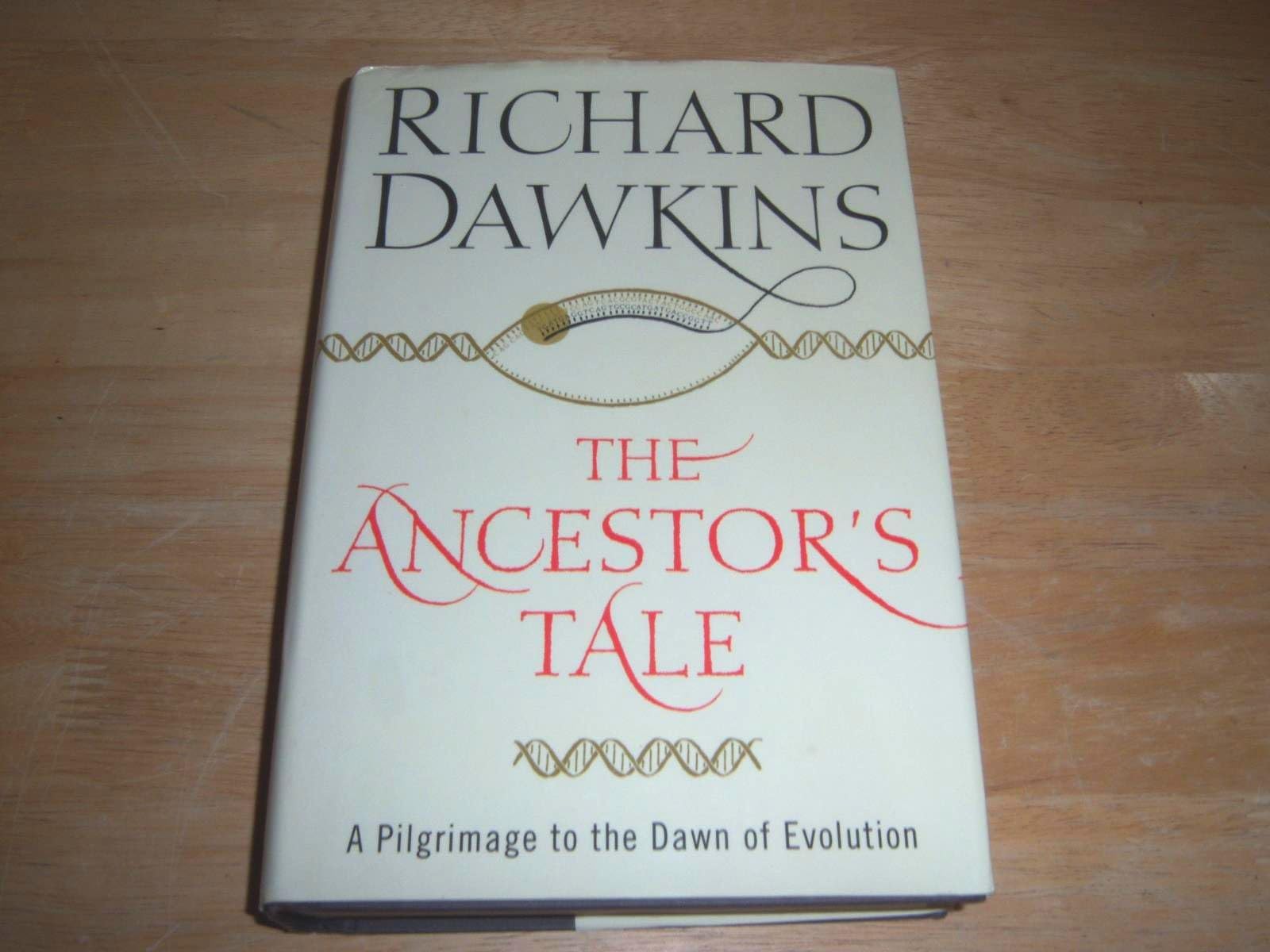



A renowned scientist and author of The Selfish Gene provides a sweeping chronicle of more than four billion years of life on Earth, shedding new light on evolutionary theory and history, sexual selection, speciation, convergent evolution, extinction, genetics, plate tectonics, geographical disperal, and other topics. Just as we trace our personal family trees from parents to grandparents and so on back in time, so in The Ancestor's Tale Richard Dawkins traces the ancestry of life. As he is at pains to point out, this is very much our human tale, our ancestry. Surprisingly, it is one that many otherwise literate people are largely unaware of. Hopefully Dawkins's name and well deserved reputation as a best selling writer will introduce them to this wonderful saga. The Ancestor's Tale takes us from our immediate human ancestors back through what he calls concestors, those shared with the apes, monkeys and other mammals and other vertebrates and beyond to the dim and distant microbial beginnings of life some 4 billion years ago. It is a remarkable story which is still very much in the process of being uncovered. And, of course from a scientist of Dawkins stature and reputation we get an insider's knowledge of the most up-to-date science and many of those involved in the research. And, as we have come to expect of Dawkins, it is told with a passionate commitment to scientific veracity and a nose for a good story. Dawkins's knowledge of the vast and wonderful sweep of life's diversity is admirable. Not only does it encompass the most interesting living representatives of so many groups of organisms but also the important and informative fossil ones, many of which have only been found in recent years. Dawkins sees his journey with its reverse chronology as cast in the form of an epic pilgrimage from the present to the past [and] all roads lead to the origin of life. It is, to my mind, a sensible and perfectly acceptable approach although some might complain about going against the grain of evolution. The great benefit for the general reader is that it begins with the more familiar present and the animals nearest and dearest to usour immediate human ancestors. And then it delves back into the more remote and less familiar past with its droves of lesser known and extinct fossil forms. The whole pilgrimage is divided into 40 tales, each based around a group of organisms and discusses their role in the overall story. Genetic, morphological and fossil evidence is all taken into account and illustrated with a wealth of photos and drawings of living and fossils forms, evolutionary and distributional charts and maps through time, providing a visual compliment and complement to the text. The design also allows Dawkins to make numerous running comments and characteristic asides. There are also numerous references and a good index.-- Douglas Palmer In this expansive book, Dawkins, the well-known evolutionary biologist and author (The Selfish Gene, The Blind Watchmaker, A Devil's Chaplain, among others), gives us an eloquent treatise on evolution, ne-glecting neither the latest developments nor his own provocative views. As the title suggests, Chaucer's Canterbury Tales provides the model for the book's conceit--a pilgrimage back through four billion years of life on earth. We join with other organisms at rendezvous points where we find common ancestors, until we arrive at the "grand ancestor of all surviving life." As Dawkins explains: "Backward chronology in search of ancestors really can sensibly aim towards a single distant target ... and we can't help converging upon it no matter where we start--elephant or eagle, swift or salmonella, wellingtonia or woman.... Instead of treating evolution as aimed toward us, we choose modern Homo sapiens as our arbitrary, but forgivably preferred, starting point for a reverse chronology.... Following Chaucer's lead, my pilgrims, which are all the different species of living creatures, will have the opportunity to tell tales along the way to their Canterbury, which is the origin of life. It is these tales that form the main substance of this book." Editors of Scientific American (202) *Starred Review* Plato plays the intellectual villain in this latest work of popular science by one of our most visible biologists. Dawkins indicts the ancient Greek thinker for advancing a doctrine of Ideal Types that has long obscured the linkages making all species one connected continuum. To remedy the effects of Plato's sin, Dawkins sets out on a pilgrimage tracing the history of the human species back to the very origins of life, marking along the way 39 rendezvous points where the human genealogical path crosses that of other terrestrial species. From kindred chimpanzees to humanity's hidden ties with eubacteria--and beyond into the very beginnings of heredity-- Dawkins charts an impressive body of biological theory and research, sometimes speculatively but never obscurely. Nonspecialists