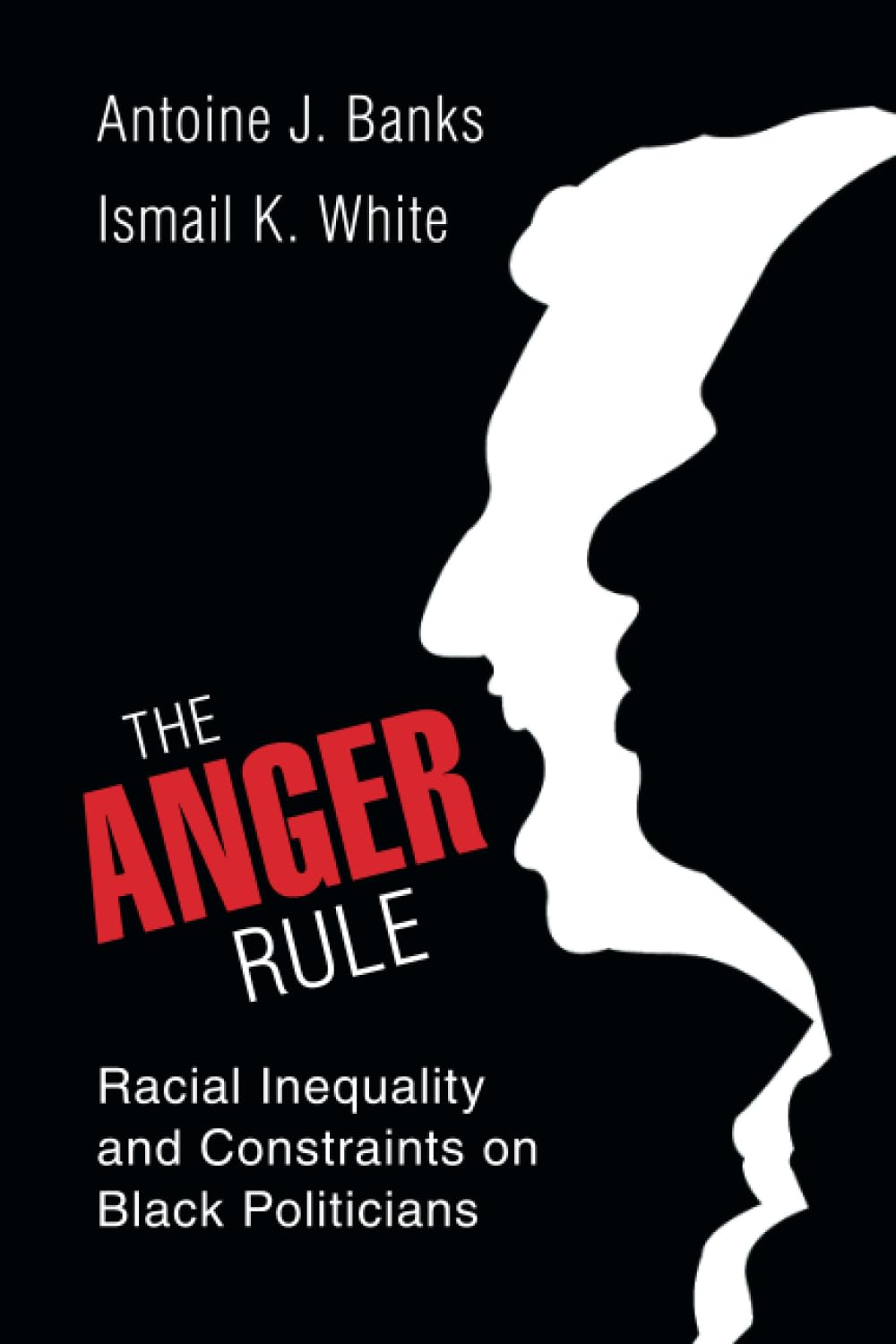



In The Anger Rule, Antoine J. Banks and Ismail K. White examine how Black politicians are uniquely penalized for expressing anger, especially anger related to race. Drawing on social psychology and philosophy, Banks and White demonstrate how this anger penalty helps sustain racial inequality. They argue that anger infers power because it propels individuals to change the status quo. When Black politicians are constrained from expressing anger, it limits their ability to mobilize against wrongs and rally fellow group members; it also signals a lack of power to Black voters. This argument is assessed using a multi-method approach of national survey experiments and content analysis of United States presidential and House congressional speeches and remarks. The findings show that Black politicians and voters are aware of the anger penalty, therefore constraining their anger in political spaces to avoid backlash from those who maintain the racial status quo. ‘With clear and persuasive evidence, Banks and White demonstrate a striking racial double standard in the expression of anger within the political arena. In doing so, they unveil the complexities of anger’s impact on public opinion and electoral outcomes. Theoretically rich and masterfully written, The Anger Rule promises to redefine how we perceive the emotional undercurrents of contemporary American politics.’ Lauren Davenport, Stanford University ‘In The Anger Rule, Banks and White provide a significant contribution to the literature on emotion and politics by demonstrating that Black politicians face an electoral penalty among white voters for expressing anger, especially on racial issues. By constraining Black political leaders’ use of anger, the public also constrains their ability to make racial progress.’ Shana Gadarian, Syracuse University ‘The Anger Rule provides illuminating insight into the boundaries imposed on Black elected officials, offering a fresh perspective on racial disparities in politics. It bridges multiple literatures to produce knowledge that can be applied to notable historical and contemporary political figures and policy debates.’ Davin L. Phoenix, University of California, Irvine ‘Banks and White offer a compelling argument for how African Americans are emotionally disadvantaged in politics. They demonstrate that Black political elites face more constraints when expressing anger than their White counterparts, arguing that anger is a political tool unavailable to Black political elites pursuing electoral office in majority White jurisdictions. At a time when scholars continue to grapple with big questions regarding racial inequality and contentious politics, it is sure to be a groundbreaking book.’ LaFleur Stephens-Dougan, Princeton University Examines how Black politicians are penalized for expressing anger and demonstrates how this anger penalty helps sustain racial inequality. Antoine J. Banks is a Professor in the Department of Government and Politics at the University of Maryland. His research interests include racial and ethnic politics, emotions, political psychology, and public opinion. His first book, Anger and Racial Politics: The Emotional Foundation of Racial Attitudes in America (2014), explores the link between emotions and racial attitudes and the consequences it has for political preferences. He has also authored numerous journal articles and research has been supported by the National Science Foundation and Russell Sage Foundation. Ismail K. White is a Professor of Politics and Public Affairs at Princeton University. He studies race and ethnic politics in America, with a focus on Black politics. His first book, Steadfast Democrats: How Social Forces Shape Black Political Behavior (2020)(co-authored with Dr. Chryl N. Laird) was a 2021 finalist for the American Publishers Award for Professional and Scholarly Excellence (PROSE) in Government and Politics and won the 2021 American Political Science Association's best book award. It was also selected to the USA Today list of best nonfiction books of 2020. He has also authored numerous journal articles and book chapters.