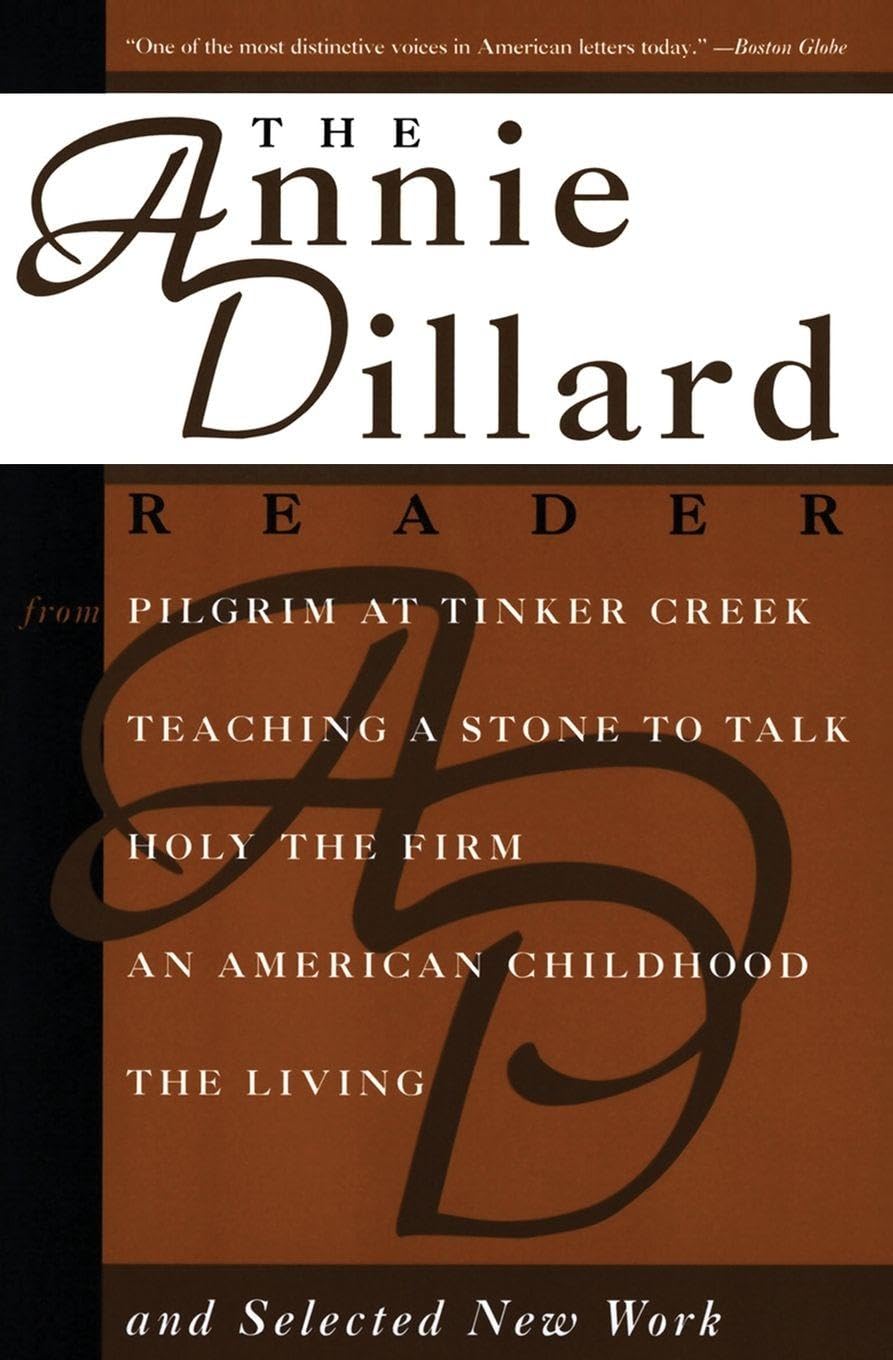



"She has a strange and wonderful mind, and the ability to speak it with enduring grace." – The New Yorker "A stand up ecstatic. . . . Like all great writers, she is fresh, jarring, passionately dedicated to her subject." — Threepenny Review From one of America's most beloved writers, a collection of her own work - from Pilgrim at Tinker Creek, Teaching a Stone to Talk, Holy the Firm, An American Childhood, and The Living - now in paperback. A lovely introduction to the prolific Annie Dillard's Pulitzer Prize-winning oeuvre, this sampler demonstrates Dillard's wide breadth of writing from the most minute observations to profound meditations on God in everyday life. "One of the most distinctive voices in American letters today." - Boston Globe "She has a strange and wonderful mind, and the ability to speak it with enduring grace." - The New Yorker "A stand up ecstatic. . . . Like all great writers, she is fresh, jarring, passionately dedicated to her subject." - Threepenny Review Annie Dillard -- "one of the most distinctive voices in American letters today" ( Boston Globe ) -- collects her favorite selections from her own writings in this compact volume. A perfect introduction to one of America's most acclaimed and bestselling authors. Annie Dillard is the Pulitzer Prize-winning author of Pilgrim at Tinker Creek, An American Childhood, The Writing Life, The Living and The Maytrees . She is a member of the Academy of Arts and Letters and has received fellowship grants from the John Simon Guggenheim Foundation and the National Endowment for the Arts. An Annie Dillard Reader By Dillard, Annie Perennial Copyright © 2004 Annie Dillard All right reserved. ISBN: 0060926600 Total Eclipse It had been like dying, that sliding down the mountain pass. It had been like the death of someone, irrational, that sliding down the mountain pass and into the region of dread. It was like slipping into fever, or falling down that hole in sleep from which you wake yourself whimpering. We had crossed the mountains that day, and now we were in a strange place--a hotel in central Washington, in a town near Yakima. The eclipse we had traveled here to see would occur early the next morning. I lay in bed. My husband, Gary, was reading beside me. I lay in bed and looked at the painting on the hotel-room wall. It was a print of a detailed and lifelike painting of a smiling clown's head, made out of vegetables. It was a painting of the sort that you do not intend to look at and that, alas, you never forget. Some tasteless fate presses it upon you; it becomes part of the complex interior junk you carry with you wherever you go. Two years have passed since the total eclipse of which I write. During those years I have forgotten, I assume, a great many things I wanted to remember--but I have not forgotten that clown painting or its lunatic setting in the old hotel. The clown was bald. Actually, he wore a clown's tight rubber wig, painted white; this stretched over the top of his skull, which was a cabbage. His hair was bunches of baby carrots. Inset in his white clown makeup, and in his cabbage skull, were his small and laughing human eyes. The clown's glance was like the glance of Rembrandt in some of the self-portraits: lively, knowing, deep, and loving. The crinkled shadows around his eyes were string beans. His eyebrows were parsley. Each of his ears was a broad bean. His thin, joyful lips were red chili peppers; between his lips were wet rows of human teeth and a suggestion of a real tongue. The clown print was framed in gilt and glassed. To put ourselves in the path of the total eclipse, that day we had driven five hours inland from the Washington coast, where we lived. When we tried to cross the Cascades range, an avalanche had blocked the pass. A slope's worth of snow blocked the road; traffic backed up. Had the avalanche buried any cars that morning? We could not learn. This highway was the only winter road over the mountains. We waited as highway crews bulldozed a passage through the avalanche. With two-by-fours and walls of plyboard, they erected a one-way, roofed tunnel through the avalanche. We drove through the avalanche tunnel, crossed the pass, and descended several thousand feet into central Washington and the broad Yakima valley, about which we knew only that it was orchard country. As we lost altitude, the snows disappeared; our ears popped; the trees changed, and in the trees were strange birds. I watched the landscape innocently, like a fool, like a diver in the rapture of the deep who plays on the bottom while his air runs out. The hotel lobby was a dark, derelict room, narrow as a corridor, and seemingly without air. We waited on a couch while the manager vanished upstairs to do something unknown to our room. Beside us, on an overstuffed chair, absolutely motionless, was a platinum-blond woman in her forties, wearing a black silk dress and a strand of pearls. Her long legs wer