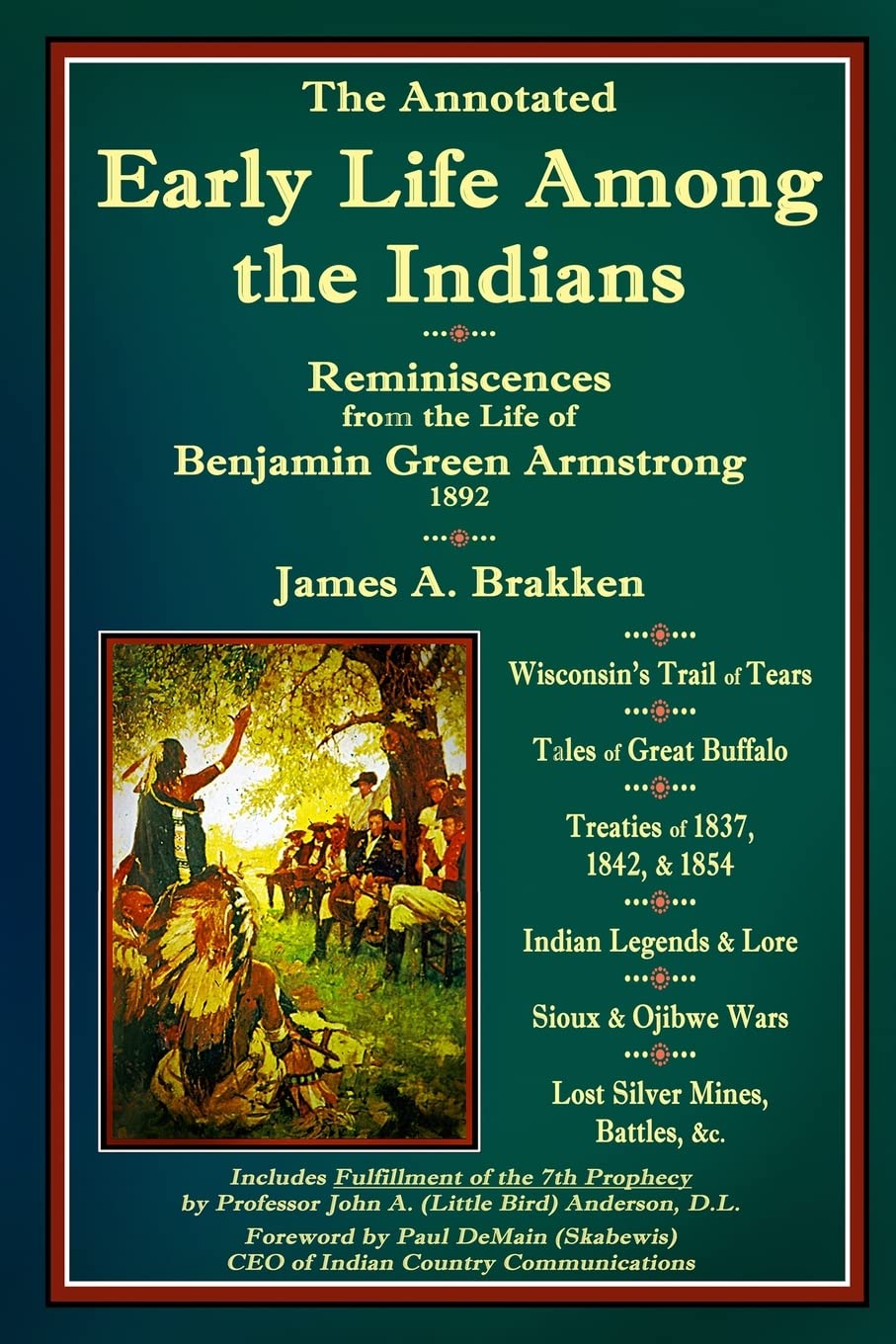
The Annotated Early Life Among the Indians by Benj Armstrong: Reminiscences from the Life of Benj. G. Armstrong 1892
$17.81
by James A. Brakken



This is the annotated 1892 memoir of Benjamin Green Armstrong, a trader, woodsman, and a man whose drive to protect his friends, the Ojibwe people, knew no bounds. His efforts to assist them included persuading the government to honor treaties granting them the right to gather fish, game, rice, and other bounty from the lands they ceded to the government in the mid-19th century. Perhaps his greatest accomplishment occurred in 1852, when he led a small contingent of Ojibwe leaders to Washington, hoping to convince President Millard Fillmore to honor past treaties. The effort was successful and avoided a war between the Lake Superior Ojibwe and the United States.But Benjamin Armstrong’s memoir is more than an account of his defense of the Ojibwe. His story encompasses more than six decades of life as a woodsman and trader working in northwestern Wisconsin, Upper Michigan, and northern Minnesota during a time when the pelts of beaver, mink, otter, and other furbearers represented the greatest economic export of a developing nation. It was also a time when the fur trade declined and industrialists’ interests shifted to timber, minerals, and the abundant lands controlled by Native Americans. This, in Benjamin Armstrong’s narrative, gives us a first-hand account of the Ojibwe people’s plight. It also offers a detailed depiction of 19th century life in the western Great Lakes states when hardworking European settlers and American businessmen descended on the north, cultures clashing and life changing forever. You'll find more about Ben Armstrong and Chief Buffalo at BadgerValley(dot)com. Award-winning author/historian James Brakken collaborated with Professor John A. (Little Bird) Anderson to bring readers this fascinating view of 19th century life among the Ojibwe people and the trappers, traders, and settlers who changed the western Great Lakes region forever. 262 pages. Illustrated. Contains basic histories of Indian wars that influenced Ojibwe life and culture. Some of James Brakken's Awards 2nd PLACE: AMAZON BREAKTHROUGH NOVEL AWARDS, out of 10,000 novels entered worldwide in 2013! 1 st PLACE: Wisconsin Writers Assn. JADE RING competition. 2015 1 st PLACE: LAKE SUPERIOR WRITERS AWARD: 2013, 2014, 2016 Critical reviews of James Brakken's 12 books and more than 140 short stories and poems: "Wonderfully written .... Compelling" "A good piece of writing with suspense and action ..." Jerry Apps, award-winning Wisconsin author "Brakken vivifies the tumultuous nature of 19th-century life in the legendary north woods." Michael Perry, NYT bestselling Wisconsin author "A fascinating tale ... "Rip-roaring action ..." "So well-written." "Difficult to put down; a great read." Publisher's Weekly Magazine "The writing style of this piece is its greatest strength." "The flow of the words is like an old fashioned song." Amazon Books "It's the dialog and characters that drive The Treasure of Namakagon, a book that, ... in the 1950s, would likely be sitting at or near the top of the best seller's lists. James Brakken is determined to make a go of this series, and ... he's made a fan of this reader." Writer's Digest Book Awards Judge "Wisconsin history buffs will find this book a treasure in itself. An exciting adventure for all ages." Waldo Asp, AARP Chairman "Open with caution. You won't want to put this one down." LaMoine MacLaughlin, President, Wisconsin Writers Assn. "I thoroughly enjoyed it!" Larry Meiller, Wisconsin Public Radio " Saving Our Lakes & Streams should be required reading for all state, county, and town officials, for those who plan a career in natural resources, and for everyone who treasures water recreation." Dan Small, Public TV's Outdoor Wisconsin "James Brakken has captured all of the current science, technology, and leadership necessary to preserve our lakes and streams." Mary Platner, Founder & Past-president of Wisconsin Lakes Bayfield County, Wisconsin author, James Brakken, began writing in college when "Muskie Madness," his story of a fishing trip with his father, appeared in Boy's Life Magazine in 1974. More articles followed in Sports Afield, Outdoor Life, Field & Stream, School Arts, and other publications.His first novel, The Treasure of Namakagon (2012), features a boy in an 1883 northern Wisconsin lumber camp and Chief Namakagon's legendary lost silver mine. The suspicious 1886 death of Namakagon and the 1846 disappearance of a Sault Ste. Marie murder fugitive led to two more novels, Tor Loken & the Death of Chief Namakagon (2013) and The Secret Life of Chief Namakagon (2014), where Brakken solved a 168-year-old cold case when he proved Chief Namakagon was actually John Falcon Tanner, the adventurer and war hero who'd vanished in 1846. Brakken's Annotated Early Life Among the Indians (2016) documents the existence of Chief Namakagon's silver mine and offers many great 1800s Lake Superior tales.Treasure won 2nd place out of 10,000 worldwide entries in the 2013