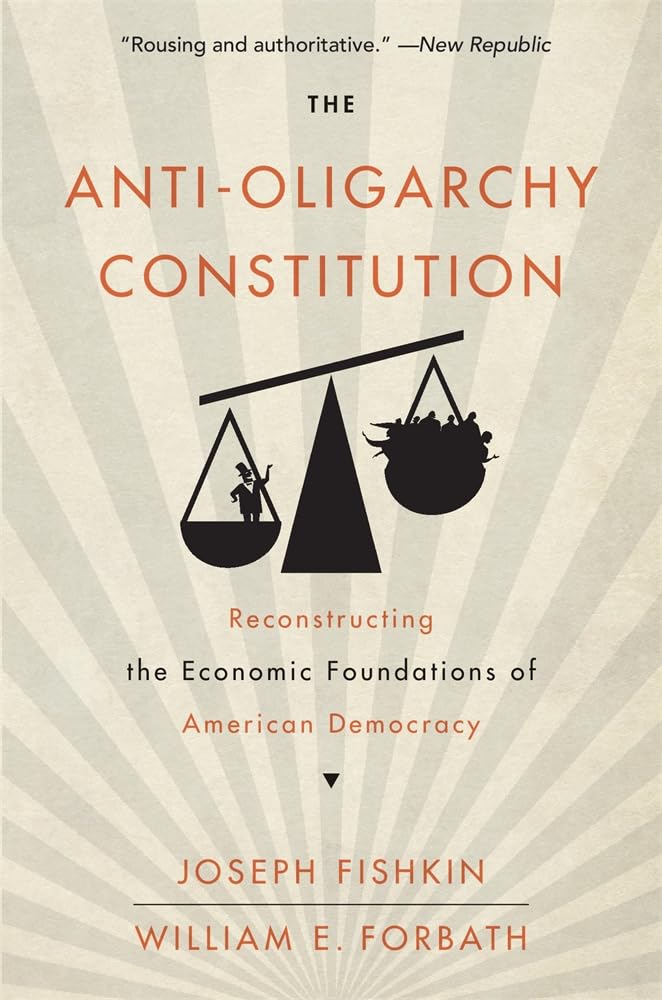
The Anti-Oligarchy Constitution: Reconstructing the Economic Foundations of American Democracy
$23.78
by Joseph Fishkin



“Eminently readable, and anybody who cares about the future of American democracy in these perilous times can only hope that it will be widely read and carefully considered.” ―James Pope, Washington Post “Fishkin and Forbath’s accessible work serves as both history lesson and political playbook, offering the Left an underutilized―and perhaps counterintuitive―tool in the present-day fight against social and economic injustice: the Constitution.” ―Benjamin Morse, Jacobin “Aims to recover the Constitution’s pivotal role in shaping claims of justice and equality…in engaging, imaginative prose that makes even the present court’s capture by the ideological right a compelling platform for a revived social-democratic constitutional politics.” ― New Republic Oligarchy is a threat to the American republic. When too much economic and political power is concentrated in too few hands, we risk losing the “republican form of government” the Constitution requires. Today, courts enforce the Constitution as if it had almost nothing to say about this threat. But as this revolutionary retelling of constitutional history shows, a commitment to prevent oligarchy once stood at the center of a robust tradition in American political and constitutional thought. Joseph Fishkin and William Forbath demonstrate that reformers, legislators, and even judges working in this “democracy-of-opportunity” tradition understood that the Constitution imposes a duty on legislatures to thwart oligarchy and promote a broad distribution of wealth and political power. These ideas led Jacksonians to fight special economic privileges for the few, Populists to try to break up monopoly power, and Progressives to battle for the constitutional right to form a union. But today, as we enter a new Gilded Age, this tradition in progressive American economic and political thought lies dormant. The Anti-Oligarchy Constitution begins the work of recovering it and exploring its profound implications for our deeply unequal society and badly damaged democracy. “Eminently readable, and anybody who cares about the future of American democracy in these perilous times can only hope that it will be widely read and carefully considered.” ― James Pope , Washington Post “Rousing and authoritative…attempt[s] to recover the Constitution’s pivotal role in shaping claims of justice and equality…Throughout this epic reconsideration of the foundational terms of our constitutional politics, Fishkin and Forbath range wide and deep across our legal, economic, and political history to deliver just this substantive view―and do so in engaging, imaginative prose that makes even the present court’s capture by the ideological right a compelling platform for a revived social-democratic constitutional politics.” ― New Republic “Over 150 years after the abolition of slavery, as the nation deals with the repercussions of a second Gilded Age and wrestles with similar questions of wealth, redistribution, equality, and democracy (all in the face of a conservative supermajority on the high court), Fishkin and Forbath’s accessible work serves as both history lesson and political playbook, offering the Left an underutilized―and perhaps counterintuitive―tool in the present-day fight against social and economic injustice: the Constitution.” ― Benjamin Morse , Jacobin “Brilliant…Challenge[s] the prestige and legitimacy that today’s liberals still largely ascribe to the Court as an institution…A sweeping and often gripping history of constitutional and political argument and engagement.” ― Caroline Fredrickson , Washington Monthly “Thoroughly and brilliantly provides the forgotten history of the positive Constitution that formed the backbone of the post–Civil War Amendments. In a magisterial study that is a must read for all students of American constitutional development…Fishkin and Forbath meticulously document how Americans, progressive Americans in particular, for almost two centuries, insisted that the Constitution of the United States mandated a political economy that generated a strong middle class with the resources necessary to prevent political domination by a small group of economic elites.” ― Mark A. Graber , Democracy “Monumental…The book’s ambitions are vast; its theoretical sophistication and attention to historical detail never fails to impress; and at 632 pages, its pace never flags. Fishkin and Forbath seek to reorient the left towards the Constitution by framing the Constitution an instrument of political economy …Readers across the political spectrum will benefit from engagement with The Anti-Oligarchy Constitution and the tradition that it recovers and enriches.” ― Evan Bernick , New Rambler “Fishkin and Forbath suggest a broad slate of reforms―encompassing labor law, antitrust, and many others―which are similar in substance to many of the ideas percolating in the progressive circles of the Democratic Party. But Fishkin and Forbath’s innovation here is