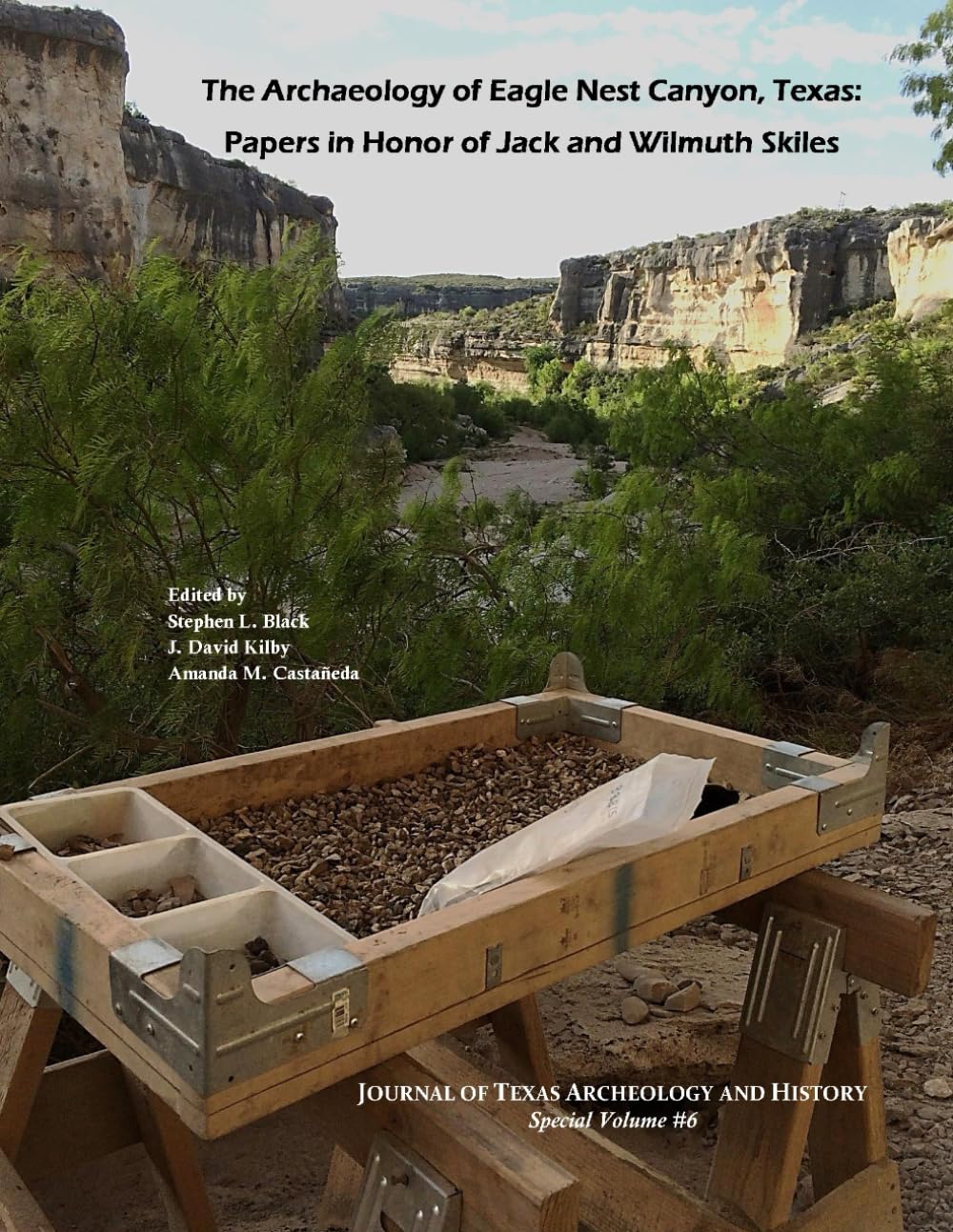
The Archaeology of Eagle Nest Canyon, Texas: Papers in Honor of Jack and Wilmuth Skiles: The Journal of Texas Archeology and History Special Volume #6
$31.35
by Dr. Stephen L. Black



The 28 research papers in Journal of Texas Archeology and History S pecial Volume #6 summarize recent archaeological investigations in Eagle Nest Canyon in the Lower Pecos Canyonlands of southwestern Texas. It honors landowners and supporters, Jack and Wilmuth Skiles, their love of the land, and its rich human history. The well-illustrated volume highlights state-of-the-art research at Eagle Cave and Bonfire Shelter, the best-known of the canyon’s well-preserved rockshelters, as well as seven other sites representing an archaeological record spanning over 13,000 years. The Eagle Nest Canyon (ENC) investigations were carried out by staff, professional collaborators, students, and volunteers under the auspices of the Ancient Southwest Texas Project (ASWT) and the Shumla Archaeological Research and Education Center, both at Texas State University (TXST). Most of the reported research was conducted during a decade-long span beginning in 2013. The volume consists of papers by the directors and professional collaborators involved in the projects, as well as papers that highlight the results of individual Master’s theses, doctoral work, and honors research carried out by students. The volume is organized into six sections. Part One introduces the research setting and the Skiles’ relationship to the canyon’s archaeology. Other papers trace the history of research and the geoarchaeological context of the ENC prehistoric record to set the scene for the remainder of the volume. Part Two contains five papers focused on the archaeology of Eagle Cave, an immense dry rockshelter containing a diverse and impressive record of prehistoric use and activity. While best known for its enormous Archaic-age earth oven facilities and rock art, ASWT encountered two previously undetected Paleoindian-age occupations. Part Three focuses on research at Bonfire Shelter. The first paper provides an overview of the extensive deposits in this deep shelter, including “bone beds” containing bison and Pleistocene megafauna, and their varying interpretations. Three papers attempt to resolve some of the ambiguity and debate concerning the bone beds using a combination of new data and analyses of previous data. Part Four presents six papers on other archaeological sites found within or overlooking ENC. Kelly Cave, Skiles Shelter, and Horse Trail Shelter are all rockshelters in the lower canyon and nearby Sayles Adobe is a deep terrace site. Langtry Rock Midden, Torres Ranch, and Lone Star Bridge are open-air sites found along the canyon rim. Part Five includes nine papers that address canyon-wide or regional aspects of the archaeological record, ranging from rock art research, to specialized studies (e.g., zooarchaeology, paleobotany, radiocarbon dating), to collections-based research spanning from early prehistoric through the historic railroad record. Part Six is a single paper that reflects on the results of ASWT work in ENC and gives an overview of data collection protocols and the amassed samples, along with an invitation for future collaborative research based on these samples. The papers were collected, organized, and edited by three veterans of the ASWT Eagle Nest Canyon Project. Dr. Steve Black, Research Professor at TXST, directed ASWT from 2010-2019. Black’s research focuses on hunter-gatherers, and hot rock cooking. Dr. David Kilby, TXST Professor of Anthropology, became a co-Director of ASWT in 2018 and took over as Director in 2020. Kilby’s research focuses primarily on the earliest hunter-gatherers of western North America. Amanda Castañeda is a professional archaeologist who has worked in Texas, Wyoming, New Mexico, Colorado, Utah, and Montana. Her research interests include rock imagery and ground stone technology. She is the Assistant Director of the Center for Big Bend Studies at Sul Ross State University. Available online at www.JTAH.org.