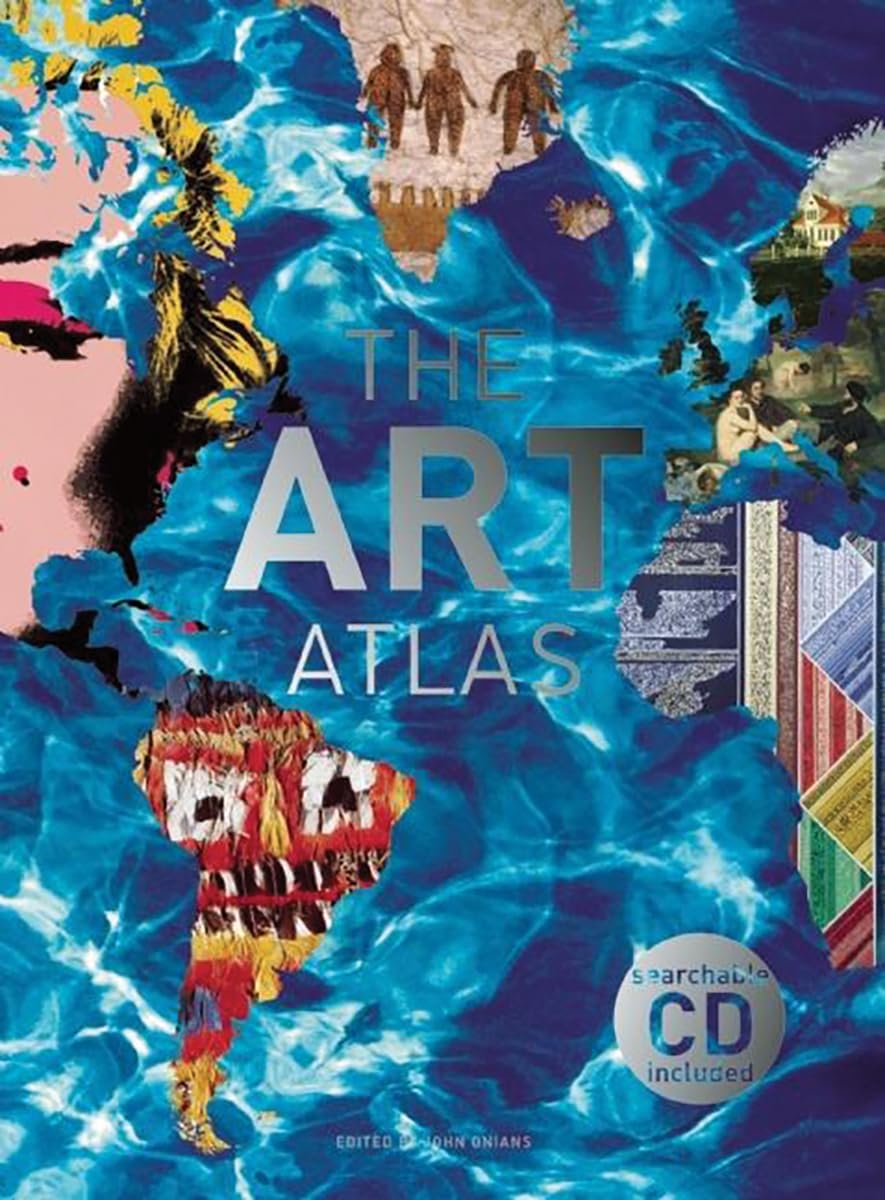



An invaluable guide to world art from prehistory to the present, complete with over 600 maps and illustrations and a searchable CD. The Art Atlas is the first work to present the art of the entire world from ancient to modern times through extensive use of specially commissioned maps. Covering painting, sculpture, and architecture as well as other arts and artifacts, the volume provides an entirely new vision of the history of the world’s art by showing how physical and political geography has shaped its developments. Over 350 pages in scope, Atlas compares countries separated by thousands of miles and many centuries, demonstrating how the art of each is affected by opportunities and constraints dictated by location or culture. Here, for the first time, readers can appreciate the art of prehistoric Oceania and the Nile Valley of the Pharaohs alongside that of nineteenth-century Russia and the twentieth-century United States. In addition to showing where and when great artists lived and worked, Atlas explains how major styles developed and the ways in which art has been influenced by religion, trade, travel, war, and other historical factors. The volume also provides the first comprehensive picture of the impact of the natural world on the development of art, charting the sources of fibers for weaving, pigments for coloring, wood for carving, paper for printing, and stone for use in sculpture and architecture. With its combination of enormous breadth and constant clarity of focus, abundant illustrations and a user-friendly, searchable CD, Art Atlas provides exceptional insight into what unites art and what makes it so varied. Organized into seven chronological periods and including contributions from 68 internationally renowned art historians, The Art Atlas is an original, comprehensive and up-to-date reference work that will be a benchmark for many years to come. "Through the innovative use of maps, The Art Atlas clearly illustrates that, at bottom, art is and always has been a global affair. Explores the relationship between art and local geography/culture in an excitingly new way. A must for every art classroom and library, a host of scholars make this a fine text for either art or social study class. Excellent reproductions; highly recommended. ***** " ― Art Times "Highly recommended. All libraries; all levels. " ― Choice "The searchable CD offers additional access beyond the already detailed index." ― Library Journal John Onians is Professor of Visual Arts at the School of World Art Studies and Museology at the University of East Anglia. He is the author of Art and Thought in the Hellenistic Age: The Greek World View, 350-50 BC (1979), Bearers of Meaning: The Classical Orders in Antiquity, the Middle Ages and the Renaissance (1988) and editor of Sight and Insight: Essays on Art and Culture in Honour of E. H. Gombrich at 85 (1994). He was also the founding editor of the prestigious journal Art History . Excerpt from The Art Atlas PART VII Art, Ideas and Technology 1900-2000 Art has always been connected to the worlds of ideas and technology, but in the twentieth century the connections tightened. Indeed for many the idea’ has been that twentieth century art should directly reflect technology, and this notion lay behind American skyscrapers, Italian Futurism, Russian Constructivism and the International Modernist architecture of the Bauhaus and Le Corbusier before the Second World War, and Jean Tinguely's motorized sculptures, Nam Jun Paik’s video installations and Tony Oursler’s projections after it. One reason why this convergence occurred was because, thanks to new technologies, ideas could be disseminated much quicker and more effectively than before. Another was that some of these technologies, such as those of the cinema, television and computer screen, are themselves visual. Of the many other ideas that affected twentieth century art, none were more recurrent than those of nationalism and internationalism. The search for visual expressions of national or regional identity, which has roots in tendencies humans share with other animals and has long been important in culture, strengthened in the nineteenth century before further intensifying in the twentieth. For many communities, as in the countries of eastern Europe that acquired independence after 1918, the starting point was a new awareness of vernacular and folk traditions, but in Fascist Italy and National Socialist Germany new political and moral ideologies were also involved. Outside Europe, on the other hand, where the suppression of local artistic traditions had been part of the policy both of colonial powers and of the classes that succeeded them, aesthetic and political ideologies were more likely to be combined in some revival of local cultural traditions, as in the Mexican revival of Aztec and the Indian revival of Hindu imagery. In such movements are was an important way for a people to s