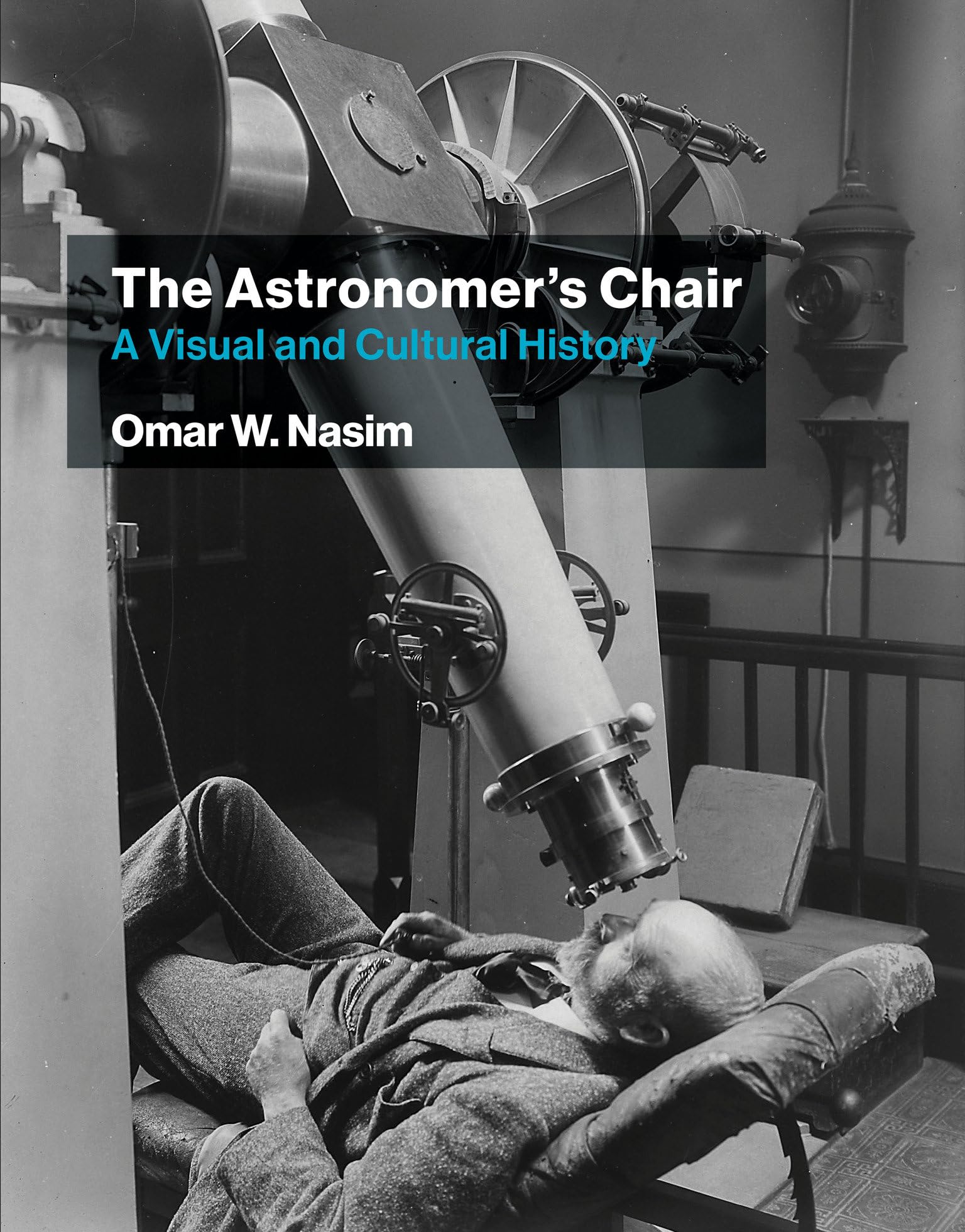



The astronomer’s observing chair as both image and object, and the story it tells about a particular kind of science and a particular view of history. The astronomer’s chair is a leitmotif in the history of astronomy, appearing in hundreds of drawings, prints, and photographs from a variety of sources. Nineteenth-century stargazers in particular seemed eager to display their observing chairs—task-specific, often mechanically adjustable observatory furniture designed for use in conjunction with telescopes. But what message did they mean to send with these images? In The Astronomer’s Chair , Omar W. Nasim considers these specialized chairs as both image and object, offering an original framework for linking visual and material cultures. Observing chairs, Nasim ingeniously argues, showcased and embodied forms of scientific labor, personae, and bodily practice that appealed to bourgeois sensibilities. Viewing image and object as connected parts of moral, epistemic, and visual economies of empire, Nasim shows that nineteenth-century science was represented in terms of comfort and energy, and that “manly” postures of Western astronomers at work in specialized chairs were contrasted pointedly with images of “effete” and cross-legged “Oriental” astronomers. Extending his historical analysis into the twentieth century, Nasim reexamines what he argues to be a famous descendant of the astronomer’s chair: Freud’s psychoanalytic couch, which directed observations not outward toward the stars but inward toward the stratified universe of the psyche. But whether in conjunction with the mind or the heavens, the observing chair was a point of entry designed for specialists that also portrayed widely held assumptions about who merited epistemic access to these realms in the first place. With more than 100 illustrations, many in color; flexibound. “An excellent example of the kinds of insights that can result from an interdisciplinary cultural history and illustrates how looking at mundane objects can reveal illuminating entanglements between science and society more broadly.” — H-Net Humanities " The Astronomer’s Chair is an inspiring study, and, indeed, a cultural history, which directs attention to the dense net of far-reaching interdependences and relations that surrounds even the most mundane objects of science.” —Journal for the History of Astronomy “Written with passion and curiosity... Starting from the analysis of an ordinary object, it well describes how much scientists are influenced by their social and cultural context.” —Isis “In addition to the beautiful illustrations and rich examples, what captivates is the elegance with which Nasim narrates a cultural history of an object that seems simple at first glance.” — The British Journal for the History of Science “[ The Astronomer's Chair ] encourages us all to consider new technologies and material objects as visual apparatus.” —Visual Studies “Brilliantly unpacks multiple layers of cultural, symbolic, and epistemic meanings of a seemingly trivial and ancillary piece of scientific apparatus. By doing so, it provides an inspiring and thought-provoking read to all those engaged with the visual and material culture of science and willing to approach it from innovative angles.” — Nuncius “Drawing on rich, compelling sources, The Astronomer’s Chair is an original, provocative, and fascinating work.” — David Kaiser, Germeshausen Professor of the History of Science, MIT “This creatively illustrated study by an eminent historian uses a seemingly mundane theme, depictions of astronomers’ seating, to reveal with startling insight and expert craft the complex cultures of comfort, attention, and discipline that governed nineteenth-century stargazing.” — Simon Schaffer, Professor of History of Science, University of Cambridge “ The Astronomer’s Chair takes us on an interdisciplinary journey through the history of science, design, imperialism, and material culture. With this book, Omar Nasim models thrilling new directions in intellectual inquiry.” — Aviva Briefel, Edward Little Professor of the English Language and Literature and Cinema Studies, Bowdoin College “A fascinating book that underscores how, in visual culture, it’s often pictures of those who explore science that best communicates the nature of their work.” — Marvin Heiferman, curator and author of Seeing Science: How Photography Reveals the Universe Omar W. Nasim is Professor for the History of Science at the Institute of Philosophy at the University of Regensburg, Germany. He is the author of Observing by Hand: Sketching the Nebulae in the Nineteenth Century , winner of the History of Science Society’s Pfizer Award for 2016.