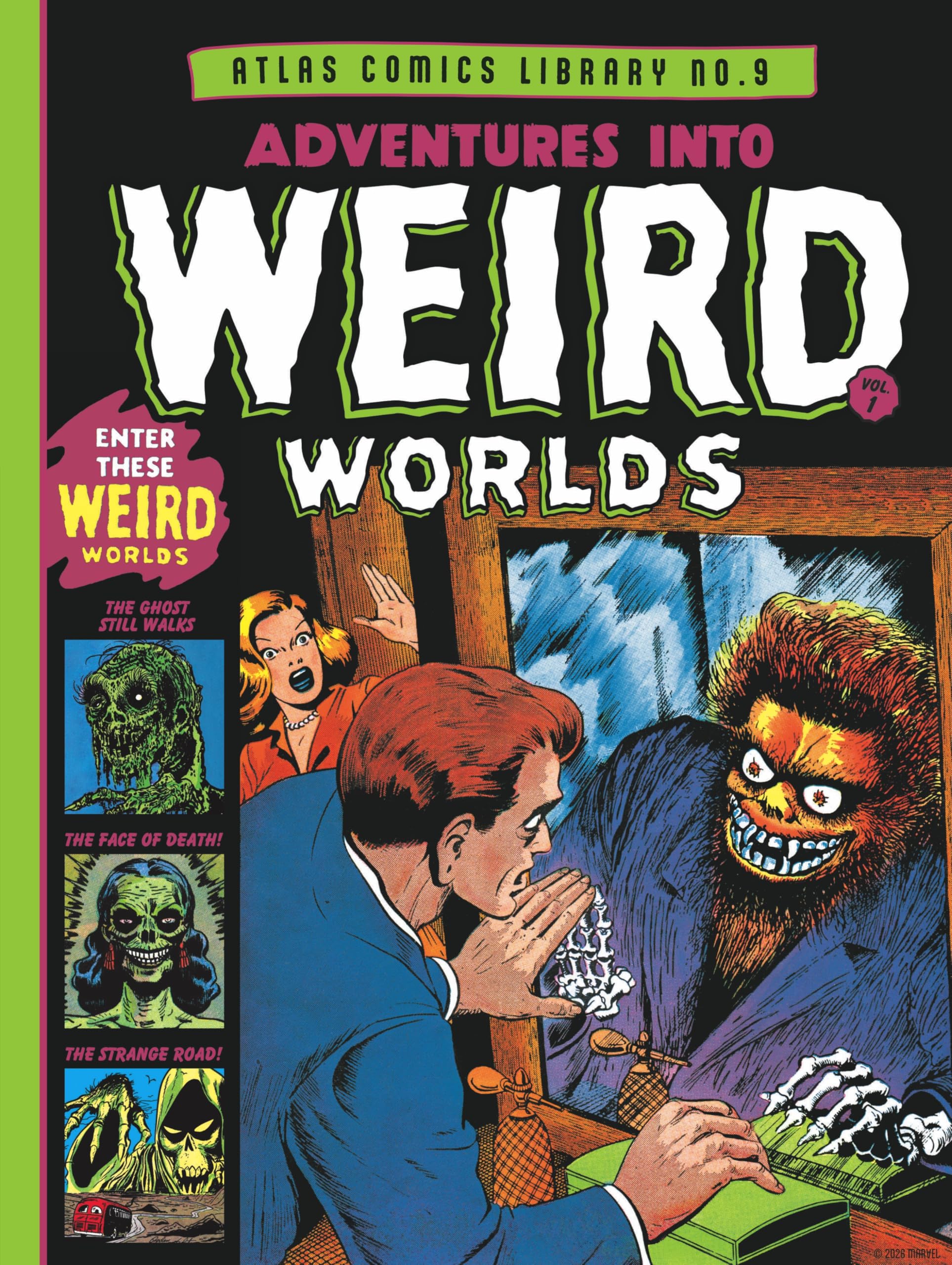
The Atlas Comics Library No. 9: Adventures Into Weird Worlds Vol. 1 (The Fantagraphics Atlas Comics Library)
$44.99
by Russ Heath



With Fantagraphics’ latest Atlas Comics Library collection, Adventures into Weird Worlds is an exploration of four-color, pre-Code depravity unseen since the early 1950s. In the unrestrained days before the Comics Code Authority censored the industry, these stories drawn by the cream of the Atlas crop ― Russ Heath, Bill Everett, Joe Maneely, Carmine Infantino, Mort Meskin, George Tuska, Bob Fujitani, Joe Sinnott, and Bernard Krigstein ― chilled readers to the bone: Irradiated, postapocalyptic monsters become “The Walking Death!” A frantic, tiny voice calls out from “The Thing in the Bottle”! Humanity faces intergalactic doomsday “When a World Goes Mad!” A cemetery robber tells how “I Crawl Through Graves”! Satan himself unveils “The Pit of Horror,” as only Bill Everett could envision it! This is the first of three volumes that will re-present this classic Atlas horror series in its entirety. Adventures don’t get any weirder! Full-color illustrations throughout Russell Heath Jr. (1926–2018) was an American artist best known for his comic book work, particularly his DC Comics war stories and his 1960s art for Playboy magazine's "Little Annie Fanny" feature. Heath was inducted into the Will Eisner Comic Book Hall of Fame in 2009. Bernard (B.) Krigstein (1919–1990) was trained as a classical painter, but early on he recognized the artistic potential of the comics medium. He worked for major publishers including Harvey, Fawcett, Atlas (Marvel) and National (DC), in 1952 he moved to EC Comics, where his work is widely recognized as among the most innovative in comics history. Bill Everett (1917-1973) was the foundational artist of Marvel Comics. He originated Namor, the Sub-Mariner as a freelance creation, before placing it in Marvel Comics #1 , the first publication from Timely Comics, later Atlas, then Marvel. Everett wrote and drew the early appearances of the character from 1940-42, and would periodically return to him during the post-war ‘40s, right up until the early 1970s. During Atlas’ heyday, Everett worked extensively on horror anthology shorts, including taking over the romance/fantasy series Venus and converting it to straight horror. After Marvel’s wholesale move to a superhero universe, Everett co-created the blind hero Daredevil with editor/scripter Stan Lee. Joe Maneely (1926–1958) blazed a trail through Marvel’s 1950s comic books that is unsurpassed in both quantity and quality. Maneely was revered as a lightning-fast talent, and he launched most of Marvel’s character features during that time, excelling at every genre ― westerns, horror, humor, and war. He is best remembered today for his signature character, The Black Knight. Maneely’s career was tragically cut short in June 1958 when, at the age of 32, he accidentally fell between the cars of a moving commuter train. Carmine Infantino (1925-2013), primarily known as a Silver Age DC artist and editor, first approached Timely while still a teenager in 1940, with his friend Frank Giacoia. He drew Young Allies, Human Torch, and Angel stories for Timely and Airboy stories for Hillman Periodicals. His first published work for DC introduced Black Canary and later he penciled the 1956 revival of the Flash. Infantino became DC's editorial director in 1967 and ultimately its president before returning to freelancing in 1976. Among his many honors, he was inducted into the Will Eisner Hall of Fame in 2000.