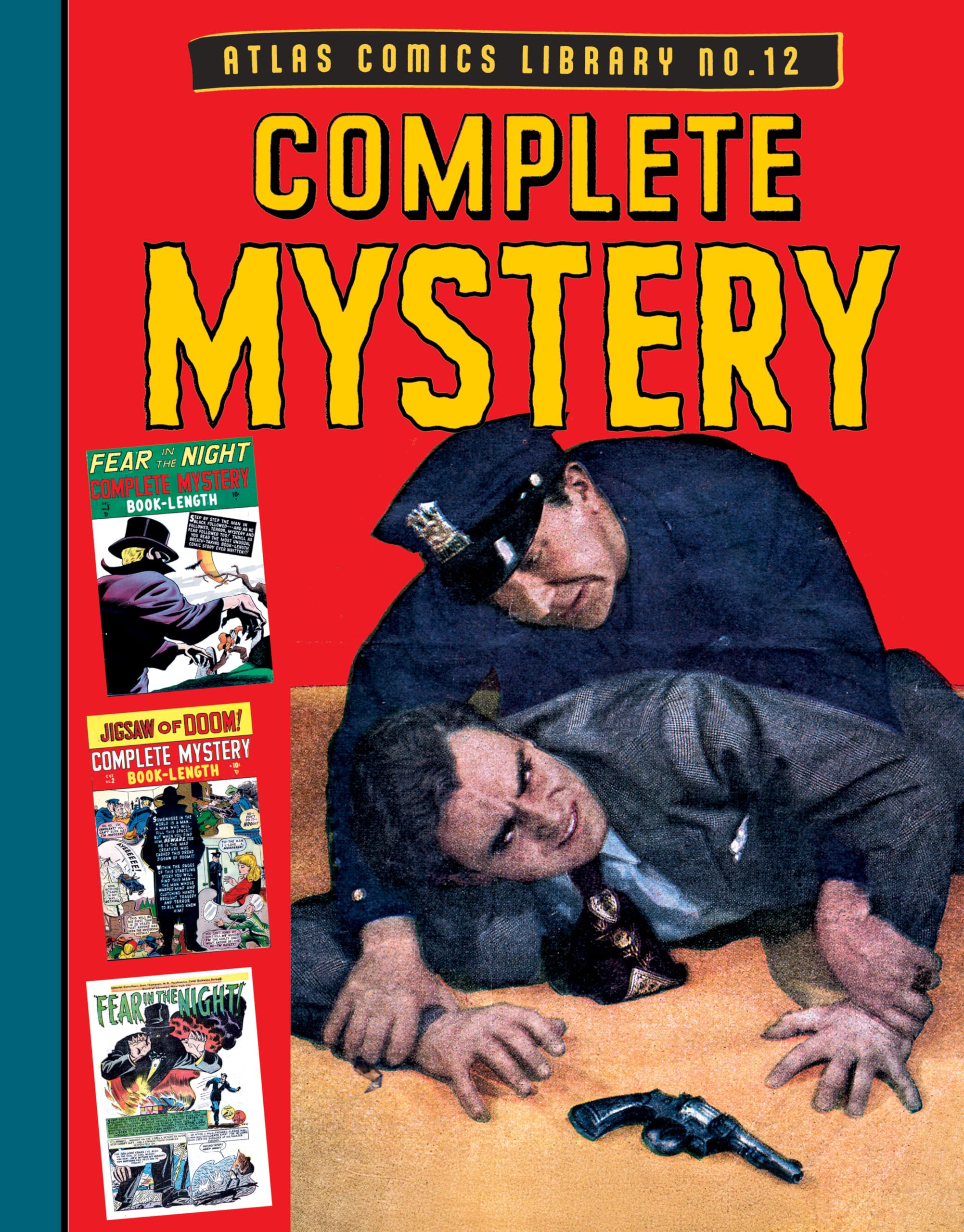
The Atlas Comics Library No. 12: Complete Mystery (The Fantagraphics Atlas Comics Library)
$44.99
by Carlos Burgos



The tense, urban tales of Complete Mystery collected in this Atlas Library volume were among the first shots fired in what would become a veritable Timely/Atlas crime wave. The year 1948 saw the debut of a long-form, film-noir-influenced “crime novella” comics format titled Complete Mystery featuring Marvel's top artists: Gene Colan, Syd Shores, and Carl Burgos (with three stories written by editor Stan Lee). In “Seven Dead Men!” greedy mobsters and a beautiful girl lust after a quarter of a million dollars. “Fate’s Fearful Jigsaw!” weaves a tale of murder and mystery, likely instigated by the contemporary accounts of the deaths of the famed NYC recluses, the Collyer brothers. “Fear in the Night!” has murder manifest under the big top, and a squealer causes gangland terror in “Squealers Die Fast!” Changing to a multi-story structure, True Complete Mystery became a showcase for the earliest work by future Marvel Comics star John Buscema, who penciled four stories and a cover in the remaining four issues: “Rico Mancini – The Deadly Dude!” “Murder Will Out!” “The Frame-Up that Failed!” and the frantic “Triangle of Terror!” The final three issues sported crime-themed photo covers, a popular novelty across numerous Timely crime, romance and western titles of the period. With an historical introduction by Atlas expert Dr. Michael J. Vassallo. Full color illustrations throughout Carl Burgos (1916-1984) After a brief period at the Harry Chesler studio in the late 1930s, the writer/artist joined the Funnies Inc. shop, which provided Timely with its first comic-book material. In Marvel Comics #1 , in 1939, Burgos introduced the world to the Human Torch. He also drew the Torch for Atlas during the character’s brief revival in the 1950s. He continued to work at Atlas, and later Marvel, until the mid-1960s. He was inducted into the Harvey Awards’ Jack Kirby Hall of Fame in 1996 and the Will Eisner Hall of Fame in 2016. Stan Lee (1922-2018) was an American comic book writer, editor, publisher and producer for Timely/Marvel Comics and was the co-creator of many of the Marvel Comics iconic heroes, including Spider-Man, the Incredible Hulk, Iron Man, the Fantastic Four, the Avengers, Daredevil, Thor, Doctor Strange, Nick Fury, and the X-Men. Eugene Jules Colan (1926-2011) illustrated many war comics for both Timely/Atlas and DC Comics. He flourished after Atlas became Marvel, with notable stints plotting and drawing on Daredevil and Captain America in the 1960s, before co-authoring Howard The Duck with Steve Gerber and Tomb of Dracula with Marv Wolfman. Syd Shores (1913-1973) was best known to Silver Age fans as a regular inker on Marvel titles, but he was also a Golden Age penciler who drew Marvel’s earliest superheroes. He began as an assistant to Mac Raboy in the Harry Chesler shop and drew his first story for Marvel/Timely’s Mystic Comics #5 in 1941. He was initially an inker on Captain America Comics but took over as penciler when Jack Kirby and Joe Simon left in 1942. He was a co-creator of Blonde Phantom. Shores drew a range of titles through the 1950s and 1960s, and his inking, whether for himself or other pencilers, had a gritty quality that also lent itself to Westerns ( Red Wolf, Two-Gun Kid ), war comics ( Battle ) and horror stories ( Tower of Shadows ). He was inducted into the Joe Sinnott Hall of Fame in 2023. John Buscema (1927 - 2002) was an American comic book artist and one of the mainstays of Marvel Comics during its 1960s and 1970s ascendancy into an industry leader and its subsequent expansion to a major pop-culture conglomerate.