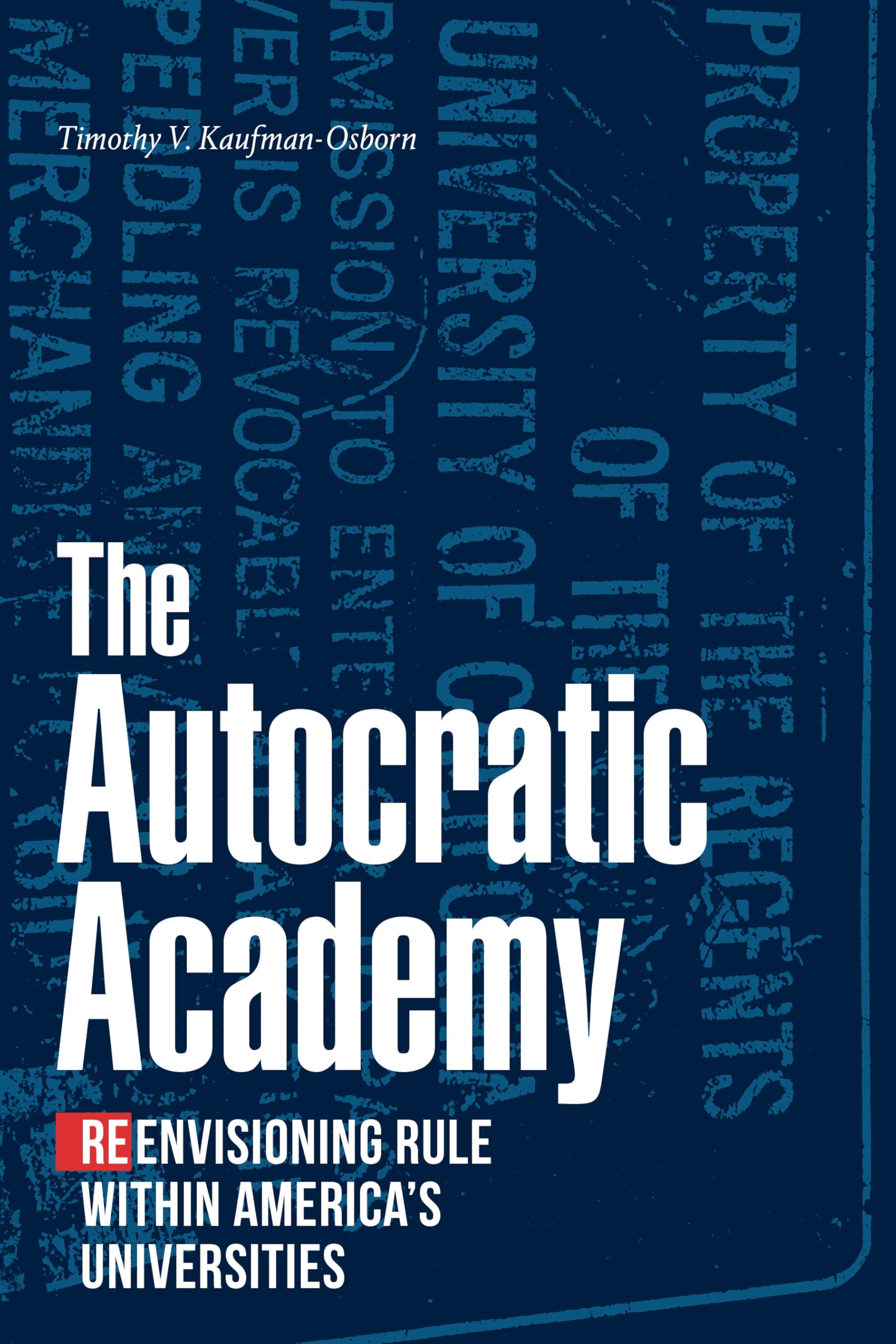
The Autocratic Academy: Reenvisioning Rule within America's Universities
$24.07
by Timothy V. Kaufman-Osborn



Critics of contemporary US higher education often point to the academy’s “corporatization” as one of its defining maladies. However, in The Autocratic Academy Timothy V. Kaufman-Osborn argues that American colleges and universities have always been organized as corporations in which the power to rule is legally vested in and monopolized by antidemocratic governing boards. This institutional form, Kaufman-Osborn contends, is antithetical to the free inquiry that defines the purpose of higher education. Tracing the history of the American academy from the founding of Harvard (1636), through the Supreme Court’s Dartmouth v. Woodward ruling (1819), and into the twenty-first century, Kaufman-Osborn shows how the university’s autocratic legal constitution is now yoked to its representation on the model of private property. Explaining why appeals to the cause of shared governance cannot succeed in wresting power from the academy’s autocrats, Kaufman-Osborn argues that American universities must now be reincorporated in accordance with the principles of democratic republicanism. Only then can the academy’s members hold accountable those chosen to govern and collectively determine the disposition of higher education’s unique public goods. "The book is extraordinarily important at precisely this moment when we need to think seriously about how dangerous our institutions’ bylaws are and how devastating it is that we never found a way to give shared governance doctrinal heft or to enshrine faculty control over curricula into law. The path to Commonwealth University—the name Kaufman-Osborn gives to his imaginary member-incorporated institution of higher education—is murky, but we can and should start to renegotiate our governance rules."― Jennifer Ruth , Academe " The Autocratic Academy does not just critique the present condition of higher education in the United States; through its stories of resistance and its vision of an alternative, it gives readers something else to want. These glimpses of flourishing show us what the health of the body politic might look like. We can begin our convalescence now."― Joel Alden Schlosser , American Political Thought “The strength of Kaufman-Osborn’s book is its ability to demonstrate that the authoritarian corporate structure is only one way to legally incorporate an academic institution. . . . This is a compelling book and one that is more necessary now than ever before.”― Isaac Kamola , Political Science & Politics "Timothy Kaufman-Osborn outlines with great lucidity what’s lacking from today’s repetitive critiques of the 'corporatized' university."― Adam Sitze , Cultural Critique “Through an erudite history of corporations and American higher education, Timothy V. Kaufman-Osborn pillories the notion that corporatization rather than autocratic rule is responsible for wrecking universities and especially shared governance. This learned, thoughtful, and provocative analysis will be useful to faculty everywhere concerned with what the powers governing higher education have become, and might be.” -- Wendy Brown, Institute for Advanced Study Timothy V. Kaufman-Osborn is Baker Ferguson Professor of Politics and Leadership Emeritus at Whitman College and author of From Noose to Needle: Capital Punishment and the Late Liberal State and Creatures of Prometheus: Gender and the Politics of Technology .