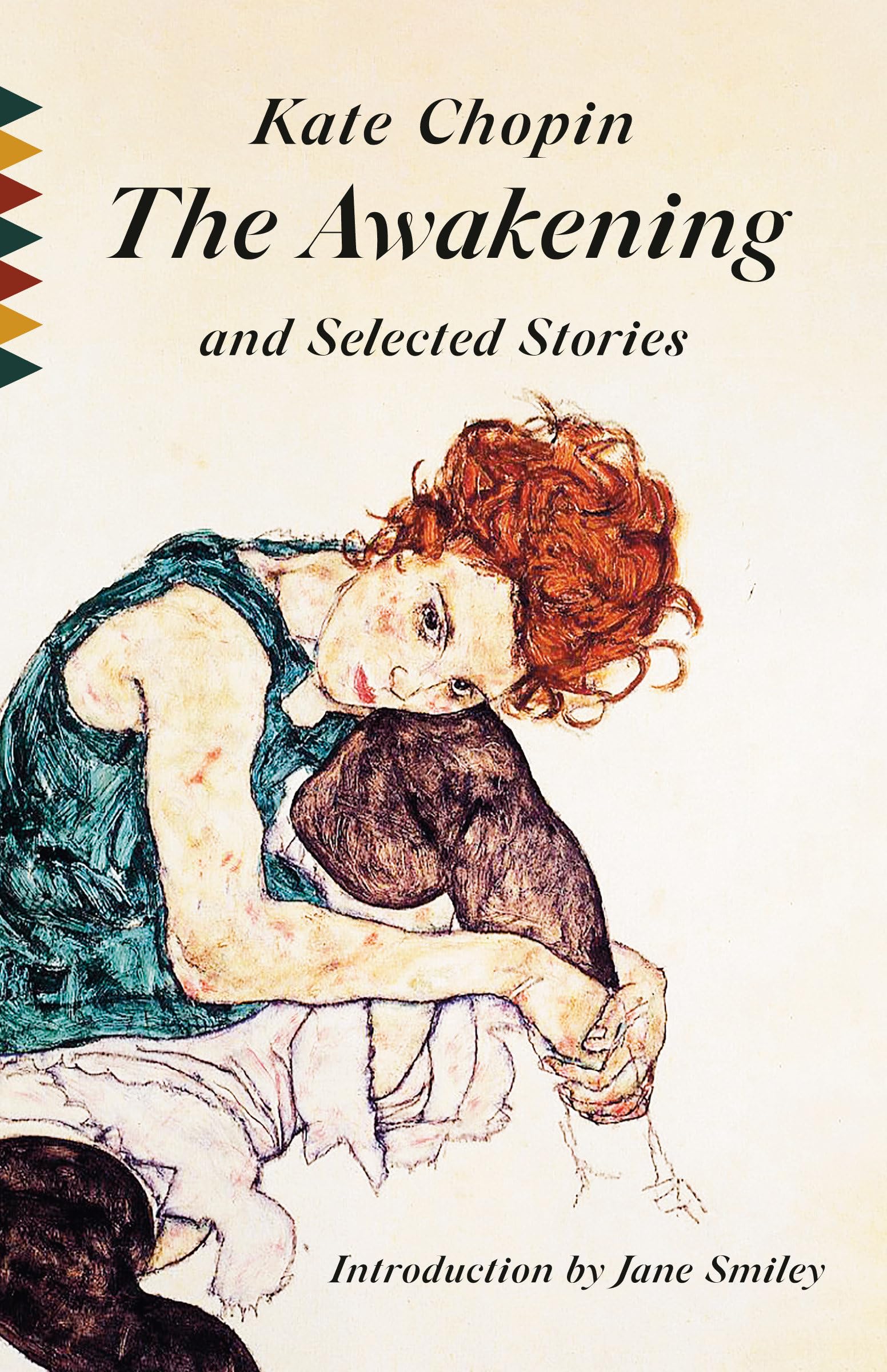



A feminist literary landmark: the daring story of a woman's search for personal freedom that was so controversial in 1899 that it ended its author's career. With an effortless, sure-handed artistry, Kate Chopin tells the story of Edna Pontellier, a young mother and model wife, whose romantic involvement with a young man at a seaside resort allows her for the first time to imagine a freer life. Upon her return to New Orleans, Edna leaves her husband’s home for her own cottage, pursues her artistic ambitions, and begins an affair, only to discover that the constraints of social custom are more powerful than she had thought. Contemporary readers were shocked by the frank, unapologetic treatment of adultery in The Awakening , but over the ensuing century the novel went on to achieve the status of a classic for its visionary prescience and narrative brilliance. "A Creole Bovary is this little novel of Miss Chopin's." --Willa Cather KATE CHOPIN (1851-1904) brought out her first novel, At Fault , at her own expense in 1890. It was followed by two well-reviewed collections of her short stories: Bayou Folk in 1894 and A Night in Acadie in 1897. The Awakening appeared in 1899 to an explosion of disapproving reviews and the cancellation of her next book contract. However, within a decade of her early death at the age of fifty-four, her literary genius began to be widely recognized. ABOUT THE INTRODUCER: JANE SMILEY is the author of numerous novels, including A Thousand Acres, which was awarded the Pulitzer Prize, and the Last Hundred Years Trilogy: Some Luck, Early Warning, and Golden Age. H er most recent novels are Perestroika in Paris and A Dangerous Business . A member of the American Academy of Arts and Letters, she has also received the PEN Center USA Lifetime Achievement Award for Literature. from the Introduction by Jane Smiley When I first read The Awakening , in my thirties, I didn’t know a thing about Kate Chopin, but her novel spoke to me because she delves so precisely into the mind of her protagonist, Edna Pontellier. Edna has thoughts and feelings that I considered to be normal for married women of her age—a withdrawal from her “duties,” a retreat into her inner life, and an urge to discover more about the world, both her social world and the natural world. I had a little trouble with a writing style that I considered archaic, but at the same time, I was putting together a novel that made use of a very archaic style ( The Greenlanders ), and so I appreciated what readers learn about the characters of a novel by uncovering the details of that style. It wasn’t until I read The Awakening again, in my fifties, that I got to know about the history of the novel and learned what a scandal its publication had caused. Not only did I still appreciate it, I appreciated it even more because an honest and explorative novelist is likely to cause a scandal at some point—novelists are literary explorers who use stories to uncover the secrets of human nature and display them. You don’t have to be the Marquis de Sade or Émile Zola to cause a scandal—in 1899, when The Awakening was published, you could do it by giving a wife and a mother a growing sense of independence and then honestly portraying the despair that her choices present to her. Kate Chopin grew up in Saint Louis, Missouri, and was living in Saint Louis when she wrote The Awakening , at around the same time that the Saint Louis suburb that I grew up in was being established. It doesn’t surprise me that Chopin turned out to be an independent-minded novelist and short story writer. Saint Louis has a way of infusing its children with a sense of curiosity and ambition, maybe because Saint Louisans have always known that you could get out of town—by steamboat, by airplane, or by Route 66 (Chuck Berry made sure we would never forget this). She was born Katherine O’Flaherty in 1851 in Saint Louis, and she understood from the beginning that her Irish and French inheritance set her apart from the American culture into which she was born. She was educated intermittently at a local Catholic school and was an avid reader in both English and French. Her father died in a bizarre railroad accident when she was only five—the state was celebrating a new bridge across the Missouri River, and various prominent figures were invited to take part in the first trip. The bridge collapsed. Kate’s mother, grandmother, and great-grandmother devoted themselves to educating her, and in doing so, they gave her a strong sense of how independent, thoughtful, and self-supporting women could be. She also made a lifelong friend, Kitty Garesché, with whom she rode ponies, ice-skated, and climbed trees. Like Kate’s female relatives, Kitty was passionate about music, art, and gossiping—the perfect friend for a future novelist. The Civil War, in Saint Louis, was a perfect example of the complicated history of Saint Louis, a home for both avid abolitio