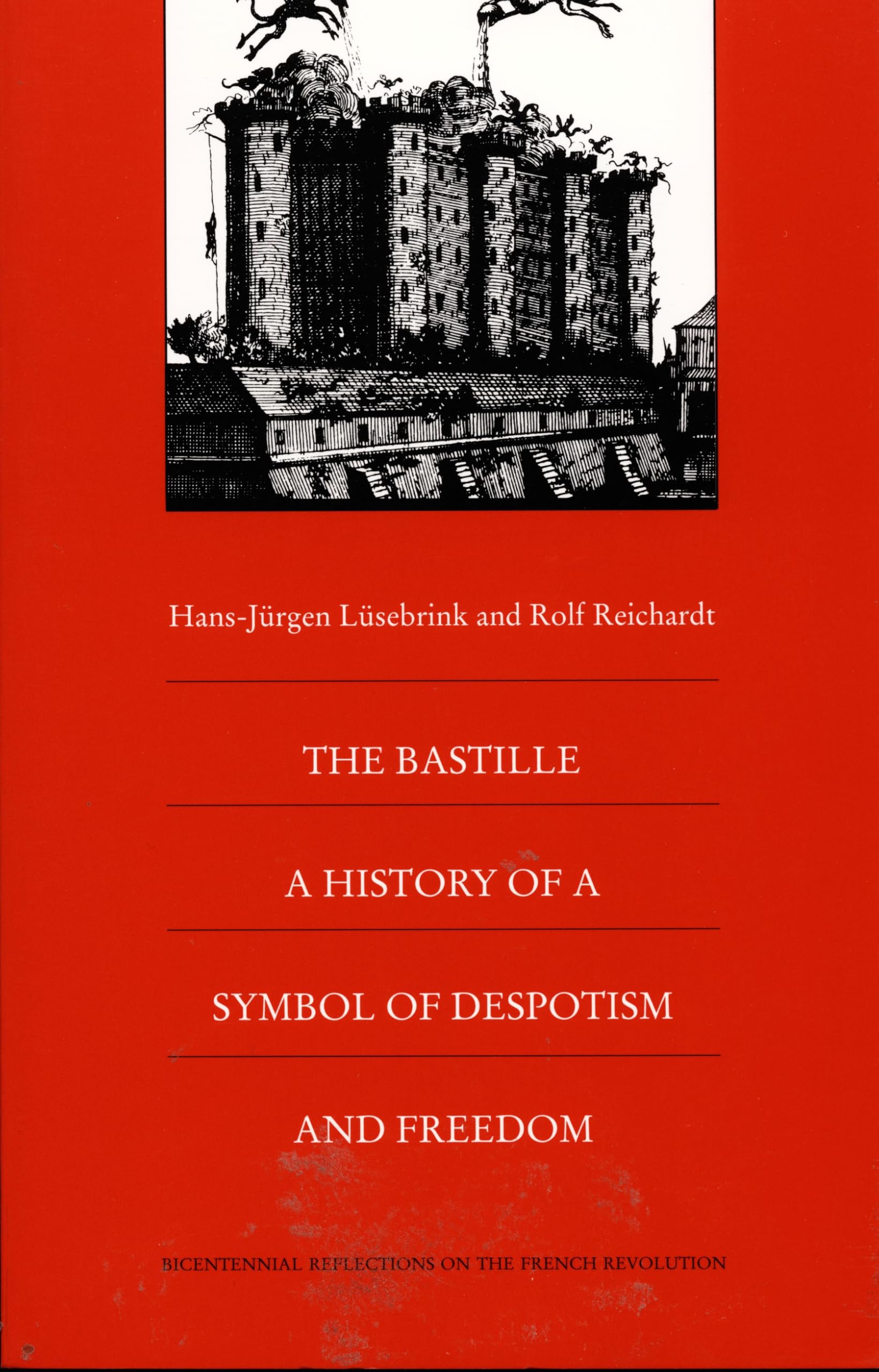
The Bastille: A History of a Symbol of Despotism and Freedom (Bicentennial Reflections on the French Revolution)
$16.98
by Hans-Jurgen Lusebrink



This book is both an analysis of the Bastille as cultural paradigm and a case study on the history of French political culture. It examines in particular the storming and subsequent fall of the Bastille in Paris on July 14, 1789 and how it came to represent the cornerstone of the French Revolution, becoming a symbol of the repression of the Old Regime. Lüsebrink and Reichardt use this semiotic reading of the Bastille to reveal how historical symbols are generated; what these symbols’ functions are in the collective memory of societies; and how they are used by social, political, and ideological groups. To facilitate the symbolic nature of the investigation, this analysis of the evolving signification of the Bastille moves from the French Revolution to the nineteenth century to contemporary history. The narrative also shifts from France to other cultural arenas, like the modern European colonial sphere, where the overthrow of the Bastille acquired radical new signification in the decolonization period of the 1940s and 1950s. The Bastille demonstrates the potency of the interdisciplinary historical research that has characterized the end of this century, combining quantitative and qualitative approaches, and taking its methodological tools from history, sociology, linguistics, and cultural and literary studies. "[F]resh and new. Lusebrink and Reichardt have produced a fascinating book about the images and representations of the Bastille that have accrued for three centuries. . . . This book cleverly combines innumerable telling anecdotes with a serious historical argument, replete with a quantitative analysis of texts. . . . [T]his wonderful book shows us a French Revolution teeming with life, with heroism, and not least, with absurdity." --Journal of Interdisciplinary History "This fascinating book, originally published in German at the turn of the decade, offers a rare view in English of the historical riches which have recently materialized "outre-Rhin,"" --Malcolm Crook," French History" This book is both an analysis of the Bastille as cultural paradigm and a case study on the history of French political culture. It examines in particular the storming and subsequent fall of the Bastille in Paris on July 14, 1789, and how it came to represent the cornerstone of the French Revolution, becoming a symbol of the repression of the Old Regime. Hans-Jürgen Lüsebrink is chair of French Cultural Studies and Intercultural Communication at the Universität des Saarlandes, Germany. Rolf Reichardt is head of the scholarly reference department, Universität Mainz, Germany. The Bastille A History of a Symbol of Despotism and Freedom By Hans-Jürgen Lüsebrink, Rolf Reichardt, Norbert Schürer Duke University Press Copyright © 1997 Duke University Press All rights reserved. ISBN: 978-0-8223-1894-1 Contents EDITORS' INTRODUCTION, PREFACE, TRANSLATOR'S NOTE, INTRODUCTION, 1. GENESIS OF A POLITICAL SYMBOL: THE BASTILLE, 1715–1789, 2. THE STORMING OF THE BASTILLE: THE HISTORICAL EVENT AS COLLECTIVE SYMBOLIC ACTION, 3. REVOLUTIONARY SYMBOLISM UNDER THE SIGN OF THE BASTILLE, 1789–1799: A PRIME EXAMPLE OF THE SELF-MYSTIFICATION OF THE FRENCH REVOLUTION, 4. BASTILLE SYMBOLISM IN MODERN FRANCE: THE REPUBLICAN LEGACY OF THE FRENCH REVOLUTION, FINAL REMARKS: ON THE ORIGIN AND FUNCTION OF A HISTORICAL SYMBOL, APPENDIX: REPORTS ON THE STORMING OF THE BASTILLE, 1789, NOTES, Introduction, 1. Genesis of a Political Symbol, 2. The Storming of the Bastille, 3. Revolutionary Symbolism Under the Sign of the Bastille, 4. Bastille Symbolism in Modern France, Final Remarks, WORKS CITED AND FURTHER REFERENCES, Primary Sources, Secondary Works, CHAPTER 1 GENESIS OF A POLITICAL SYMBOL: The Bastille, 1715–1789 Anti-Bastille Journalism: Scandalous Stories of Prisoners ORIGINALLY, "BASTILLES" WAS NOTHING MORE THAN A technical term for the municipal peel towers of the late Middle Ages built during the Hundred Years' War in Southern France. In the singular, the term also described the royal fortress with eight towers built between 1356 and 1382 at the gate to the Northwestern part of Paris, the later Faubourg Saint-Antoine. In the end, the use of the word was restricted to this edifice alone. The technical term-turned-proper name only started attaining a figurative meaning, and thus the character of a symbol, as the Bastille was increasingly refashioned from a fortress protecting Paris into a state prison. This remodeling had already begun during the reign of Louis XI (1461–83), but it occurred primarily during the time of Cardinal Richelieu. Finally, under the personal rule of the Sun King, not only rebellious aristocrats and spies but also loyal subjects were imprisoned in the Bastille if they had, like the superintendant of finance Fouquet, provoked the king or had, like many Protestants, refused to swear to the exclusive legitimacy of the Catholic religion. Because it was centrally located, beyo