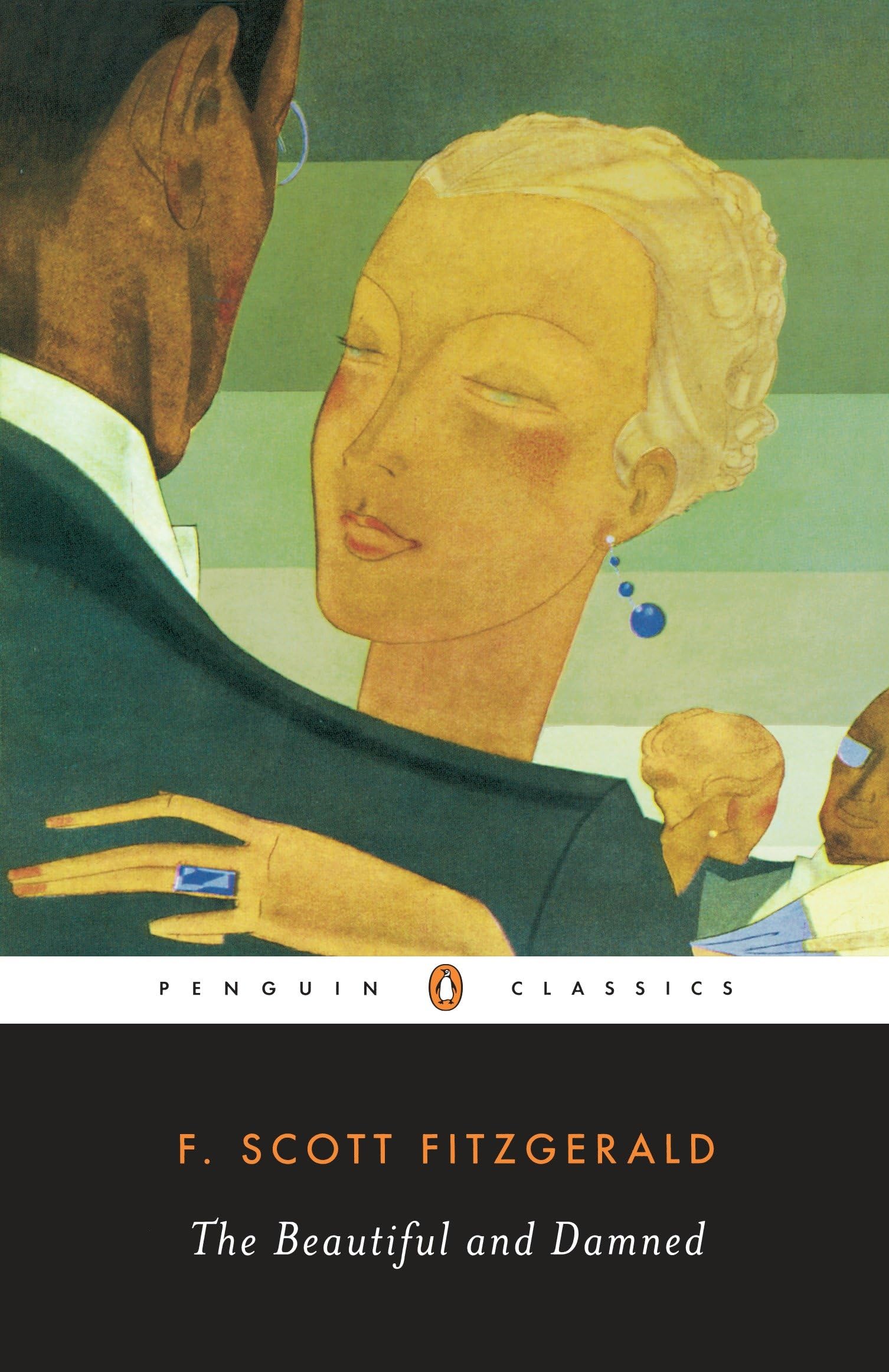
The Beautiful and Damned (Penguin Twentieth-Century Classics)
$14.00
by F. Scott Fitzgerald



"We know the old adage about judging books by their covers, but how could you not when the covers are as lovely as these?" — Vogue (U.K.) The jacket design by Coralie Bickford-Smith reflects the elegance and glamour of the Art Deco period paired with the modern aesthetic of mechanical repetition. Each jacket comes with a detachable bookmark. Anthony and Gloria are the essence of Jazz Age glamour. A brilliant and magnetic couple, they fling themselves at life with an energy that is thrilling. New York is a playground where they dance and drink for days on end. Their marriage is a passionate theatrical performance; they are young, rich, alive and lovely and they intend to inherit the earth. But as money becomes tight, their marriage becomes impossible. And with their inheritance still distant, Anthony and Gloria must grow up and face reality; they may be beautiful but they are also damned. Much of Scott's work is going public domain, and reprints are coming fast and furious. Besides "Diamond," this contains other gems, e.g., "The Ice Palace" and "Bernice Bobs Her Hair." Penguin has also released an $8.95 edition of The Beautiful and the Damned (ISBN 0-14-118087-0). Copyright 1998 Reed Business Information, Inc. “Full of precisely observed life.” — Arthur Mizener F. Scott Fitzgerald was born in 1896 in St Paul, Minnesota, and went to Princeton University which he left in 1917 to join the army. Fitzgerald was said to have epitomised the Jazz Age, an age inhabited by a generation he defined as ‘grown up to find all Gods dead, all wars fought, all faiths in man shaken’. In 1920 he married Zelda Sayre. Their destructive relationship and her subsequent mental breakdowns became a major influence on his writing. Among his publications were five novels, This Side of Paradise , The Great Gatsby , The Beautiful and the Damned , Tender is the Night and The Love of the Last Tycoon (his last and unfinished work): six volumes of short stories and The Crack-Up , a selection of autobiographical pieces. Fitzgerald died suddenly in 1940. After his death The New York Times said of him that ‘He was better than he knew, for in fact and in the literary sense he invented a “generation” … he might have interpreted them and even guided them, as in their middle years they saw a different and nobler freedom threatened with destruction.’ CHAPTER I Anthony Patch In 1913, when Anthony Patch was twenty-five, two years were already gone since irony, the Holy Ghost of this later day, had, theoretically at least, descended upon him. Irony was the final polish of the shoe, the ultimate dab of the clothes-brush, a sort of intellectual “There!”—yet at the brink of this story he has as yet gone no further than the conscious stage. As you first see him he wonders frequently whether he is not without honor and slightly mad, a shameful and obscene thinness glistening on the surface of the world like oil on a clean pond, these occasions being varied, of course, with those in which he thinks himself rather an exceptional young man, thoroughly sophisticated, well adjusted to his environment, and somewhat more significant than any one else he knows. This was his healthy state and it made him cheerful, pleasant, and very attractive to intelligent men and to all women. In this state he considered that he would one day accomplish some quiet subtle thing that the elect would deem worthy and, passing on, would join the dimmer stars in a nebulous, indeterminate heaven half-way between death and immortality. Until the time came for this effort he would be Anthony Patch—not a portrait of a man but a distinct and dynamic personality, opinionated, contemptuous, functioning from within outward—a man who was aware that there could be no honor and yet had honor, who knew the sophistry of courage and yet was brave. a worthy man and his gifted son Anthony drew as much consciousness of social security from being the grandson of Adam J. Patch as he would have had from tracing his line over the sea to the crusaders. This is inevitable; Virginians and Bostonians to the contrary notwithstanding, an aristocracy founded sheerly on money postulates wealth in the particular. Now Adam J. Patch, more familiarly known as “Cross Patch,” left his father’s farm in Tarrytown early in sixty-one to join a New York cavalry regiment. He came home from the war a major, charged into Wall Street, and amid much fuss, fume, applause, and ill will he gathered to himself some seventy-five million dollars. This occupied his energies until he was fifty-seven years old. It was then that he determined, after a severe attack of sclerosis, to consecrate the remainder of his life to the moral regeneration of the world. He became a reformer among reformers. Emulating the magnificent efforts of Anthony Comstock, after whom his grandson was named, he levelled a varied assortment of uppercuts and body-blows at liquor, literature, vice, art, patent medicines, and Sunday theatres. His mind