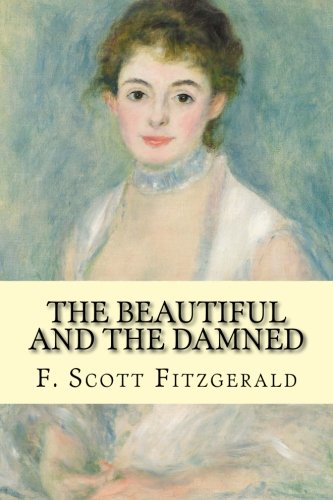



The Beautiful and Damned, first published by Scribner's in 1922, is F. Scott Fitzgerald's second novel. It portrays the Eastern elite during the Jazz Age, exploring New York café society. As in Fitzgerald's other novels, the characters are complex, especially with respect to marriage and intimacy. The book is believed to be largely based on Fitzgerald's relationship with Zelda Fitzgerald. The Beautiful and Damned tells the story of Anthony Patch, a 1910s socialite and presumptive heir to a tycoon's fortune, and his courtship and relationship with his wife Gloria Gilbert. It describes his brief service in the Army during World War I, and the couple's post-war partying life in New York, and his later alcoholism. Gloria and Anthony’s love story is much more than just a couple falling in love. Their story deals with the hardships of a relationship, especially when each character has a tendency to be selfish. Joanna Stolarek suggests, Fitzgerald draws on “Zelda, the object of the writer’s literary passion” (Stolarek et al. 53). Toward the end of the novel, Fitzgerald sums up the plot and his intentions in writing it somewhat, even referencing his own first novel, when a financially successful writer friend tells Anthony: "You know these new novels make me tired. My God! Everywhere I go some silly girl asks me if I've read 'This Side of Paradise'. Are our girls really like that? If it's true to life, which I don't believe, the next generation is going to the dogs. I'm sick of all this shoddy realism. I think there's a place for the romanticist in literature." The Beautiful and Damned is, at once, a morality tale, a meditation on love, money and decadence, and a social documentary. It concerns the characters' disproportionate appreciation of and focus on their past, which tends to consume them in the present. The theme of absorption in the past also continues through much of Fitzgerald's later works, perhaps best summed up in the final line of his 1925 novel, The Great Gatsby: "So we beat on, boats against the current, borne back ceaselessly into the past", which is now also inscribed on Fitzgerald's tombstone shared with Zelda in Maryland. According to Fitzgerald critic James West, The Beautiful and Damned is concerned with the question of 'vocation'—what does one do with oneself when one has nothing to do? Fitzgerald presents Gloria as a woman whose vocation is nothing more than to catch a husband. After her marriage to Anthony, Gloria's sole vocation is to slide into indolence; her husband's sole vocation is to wait for his inheritance, during which time he slides into alcoholism.