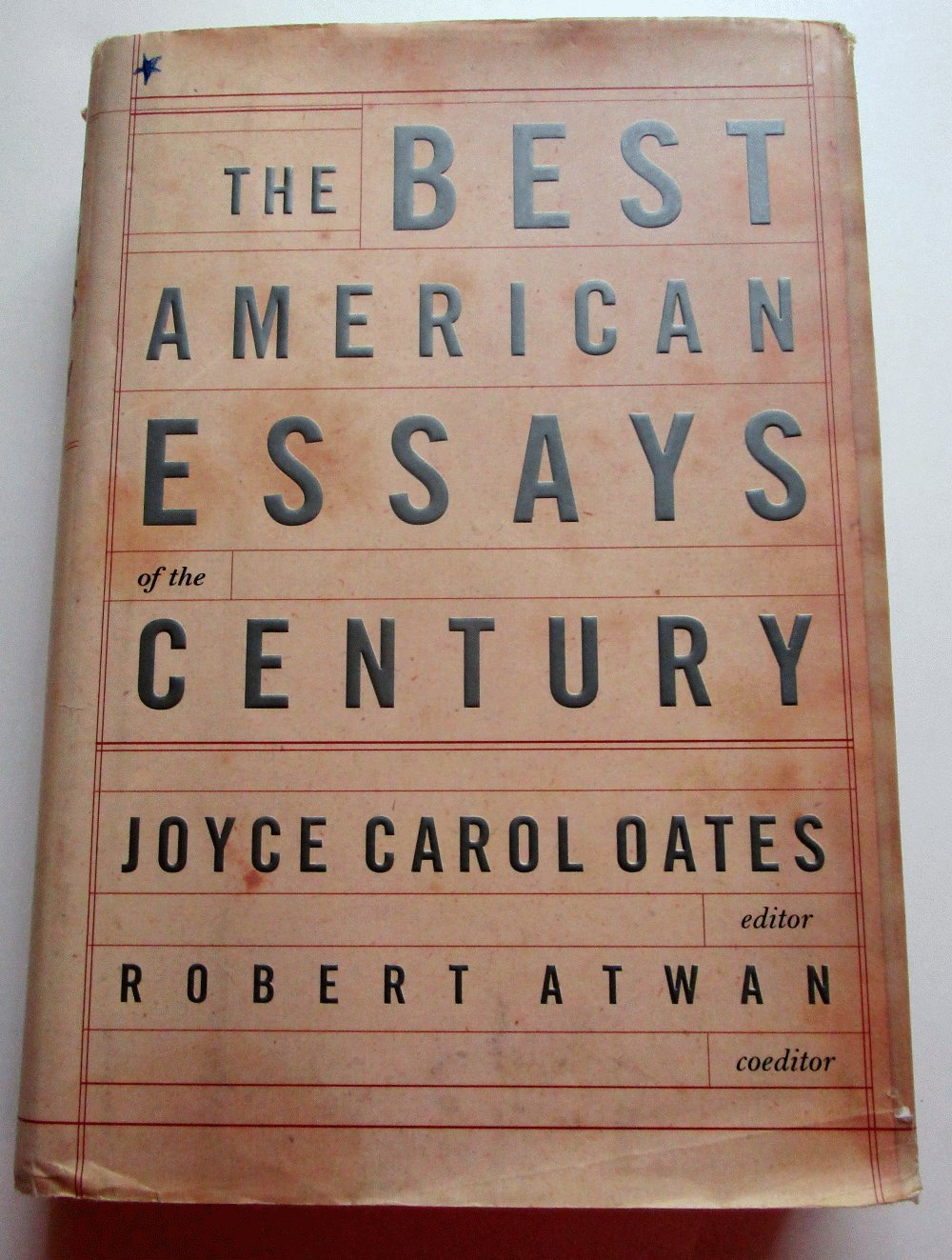



Selected by acclaimed author Joyce Carol Oates, a remarkable anthology of fifty-five outstanding essays on a variety of topics features contributions by F. Scott Fitzgerald, W. E. B. DuBois, James Baldwin, Eudora Welty, Stephen Jay Gould, John Updike, Saul Bellow, Joan Didion, Alice Walker, Maya Angelou, John McPhee, Rachel Carson, and other notable twentieth-century literary masters. The title The Best American Essays of the Century seems transparent enough, but don't be deceived. What Joyce Carol Oates has assembled is not so much a diverse collection as a sonorous march through what keeps getting called the American century. Read this not as a collection to dip into but as a history--a history of race in America. Oates says it best herself in her introduction: "It can't be an accident that essays in this volume by men and women of ethnic minority backgrounds are outstanding; to paraphrase Melville, to write a 'mighty' work of prose you must have a 'mighty' theme." The mighty pens at work here belong to, among others, Zora Neale Hurston ("How It Feels to Be Colored Me"), Langston Hughes ("Bop"), and James Baldwin ("Notes of a Native Son"). Oates has opted not for the most unexpected but for the most important and stirring essays of our time. Other chords sound repeatedly as well: the problem of our relationship with nature (Annie Dillard, John Muir, and Gretel Ehrlich); the difficulty of identity in disrupted times (F. Scott Fitzgerald, Joan Didion, and Michael Herr). In her essay "The White Album," Didion famously declares: "We tell ourselves stories in order to live." The stories Oates has collected are not easy. Here is the hard-won truth, from writers unwilling to forgive even themselves. Even Martin Luther King Jr. doesn't let himself off the hook, as he writes in his "Letter from Birmingham Jail": "If I have said anything in this letter that is an overstatement of the truth and is indicative of an unreasonable impatience, I beg you to forgive me. If I have said anything in this letter that is an understatement of the truth and is indicative of my having a patience that makes me patient with anything less than brotherhood, I beg God to forgive me." --Claire Dederer One of the pleasures of an anthology like this is reading people you might not otherwise have picked up. Like John Muir, whose "Stickeen," a life-and-death adventure on an Alaskan glacier with a singular small black dog, is a great piece of adventure writing. Or Jane Addams, whose insights into the spread of an urban legend of "The Devil Baby at Hull House" are thoughtful and compassionate. Another sort of pleasure comes from rereading familiar works in a new context: E.B. White's "Once More to the Lake," N. Scott Momaday's "The Way to Rainy Mountain," John McPhee's "The Search for Marvin Gardens," and Annie Dillard's "Total Eclipse." Only seven of the essays come from the annual "Best American Essays" series that Atwan has coedited since 1986. The other 48 were culled from the rest of the century, with the ruling idea, Atwan says, "that the essays should speak to the present, not merely represent the past." Oates looked "for the expression of personal experience within the historical." They have created a mosaic of a century in an America whose dominant and recurring theme has been race. Essential for most libraries.DMary Paumier Jones, Westminster P.L., CO Copyright 2000 Reed Business Information, Inc. As Oates observes in her rousing introduction to this powerful collection (a companion volume to the short story compendium edited by John Updike in 1999), the essay's great strength comes from its leap from the specific to the universal and from the magnetism and distinction of the writer's voice. The 55 essays showcased here do, as promised, exemplify the form. Virtuosic performances by writers passionate in their quest for understanding, and electrifying in their eloquence and perception, these are works of wit, discovery, anger, and praise. Oates took pains to select essays that contemplate diverse worlds, from nature to courtrooms, war and family memories. Race is a pervasive theme, explored with candor and insight by many, including James Baldwin, Zora Neale Hurston, and, in a jolting 1912 condemnation of a Coatesville, Pennsylvania, lynching, John Jay Chapman. Complex and vital issues and states of mind are also crystallized by H. L. Mencken, Rachel Carson, Joan Didion, Michael Herr, Maxine Hong Kingston, and Richard Rodriguez. Donna Seaman Copyright © American Library Association. All rights reserved ". . . Oates has assembled a provocative collection of masterpieces ..." -- Publishers Weekly, Starred ". . . Oates has assembled a provocative collection of masterpieces reflecting both the fragmentation and surprising cohesiveness of various American identities." -- Review JOYCE CAROL OATES -- novelist, essayist, critic, poet, playwright, teacher, and short story writer -- is one of the preeminent literary figures and s