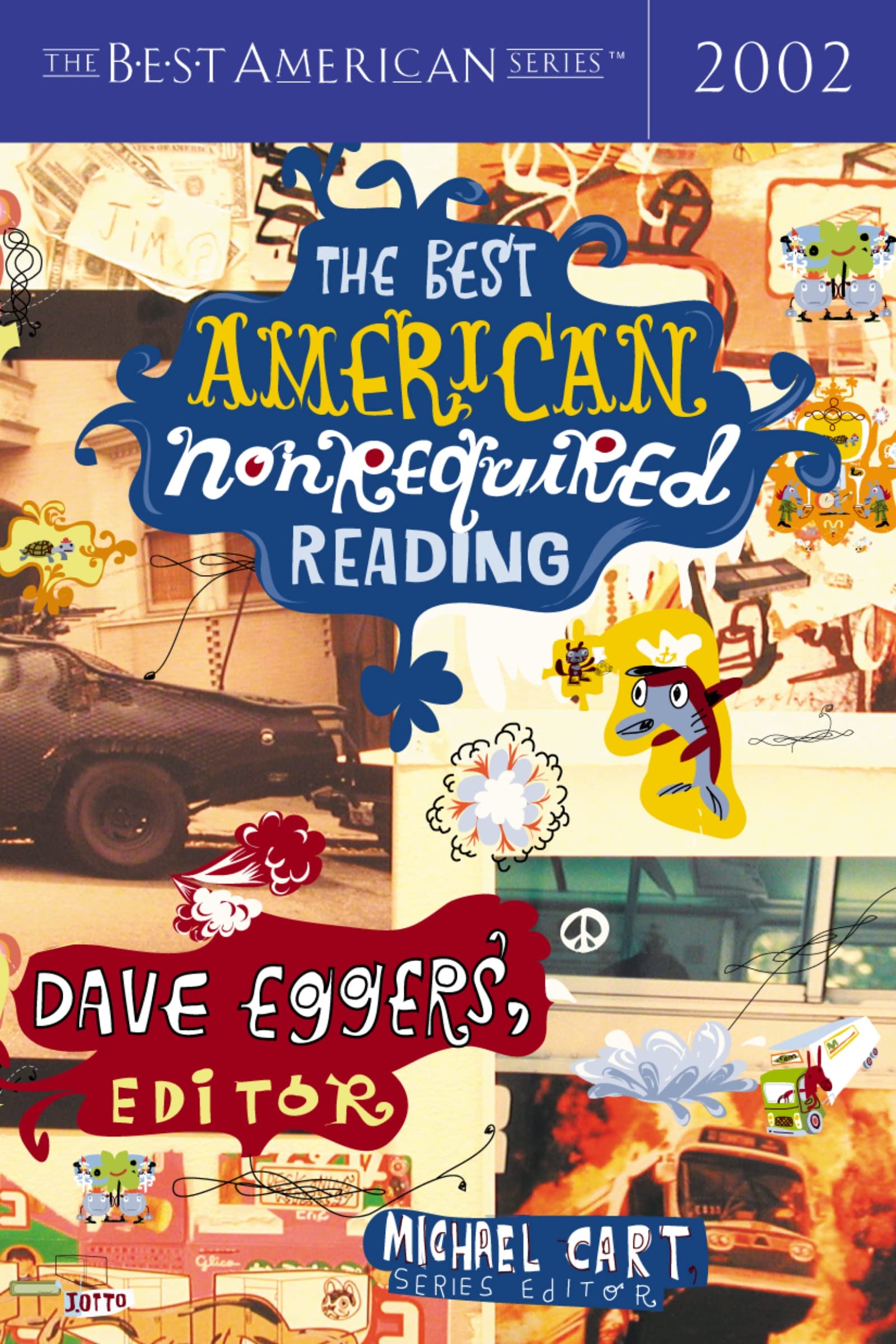
The Best American Nonrequired Reading 2002 (The Best American Series)
$14.36
by Michael Cart



Since its inception in 1915, the Best American series has become the premier annual showcase for the country's finest short fiction and nonfiction. For each volume, a series editor reads pieces from hundreds of periodicals, then selects between fifty and a hundred outstanding works. That selection is pared down to the twenty or so very best pieces by a guest editor who is widely recognized as a leading writer in his or her field. This unique system has helped make the Best American series the most respected -- and most popular -- of its kind. The Best American Nonrequired Reading 2002 is a selection for young people of the best literature from mainstream and alternative American periodicals: from the New Yorker, Jane, Rolling Stone, Zyzzyva, Vibe, The Onion, Spin, Epoch, Time, Little Engines, Modern Humorist, Esquire, and more. Dave Eggers has chosen the highlights of 2001 for this genre-busting collection that includes new fiction, essays, satire, journalism -- and much more. From Eric Schlosser on french fries to Elizabeth McKenzie on awful family to Seaton Smith on how to "jive" with your teen, The Best American Nonrequried Reading 2002 is the first and the best. Nonrequired? That means your college professor didn't put it on the reading list. Houghton addresses its newest "best of" series to the under-25 crowd, who buy more books than anyone else and should enjoy this blend of fiction and nonfiction from some truly cool zines. Copyright 2002 Reed Business Information, Inc. "[T]he most grown-up young adult fiction excerpts ever compiled." --Allegra Muzzillo, Black Book "If only this book were mandatory in schools!" --Seventeen "...[A]n impressive job of collecting..." --Rob Walker The Wall Street Journal DAVE EGGERS is the editor of McSweeney’s and a cofounder of 826 National, a network of nonprofit writing and tutoring centers for youth, located in seven cities across the United States. He is the author of four books, including What Is the What and How We Are Hungry . foreword The word reading: by itself, it describes one of the most pleasurable, stimulating, rewarding, exciting, even joyful acts we human beings are capable of. Yet put one single adjective required in front of it and you suck all the joy out of the process, turning it into drudgery. That’s the reason that reading has always been too closely linked with schoolwork and the other stuff that life requires. In fact, in a recent national survey of people under twenty-five, conducted by SmartGirl.com and the American Library Association, more than 80 percent of respondents said the books they read are assigned for class.” That’s the bad news. The good news is that 65 percent also said that outside of class” they read books for pleasure.” Even more read magazines, newspapers, comics, graphic novels, and Web zines and a host of other on-line publications. Not only are they reading more than ever, the under-twenty-five population is now, according to the Wall Street Journal, actually buying books for leisure reading at three times the rate of the overall market.” Oh, sure, this book-buying is partly because of the fact that young people have more disposable income than ever before teenagers spent an average of $104 a week in 2001, according to Teenage Research Unlimited but it’s also because of the fact that more good stuff is available now than ever before. I mean, there is more reading material, regardless of format, that addresses with authentic wit, lively style, unsparing realism, and urgent relevance the real interests and real lives of real readers. Sometimes this material is pulled from the headlines, but more often it is ripped from the heart of matters that have to do with the emotional, developmental, intellectual, and yes, even survival, skills of fifteen- to twenty- five-year-olds. This was not always the case. Not long ago, publishers were publishing young adult literature,” an unfortunate phrase that always made the work sound like adult literature in training wheels. Even worse, in the 1930s and early 1940s there was a category patronizingly called the junior novel.” For too many years this literature” for young adults bore about as much resemblance to reality as the Cleaver family. Part of this may have been the result of a collective exercise in wishful thinking, and of an adult desire to protect” young readers from the grittier realities of life. No wonder that Chris Lynch, one of the most important younger writers for these readers (Gold Dust, Dog Eat Dog, Slot Machine), observed as recently as 1994 that when writers hear the term Young Adult, they get the feeling the the gloves are on.’” The gloves finally came off sometime in the middle of the 1990s, and writers were at last permitted to match the sophistication of their readers with the sophistication of their material and their creative ambition. Or, to put it another way, writers were at last allowed to respect their readers, their readers’ abilities and inherent