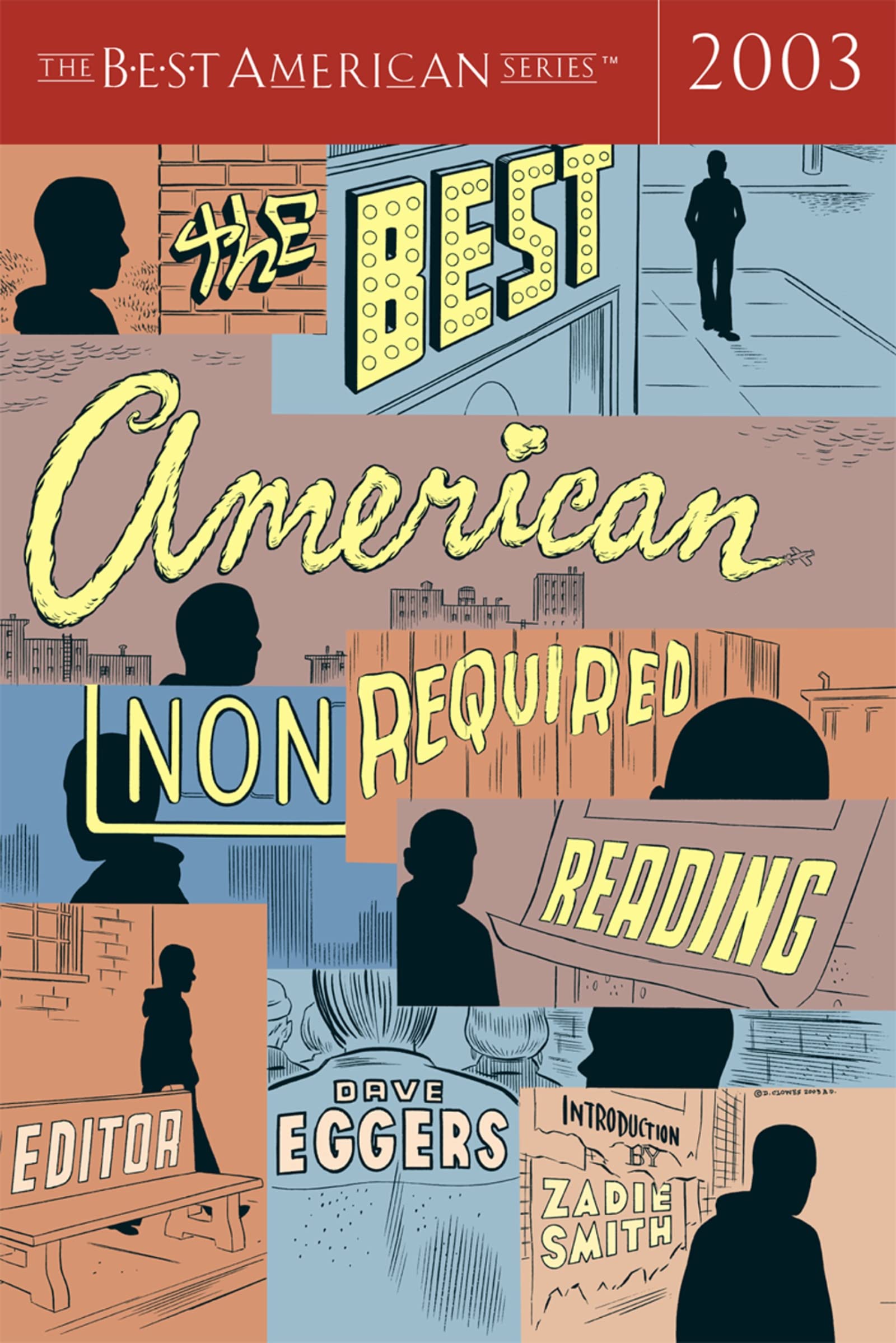



Since its inception in 1915, the Best American series has become the premier annual showcase for the country's finest short fiction and nonfiction. For each volume, the very best pieces are selected by an editor who is widely recognized as a leading writer in his or her field, making the Best American series the most respected -- and most popular -- of its kind. Dave Eggers, who will be editing The Best American Nonrequired Reading annually, has once again chosen the best and least-expected fiction, nonfiction, satire, investigative reporting, alternative comics, and more from publications large, small, and on-line -- The Onion, The New Yorker, Shout, Time, Zoetrope, Tin House, Nerve.com,and McSweeney's, to name just a few. Read on for "Some of the best literature you haven't been reading . . . And it's fantastic. All of it." (St. Petersburg Times). Lynda Barry Jonathan Safran Foer Lisa Gabriele Andrea Lee J. T. Leroy Nasdijj ZZ Packer David Sedaris "An excellent literary compilation . . . Eggers deserves credit for another first-rate collection." Publishers Weekly DAVE EGGERS is the editor of McSweeney’s and a cofounder of 826 National, a network of nonprofit writing and tutoring centers for youth, located in seven cities across the United States. He is the author of four books, including What Is the What and How We Are Hungry . Introduction Dead Men Talking For young readers and young writers, here are half a dozen commonplaces concerning the act of reading, required or otherwise: 1. Dr. Johnson: A man ought to read just as inclination leads him; for what he reads as a task will do him little good.” In principle I agree with this but I’m not quite this sort of reader. Not confident enough to be this reader. Inclination” is all very well if you are born into taste or are in full possession of your own, but for those of us born into families who were not quite sure what was required and what was not well, we fear our inclinations. For myself, I grew up believing in the Western literary canon in a depressing, absolutist way: I placed all my faith in its hierarchies, its innate quality and requiredness. The lower-middleclass, aspirational reader is a very strong part of me, and the only books I wanted to read as a teenager were those sanctified by my elders and betters. I was certainly curious about the nonrequired reading of the day (back then, in London, these were young, edgy men like Mr. Self and Mr. Kureishi and Mr. Amis), but I didn’t dare read them until my required reading was done. I didn’t realize then that required reading is never done. My adult reading has continued along this fiercely traditional and cautiously autodidactic path. To this day, if I am in a bookshop, browsing the new fiction, and Robert Musil’s A Man Without Qualities happens to catch my eye from across the room, I am shamed out of the store and must go home to try to read that monster again before I can allow myself to read new books by young people. Of course, the required nature of The Faerie Queene, books 3 through 10 of Paradise Lost, or the Phaedrus exists mostly in my head, a rigid idea planted by a very English education. An education of that kind has many advantages for the aspiring writer, but in my case it also played straight and true to the creeping conservatism in my soul. Requiredness lingers over me. When deciding which book of a significant author to read, I pick the one that appears on reading lists across the country. When flicking through a poetry anthology, I begin with the verse that got repeated in the .lm that took the Oscar. I met an Englishwoman recently, also lower middle class, who believed she was required to read a book by every single Nobel laureate, and when I asked her how that was working out for her, she told me it was the most bloody miserable reading experience she’d ever had in her life. Then she smiled and explained that she had no intention of stopping. I am not that bad, but I’m pretty bad. It is only recently, and in America, that the hold required reading has had on me has loosened a little. Tradition is a formative and immense part of a writer’s world, of the creation of the individual talent but experiment is essential. I have been very slow to realize this. Reading this collection made me feel the literary equivalent of Zadie, honey, you need to get out more”; I began to see that interesting things are going on, more and more things, and that I can’t keep up with them, and that many of them cause revolt in the required-reading part of my brain (I get very concerned by the disappearance of some of the more expressive punctuations: the semicolon, the difference between long and short dashes, the potential comic artfulness of the parentheses), and yet, I so enjoyed myself that even if what I have read in this book is the clarion call of my own obsolescence, it seems essential to defend experiment and nonrequiredness from those who would attack it. Thing is, the very young and ve