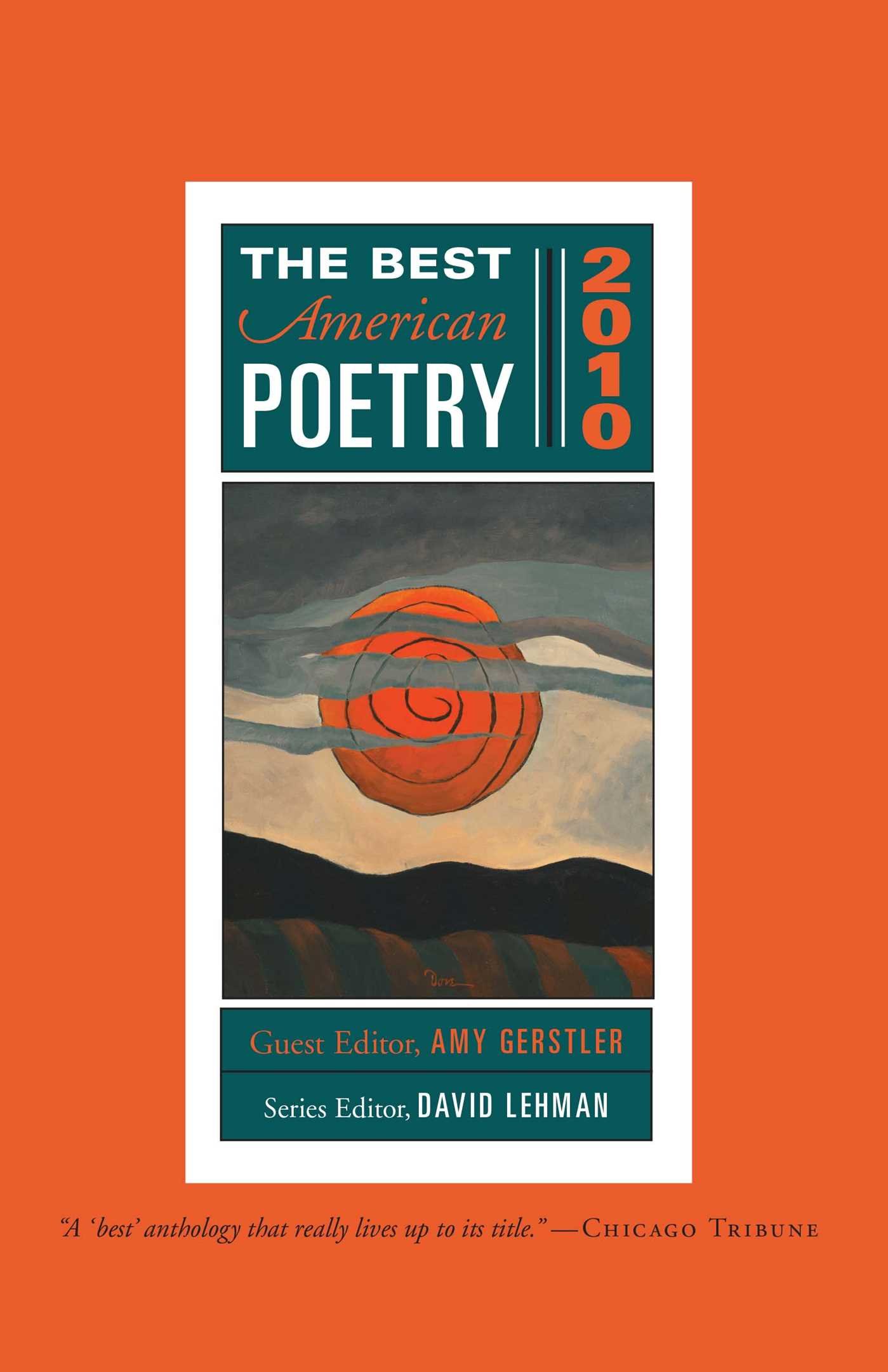



AMY GERSTLER’S COMMITMENT TO INNOVATIVE POETRY that conveys meaning, feeling, wit, and humor informs the cross section of poems in the 2010 edition of The Best American Poetry. The works collected here represent the wealth, the breadth, and the tremendous energy of poetry in the United States today. Featuring poems from some of our country’s top bards, including John Ashbery, Anne Carson, Louise Glück, Sharon Olds, and Charles Simic, The Best American Poetry 2010 also presents poems that poignantly capture the current moment, such as the sonnets John Updike wrote to chronicle his dying weeks. And there are exciting poems from a constellation of rising stars: Bob Hicok, Terrance Hayes, Denise Duhamel, Dean Young, and Elaine Equi, to name a very few. The anthology’s mainstays are in place: It opens with series editor David Lehman’s incisive foreword about the state of American poetry and has a marvelous introduction by Amy Gerstler. Notes from the poets, illuminating their poems and their writing processes, conclude this delightful addition to a classic series. Dick Allen * John Ashbery * Sandra Beasley * Mark Bibbins * Todd Boss * Fleda Brown * Anne Carson * Tom Clark * David Clewell * Michael Collier * Billy Collins * Dennis Cooper * Kate Daniels * Peter Davis * Tim Dlugos * Denise Duhamel * Thomas Sayers Ellis * Lynn Emanuel * Elaine Equi * Jill Alexander Essbaum * B. H. Fairchild * Vievee Francis * Louise Glück * Albert Goldbarth * Amy Glynn Greacen * Sonia Greenfield * Kelle Groom * Gabriel Gudding * Kimiko Hahn * Barbara Hamby * Terrance Hayes * Bob Hicok * Rodney Jones * Michaela Kahn * Brigit Pegeen Kelly * Corinne Lee * Hailey Leithauser * Dolly Lemke * Maurice Manning * Adrian Matejka * Shane McCrae * Jeffrey McDaniel * W. S. Merwin * Sarah Murphy * Eileen Myles * Camille Norton * Alice Notley * Sharon Olds * Gregory Pardlo * Lucia Perillo * Carl Phillips * Adrienne Rich * James Richardson * J. Allyn Rosser * James Schuyler * Tim Seibles * David Shapiro * Charles Simic * Frank Stanford * Gerald Stern * Stephen Campbell Sutherland * James Tate * David Trinidad * Chase Twichell * John Updike * Derek Walcott * G. C. Waldrep * J. E. Wei * Dara Wier * Terence Winch * Catherine Wing * Mark Wunderlich * Matthew Yeager * Dean Young * Kevin Young David Lehman, the series editor of The Best American Poetry , edited The Oxford Book of American Poetry . His books of poetry include The Morning Line , When a Woman Loves a Man , and The Daily Mirror. He has written such nonfiction books as Signs of the Times: Deconstruction and the Fall of Paul de Man. He lives in New York City and Ithaca, New York. FOREWORD by David Lehman Over the years I’ve read novels centering on lawyers, doctors, diplomats, teachers, financiers, even car salesmen and dentists, but not until 2009 did I come across one about the travails of the editor of a poetry anthology. When word of The Anthologist , Nicholson Baker’s new novel, reached me last September, I couldn’t wait to read it. Baker’s novels defy convention and reveal an obsessive nature, and I wondered what he would make of American poetry, for surely his novel would reflect a strenuous engagement with the art. The title character here, Paul Chowder by unfortunate name, has put together an anthology of poems he is calling Only Rhyme. The phrase describes the notional book’s contents and indicates the editor’s conception of poetic virtue. Paul has chosen the contents of his anthology but is now, on the eve of a deadline, afflicted with writer’s block. He needs to write a foreword but cannot. “How many people read introductions to poetry anthologies, anyway?” he wonders, then volunteers, “I do, but I’m not normal.” Having asked myself that same question and given a similar answer, I can appreciate the speaker’s troubling awareness of the many poets who have to be left out of his book—and the relatively few people who will bother to read his introductory essay. The task of writing a prefatory note becomes no less difficult when it is an annual requirement, though Nicholson Baker may have made my job a little easier this time around. Every editor has the impulse to use the introductory space to open the door, welcome the guest, and disappear without further ado. But some things are worth saying, and one such is Baker’s defense of anthologies. For a poet facing all the perils that lurk in a poet’s path—a poet very like the novel’s Paul Chowder—anthologies represent the possibility of a belated second chance. And it is that possibility, however slim, that spurs the poet to stick to a vocation that offers so much resistance and promises so few rewards. The “you” in these sentences refers to the American poet—and perhaps to American poetry itself, an oddity in an age that worships celebrity. “You think: One more poem. You think: There will be some as yet ungathered anthology of American poetry. It will be the anthology that people tote around with them on subways thi