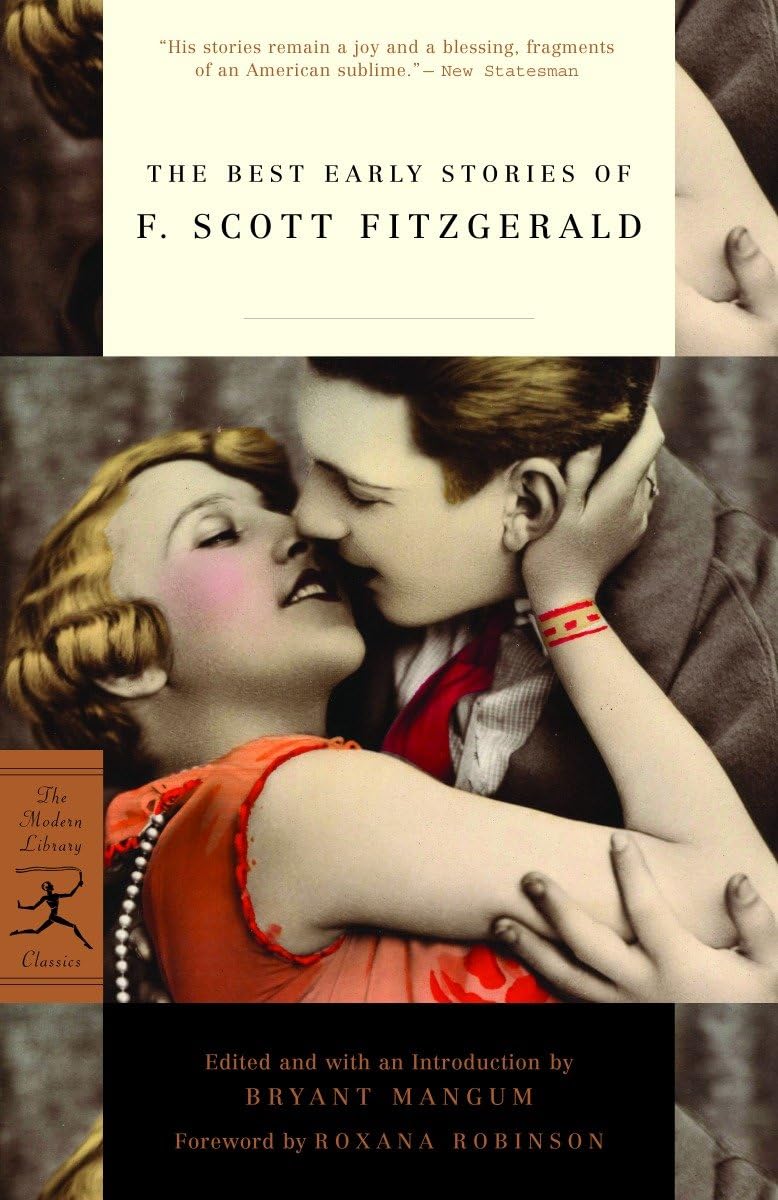
The Best Early Stories of F. Scott Fitzgerald (Modern Library Classics)
$9.45
by F. Scott Fitzgerald



Edited and with an Introduction by Bryant Mangum Foreword by Roxana Robinson Benediction • Head and Shoulders • Bernice Bobs Her Hair • The Ice Palace • The Offshore Pirate • May Day • The Jelly Bean • The Diamond as Big as the Ritz • Winter Dreams • Absolution In the euphoric months before and after the publication of This Side of Paradise , F. Scott Fitzgerald, the flapper’s historian and poet laureate of the Jazz Age, wrote the ten stories that appear in this unique collection. Exploring characters and themes that would appear in his later works, such as The Beautiful and Damned and The Great Gatsby , these early selections are among the very best of Fitzgerald’s many short stories. This Modern Library Paperback Classic includes notes, an appendix of nonfiction essays by Scott and Zelda Fitzgerald and their contemporaries, and vintage magazine illustrations. Bryant Mangum is a professor of English at Virginia Commonwealth University. He is the author of A Fortune Yet: Money in the Art of F. Scott Fitzgerald’s Short Stories. Roxana Robinson is the author of three novels, Summer Light, Sweetwater, and This Is My Daughter; a biography of Georgia O’Keeffe; and three short story collections, including A Perfect Stranger and Other Stories. She has received fellowships from the Guggenheim Foundation, the National Endowment for the Arts, and the MacDowell Colony. She lives in New York. Chapter 1 Benediction The Baltimore Station was hot and crowded, so Lois was forced to stand by the telegraph desk for interminable, sticky seconds while a clerk with big front teeth counted and recounted a large lady’s day message, to determine whether it contained the innocuous forty-nine words or the fatal fifty-one. Lois, waiting, decided she wasn’t quite sure of the address, so she took the letter out of her bag and ran over it again. “Darling”: it began—“I understand and I’m happier than life ever meant me to be. If I could give you the things you’ve always been in tune with—but I can’t, Lois; we can’t marry and we can’t lose each other and let all this glorious love end in nothing. “Until your letter came, dear, I’d been sitting here in the half dark thinking and thinking where I could go and ever forget you; abroad, perhaps, to drift through Italy or Spain and dream away the pain of having lost you where the crumbling ruins of older, mellower civilizations would mirror only the desolation of my heart—and then your letter came. “Sweetest, bravest girl, if you’ll wire me I’ll meet you in Wilmington—till then I’ll be here just waiting and hoping for every long dream of you to come true. “Howard.” She had read the letter so many times that she knew it word by word, yet it still startled her. In it she found many faint reflections of the man who wrote it—the mingled sweetness and sadness in his dark eyes, the furtive, restless excitement she felt sometimes when he talked to her, his dreamy sensuousness that lulled her mind to sleep. Lois was nineteen and very romantic and curious and courageous. The large lady and the clerk having compromised on fifty words, Lois took a blank and wrote her telegram. And there were no overtones to the finality of her decision. It’s just destiny—she thought—it’s just the way things work out in this damn world. If cowardice is all that’s been holding me back there won’t be any more holding back. So we’ll just let things take their course, and never be sorry. The clerk scanned her telegram: “Arrived Baltimore today spend day with my brother meet me Wilmington three P.M. Wednesday Love “Lois.” “Fifty-four cents,” said the clerk admiringly. And never be sorry—thought Lois—and never be sorry—— II Trees filtering light onto dappled grass. Trees like tall, languid ladies with feather fans coquetting airily with the ugly roof of the monastery. Trees like butlers, bending courteously over placid walks and paths. Trees, trees over the hills on either side and scattering out in clumps and lines and woods all through eastern Maryland, delicate lace on the hems of many yellow fields, dark opaque backgrounds for flowered bushes or wild climbing gardens. Some of the trees were very gay and young, but the monastery trees were older than the monastery which, by true monastic standards, wasn’t very old at all. And, as a matter of fact, it wasn’t technically called a monastery, but only a seminary; nevertheless it shall be a monastery here despite its Victorian architecture or its Edward VII additions, or even its Woodrow Wilsonian, patented, last-a-century roofing. Out behind was the farm where half a dozen lay brothers were sweating lustily as they moved with deadly efficiency around the vegetable-gardens. To the left, behind a row of elms, was an informal baseball diamond where three novices were being batted out by a fourth, amid great chasings and puffings and blowings. And in front as a great mellow bell boomed the half-hour a swarm of black, human leaves were