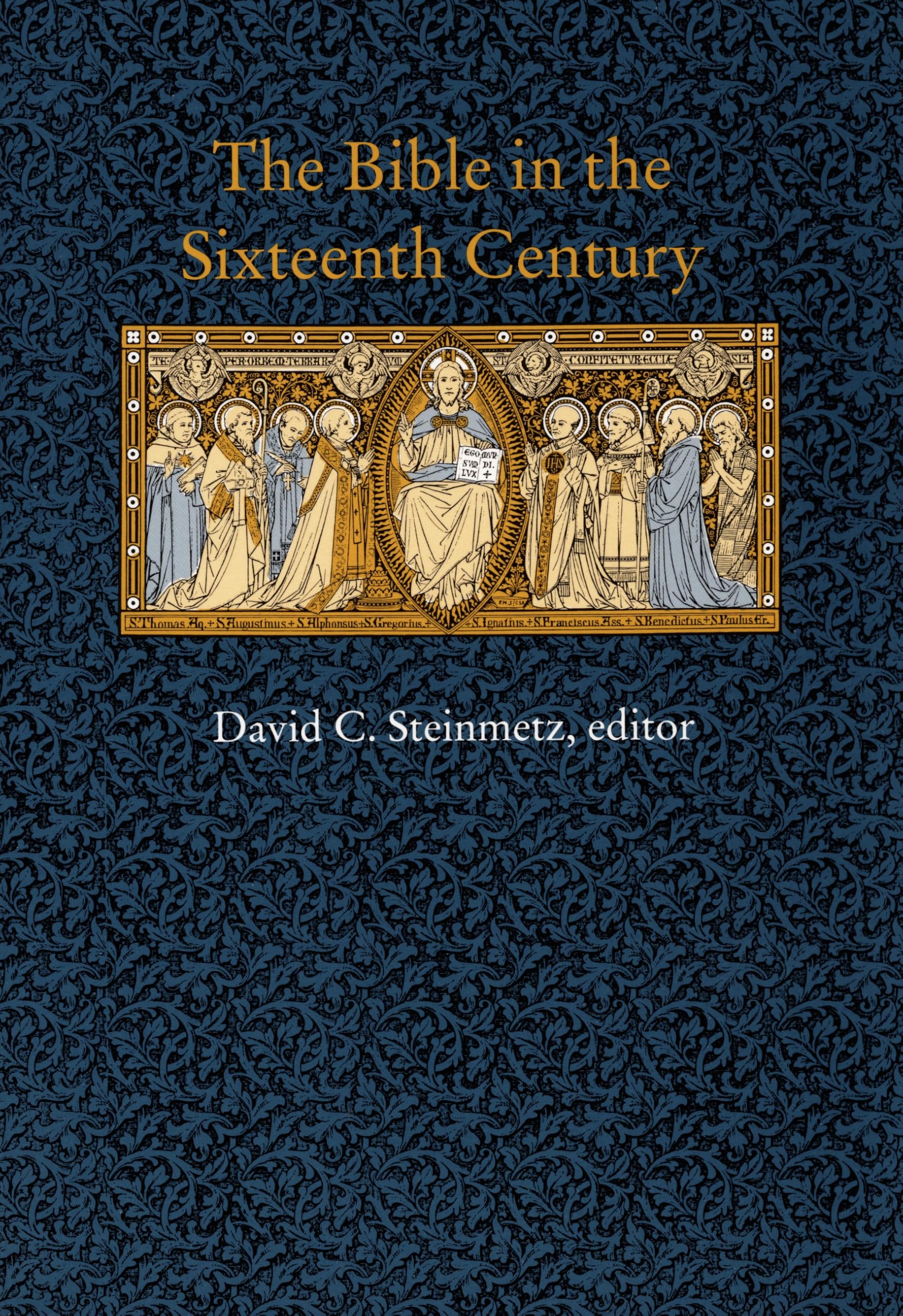
The Bible in the Sixteenth Century (Duke Monographs in Medieval and Renaissance Studies)
$27.95
by David C. Steinmetz



A distinguished group of authors here illuminate a broad spectrum of themes in the history of biblical interpretation. Originally published in 1990, these essays take as their common ground the thesis that the intellectual and religious life of the sixteenth century cannot be understood without attention to the preoccupation of sixteenth-century humanists and theologians with the interpretation of the Bible. Topics explored include Jewish exegesis and problems of Old Testament interpretation and the relationship between the Bible and social, political, and institutional history. Contributors . Irena Backus, Guy Bedouelle, Kalman P. Bland, Kenneth G. Hagen, Scott H. Hagen, Scott H. Hendrix, R. Gerald Hobbs, Jean-Claude Margolin, H. C. Erik Midelfort, Richard A. Muller, John B. Payne, David C. Steinmetz "From reviews for the cloth edition: " "These essays . . . provide a valuable introduction to the sixteenth-century Bible commentary as a genre. However, the contributors have also succeeded in forging links between this genre and larger themes and problems of sixteenth-century history, offering numerous examples of how commentaries mirror the intellectual, social, and institutional developments of their time."--Stephen G. Burnett, "The Sixteenth Century Journal" "The book contributes to the cause of understanding Reformation era exegetical debates in their late medieval context rather than from an anachronistic perspective that attempts to claim the Protestant Reformers for one side or the other in modern debates over doctrines of Scripture."--Joel E. Kok, "Calvin Theological Journal ""All who work in this history of exegesis and its impact on society will want to read this volume. . . ."--Robert Kolb, "Religious Studies Review" David Steinmetz is Amos Ragan Kearns Professor of the History of Christianity at Duke University Divinity School. The Bible in the Sixteenth Century By David C. Steinmetz Duke University Press Copyright © 1990 Duke University Press All rights reserved. ISBN: 978-0-8223-1849-1 Contents Introduction, Social History and Biblical Exegesis: Community, Family, and Witchcraft in Sixteenth-Century Germany, The Consultations of the Universities and Scholars Concerning the "Great Matter" of King Henry VIII, The Use of Scripture in Establishing Protestantism: The Case of Urbanus Rhegius, Issues in Sixteenth-Century Jewish Exegesis, The Hermeneutic of Promise and Fulfillment in Calvin's Exegesis of the Old Testament Prophecies of the Kingdom, Hebraica Veritas and Traditio Apostolica: Saint Paul and the Interpretation of the Psalms in the Sixteenth Century, Calvin and the Patristic Exegesis of Paul, Erasmus on Romans: 9; 6-24, The Epistle to the Romans (Chapter 11) According to the Versions and I or Commentaries of Valla, Colet, Lefèvre, and Erasmus, Polemic, Exegetical Tradition, and Ontology: Bucer's Interpretation of John 6: 52, 53, and 64 Before and After the Wittenberg Concord, "De Exegetica Methodo": Niels Hemmingsen's De Methodis (1555), Notes, CHAPTER 1 H. C. ERIK MIDELFORT Social History and Biblical Exegesis: Community, Family, and Witchcraft in Sixteenth-Century Germany It is not often that social historians are given a formal reason to reflect on the biblical exegesis of the age that they study. Even social historians hardy enough to concede the general importance of ideas are likely to shrink from the daunting task of dealing with a subject so obviously bristling with technical difficulties. But a prejudice was common enough in the not-so-distant past to further guarantee that social history and biblical studies would remain separate. This was the assumption, on both sides, that we/they alone were dealing with timeless truths. Biblical scholars do not need to be reminded of this assumption on their part, but it was no less common among social historians who dealt not with "mere events" and mere personalities but with the "longue durée"—the glacial shifts in social and economic structure, the vast continuities that seemed to signal the reality beneath the apparent flux of everyday experience. In grasping imaginatively after comparative methods and interdisciplinary tools from anthropology, sociology, economics, and the experience of peoples from around the world, social historians often proclaimed, at least implicitly, the timelessness of their subjects—subjects such as the peasant economy, the village as a legal or political unit, the moral economy of the crowd, and the sense of time, or of space, or of work and play among "preindustrial" peoples. These subjects were not, of course, literally timeless. They showed characteristic shifts under the impact of industrialization, secularization, and urbanization, of "modernization" as it was once naively called. Few doubted, however, that the experiences of peoples in similar circumstances were fundamentally comparable because fundamentally similar. This assumption still undergirds a good dea