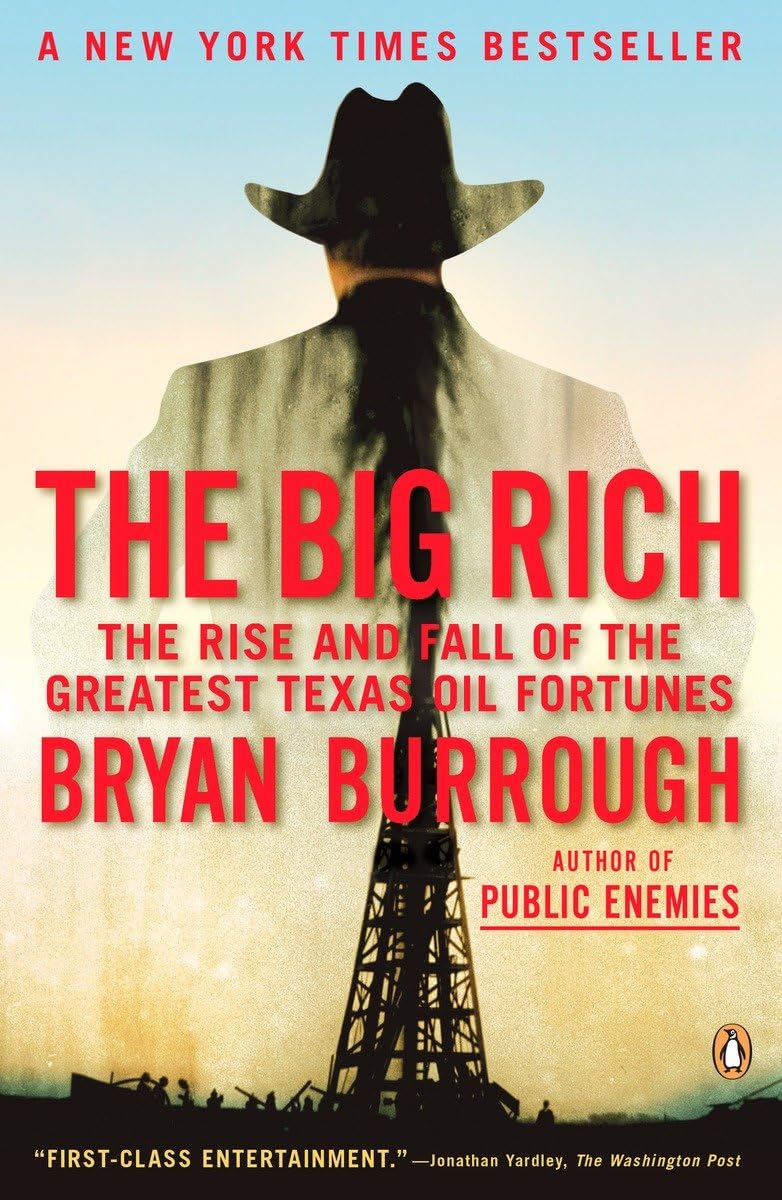
The Big Rich: The Rise and Fall of the Greatest Texas Oil Fortunes
$11.49
by Bryan Burrough



“Burrough, with his gifts for both synthesis and lyricism, brings more to the table . . . [he] has also done estimable new reporting, showing links between Texas money and national politics that stretch back far earlier than the days of Lyndon B. Johnson.” —Mimi Swartz, The New York Times “Full of schadenfreude and speculation—and solid, timely history too.” — Kirkus “What's not to enjoy about a book full of monstrous egos, unimaginable sums of money, and the punishment of greed and shortsightedness?” —The Economist Phenomenal reviews and sales greeted the hardcover publication of The Big Rich, New York Times bestselling author Bryan Burrough's spellbinding chronicle of Texas oil. Weaving together the multigenerational sagas of the industry's four wealthiest families, Burrough brings to life the men known in their day as the Big Four: Roy Cullen, H. L. Hunt, Clint Murchison, and Sid Richardson, all swaggering Texas oil tycoons who owned sprawling ranches and mingled with presidents and Hollywood stars. Seamlessly charting their collective rise and fall, The Big Rich is a hugely entertaining account that only a writer with Burrough's abilities-and Texas upbringing-could have written. “Burrough, with his gifts for both synthesis and lyricism, brings more to the table . . . His set pieces describing the events at Spindletop, the gusher that started it all, and the rise and fall of the wildcatter Glenn McCarthy (the model for Ferber’s Jett Rink) are impeccably rendered, as are the tales of many other fabled characters. Burrough has also done estimable new reporting, showing links between Texas money and national politics that stretch back far earlier than the days of Lyndon B. Johnson.” — Mimi Swartz, The New York Times “Full of schadenfreude and speculation—and solid, timely history too.” — Kirkus “Capitalism at its most colorful oozes across the pages of this engrossing study of independent oil men. . . . This is a portrait of capitalism as white-knuckle risk taking, yielding fruitful discoveries for the fathers, but only sterile speculation for the sons—a story that resonates with today's economic upheaval.” — Publishers Weekly “What's not to enjoy about a book full of monstrous egos, unimaginable sums of money, and the punishment of greed and shortsightedness?” — The Economist Bryan Burrough is a special correspondent at Vanity Fair and the author of three previous books. A former reporter for the Wall Street Journal , he is a three-time winner of the John Hancock Award for excellence in financial journalism. Burrough lives in Summit, New Jersey, with his wife and their two sons. INTRODUCTION It’s hard to tell people about Texas. It is. It’s hard to explain what it means to be a Texan. To anyone who grew up in the North, it probably means nothing. The idea of a state “identity,” or that a state’s citizens might adopt it as part of their own self-image, seems a quaint, almost antebellum notion. Folks in Iowa don’t strut around introducing themselves as Iowans, at least none I know. But if you grew up in Texas, as I did, it becomes a part of you, as if you’re a member of a club. It’s a product of the state’s enduring, and to my mind endearing, parochialism, a genetic tie to the days when Texas was a stand-alone nation born of its own fight for independence, which produced its own set of national myths. Ohio doesn’t have an Alamo. I’m not sure Ohioans, as wonderful as they are, have a distinct culture. As a child I was always vaguely ashamed I wasn’t born in Texas. I’ll never forget the day a boy in my fifth-grade class actually called me a carpetbagger. How on earth would he even know what that was? The myths about Texas die so hard, mostly because Texans love them so. So much of it is wrapped up in oil. Non-Texans probably think it’s all-pervasive; it’s not. The fact is, growing up in Central Texas during the 1970s, I never met an actual oilman. There were a few pump jacks out in the fields around our little town, but we never gave a thought to who owned them. It wasn’t until I was sixteen, the weekend I served as an escort at Waco’s Cotton Palace debutante ball, that I was introduced to the class of Texans known as the Big Rich: boys from Highland Park and River Oaks in white dinner jackets and gleaming hair, willowy Hockaday girls with enormous eyes and glistening jewels. Ogling them from within my rumpled rented tux, they seemed like royalty. And they were, Texas royalty at least. They had flasks in their pockets and talked of boarding schools and weekends in Las Vegas and the wine in Paris and jetting to London and my head just spun and spun and spun. It wasn’t for another five years that, as a cub reporter for the Wall Street Journal in Dallas and later in Houston, I began to read—and write a little—about the Big Rich. Though I didn’t realize it at the time, those were the years, the early and mid-1980s, when their era was ending. The fathers of those boys from River Oaks