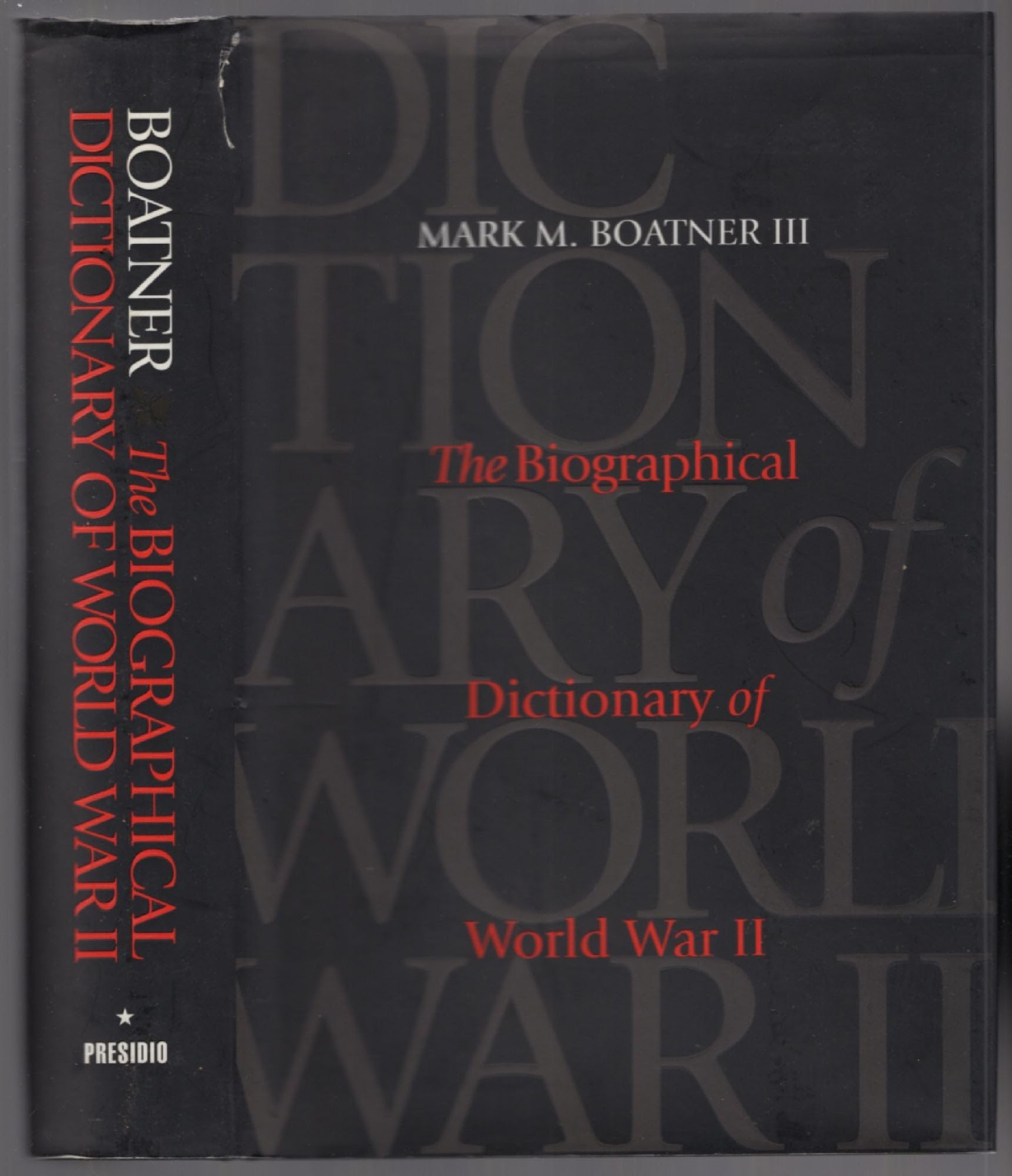



The Biographical Dictionary of World War II is a monumental, single-volume reference that contains authoritative accounts of more than 1,000 key personalities from the war years. Selected from the vast stage of World War II are concise, fact-filled biographical sketches of the personages who shaped and directed the events of this titanic conflict. Arranged alphabetically from Abdul Illah ibn Ali, the regent of Iraq who was executed by his own people following the war, to Solly Zuckerman, the British scientist and adviser on strategic bombing decisions, the more than 1,000 entries form a comprehensive and invaluable reference to World War II. A major feature increasing the dictionary's usefulness is a wealth of comprehensive cross references used to link the entries of individuals referred to elsewhere in the book. Pertinent bibliographical information accompanies entries, and at the end of the book is a complete bibliography of works and sources used, as well as an extensive glossary. Boatner (The Encyclopedia of the American Revolution, 1994. rev. ed.), a retired colonel, West Point graduate, and veteran of World War II and the Korean conflict, here offers biographical sketches of 1000 significant World War II personalities selected primarily on the basis of statistical frequency in standard works. Although this is primarily a biographical work, some of the dictionary's glossary entries (cross-referenced to the biographies and vice versa) are veritable miniarticles of useful supplementary information. While the majority of the biographies are of major figures, e.g., Eisenhower, Stalin, and Roosevelt, an impressive number of lesser-known personalities appear, e.g., Philippine patriot Carlos Romulo and Rene Pleven, who did important liaison work with the American and British governments. Nonmilitary figures from filmmaker Leni Riefenstal to writer Erich Maria Remarque to industrialist Henry Kaiser are included, as are civilian victims of the Nazi machine Anne Frank and Dietrich Bonhoeffer (but neither Sophie nor Hans Scholl, German university students who, with several colleagues, were executed for treason in 1943). The balance of Anglo-American, German, Russian, Japanese, and French names seems appropriate, and other nationalities are well represented. Overall, this is a well-researched and eminently readable work, written in vigorous and refreshingly colorful language, that will update Christopher Tunney's Biographical Dictionary of World War II (1972) and complement The Oxford Companion to World War II (Oxford Univ., 1995). For larger public, university, and four-year college libraries.?Harry E. Whitmore, formerly with Univ. of Maine at Augusta, Portland Copyright 1997 Reed Business Information, Inc. Boatner is a West Point graduate, World War II veteran, and former professor of military history at West Point. He is also the author of five widely used reference books dealing with military history. For this book, he compiled a list of several thousand names connected to World War II by counting name citations in indexes. Culling out the most frequently cited names and choosing additional names after consultation with historical experts from several countries, Boatner selected more than 1,000 key personalities for inclusion in this book, including military personnel, civilian leaders, diplomats, scientists, spies, entertainers, and writers. The alphabetically arranged entries range from 250 to 1,000 words in length. A typical entry provides the person's nationality, rank or position, and birth and death years, followed by a biography of the person's entire life noting education or training, positions held, accomplishments, failures, and publications. Within an entry, bold type designates a cross-reference to another entry, and small capital letters refer to the accompanying glossary. Short-form citations to the bibliography are in parentheses. The 70-page glossary describes events, issues, and terms too cumbersome to be included within entries (e.g., ATC [US] Air Traffic Command). The 18-page bibliography often has brief comments by the author. Foreign titles have English-language translations. There are no illustrations. Despite the plethora of reference books on World War II, there are only a few comparable biographical works. A Biographical Dictionary of World War II by Tunney (St. Martin's, 1972) has approximately 540 entries; biographies only cover the war period. Who's Who in World War II by Mason (Little, Brown, 1978) has about 290 entries. Again, most information is limited to the war period. The book is well illustrated with more than 200 photographs and several pages of maps. Who Was Who in World War II by Keegan (Crescent Books, 1984) contains 527 entries; most information is limited to the war period. The book is illustrated with 250 photographs. This work was also published in paperback as Who's Who in World War II (Oxford, 1984) without illustrations. The Biographical Dictionary of Wo