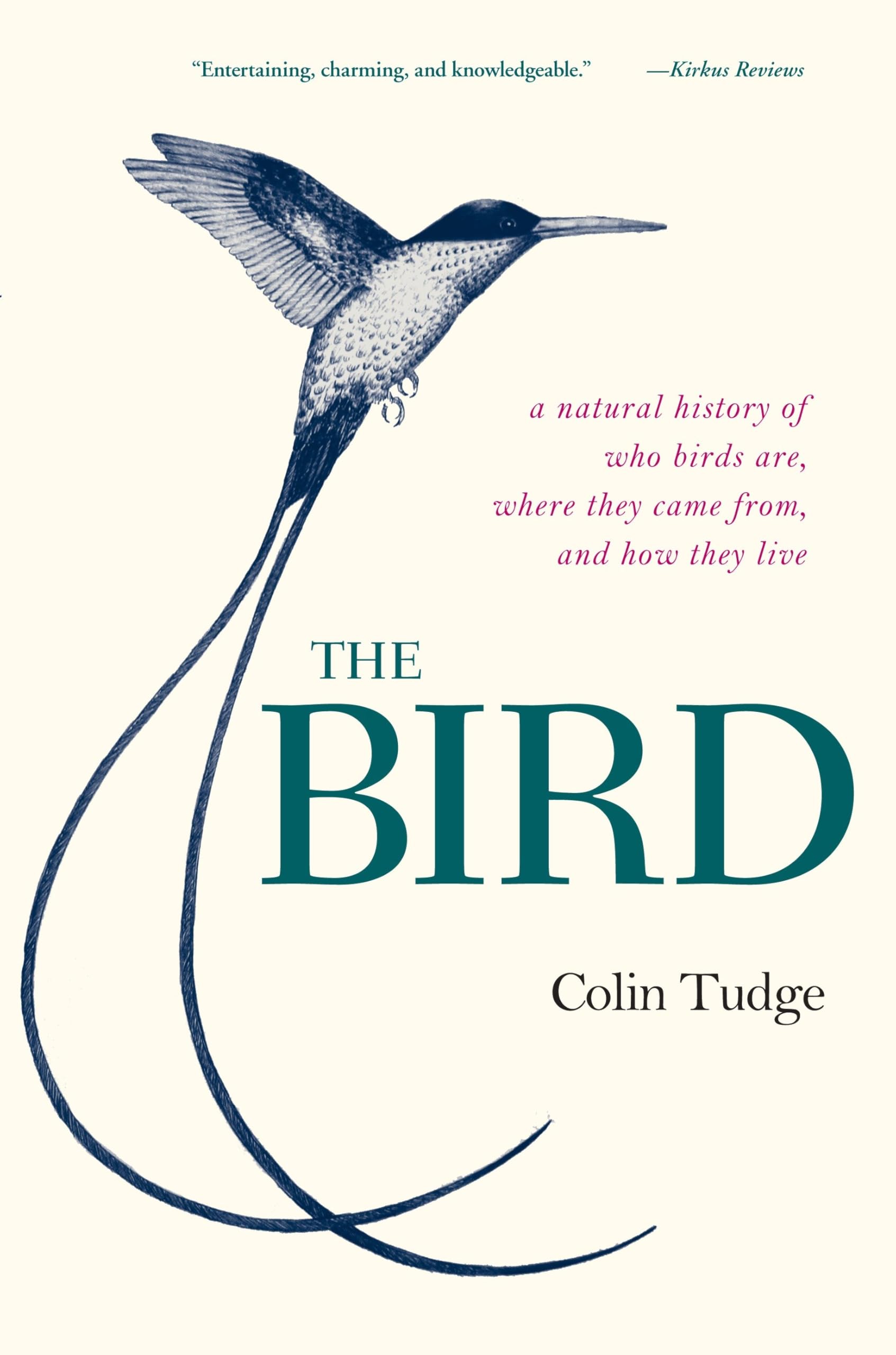
The Bird: A Natural History of Who Birds Are, Where They Came From, and How They Live
$15.32
by Colin Tudge



Chosen as a best book of the year by The Independent Complete with an "annotated cast list" of all the known birds in the world—plus gorgeous illustrations— The Bird is a comprehensive and delightfully accessible guide for everyone from dedicated birders to casual birdwatchers that celebrates and illuminates the remarkable lives of birds. In this fascinating exploration of the avian class, Colin Tudge considers the creatures of the air. From their evolutionary roots to their flying, feeding, fighting, mating, nesting, and communicating, Tudge provocatively ponders what birds actually do–as well as why they do it and how. With the same curiosity, passion, and insight he brought to redwoods, pines, and palm trees in his widely acclaimed book The Tree , Tudge here studies sparrows, parrots, and even the Monkey-eating Eagle to better understand their world–and our own. There is far more to a bird's existence than gliding gracefully on air currents or chirping sweetly from fence posts–the stakes are life and death. By observing and explaining the complex strategy that comes into play with everything from migration to social interaction to the timing of giving birth to young, Tudge reveals how birds are uniquely equipped biologically to succeed and survive. And he offers an impassioned plea for humans to learn to coexist with birds without continuing to endanger their survival. Praise for The Bird “Colin Tudge marries the poetry and the science of the dinosaur’s best-loved descendants. . . . A master of clear science writing, Tudge throws a state-of-the-art spotlight on every aspect of the bird’s life from migration to cooperation.” — The Independent “[A] book simply fizzing with ideas. Provoking yet always persuasively argued. . . . Besides having an enviable grasp of scientific fact, Tudge writes with narrative fluency.” — Literary Review “Tudge’s writing is always clear and frequently embellished with wry humor. Occasionally, it is inspired.” — Sunday Telegraph “In the book’s final section . . . the gloves are off, and he produces a masterful critique of politicians and economists, making an excellent (but probably doomed) case against the geopolitical status quo and its tragic effect on the world’s birds. This is a powerful, thoughtful piece of writing, which transforms an entertaining romp through avian biology into a compelling tract for our times.” —The Guardian Praise for The Tree “Enchanting . . . Tudge sees grandeur in how trees exist in the world . . . and demonstrates it with fascinating stories.” — New York Times Book Review “Tudge writes in the great tradition of naturalists such as Humboldt and John Muir. . . . Eloquent and deeply persuasive.” — Los Angeles Times “A love letter to trees, written with passion and scientific rigour . . . a pleasure to read. Tudge writes with warmth and wit.” —The Financial Times COLIN TUDGE is the author of The Link, The Tree, The Variety of Life , and So Shall We Reap and a fellow of the Linnean Society of London. A former features editor for New Scientist and documentarian for the BBC, he is currently a full-time writer and public speaker. He lives in Oxford, England. 1 What It Means to Be a Flier "All animals are equal," the ruling pigs declared in George Orwell's Animal Farm. "But," they added, "some animals are more equal than others." All animals are equal no doubt in the eyes of God, and all that manage to survive at all in this difficult world are in some sense "equal." But some, by all objective measures, are far more impressive than others; and none, not even the mammals, the group to which we ourselves belong, quite match up to the birds. Birds have their shortcomings, to be sure, as flesh and blood must. But they are, nonetheless, a very superior form of life. Above all, birds fly. They are not the only animals that have taken to the air, of course. There are many gliders. Flying fish are remarkably adept, and various frogs and snakes and lizards contrive to parachute from tree to tree; and there is a variety of gliding mammals, including phalangers and squirrels and colugos (sometimes known as flying lemurs). But only four groups have managed powered flight, driving themselves through the air by flapping or whirring their wings. Many insects fly wonderfully. Bats fly well enough to catch insects in the air—and, for good measure, they do it at night. The ancient pterosaurs, contemporaries of the dinosaurs, included some of the biggest powered fliers of all time—and what a sight they must have been! Pelicans, returning home against the evening sun, might give us some idea of what they were like. But none of these creatures flies as well as the birds. Perhaps this is why birds are still with us and pterosaurs are not. Perhaps this is why bats fly mainly at night; if they are ever forced to fly by day, as they may do in cold weather when there are too few nighttime insects, they quickly get picked off by hawks. F