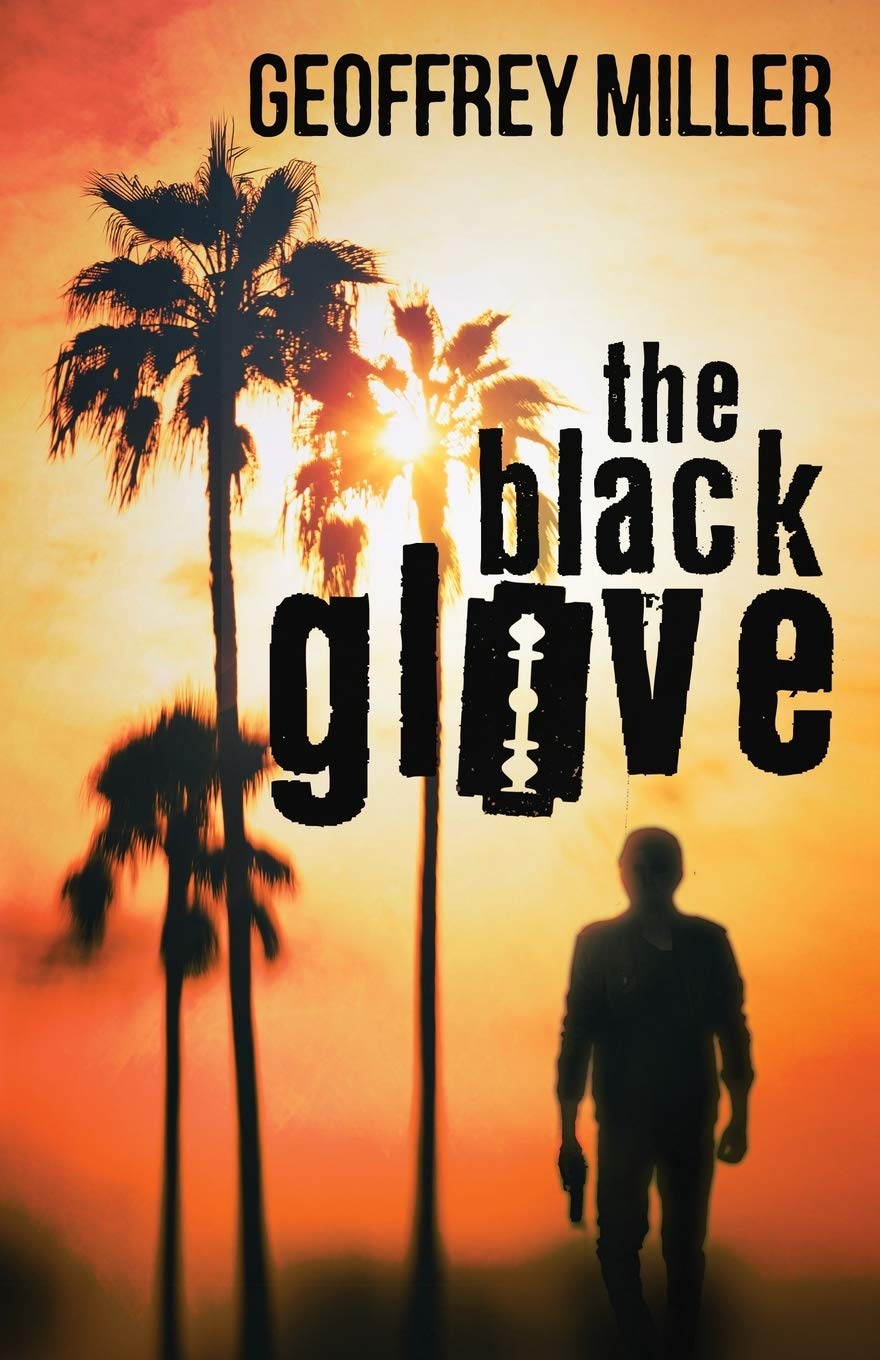



NOMINATED FOR THE EDGAR AWARD Terry Traven is an L. A. private eye who modeled himself after Philip Marlowe and thrived in the 1960s, becoming a minor celebrity for his hardboiled style and his skill at tracking down runaways. But now it’s the 1980s, his minor fame has completely faded, and he’s barely making a living. So he jumps at the opportunity to find a wealthy, born-again industrialist’s missing son who has been dabbling in drugs and punk rock. It’s not just a chance to save the kid… but himself. Traven’s search leads him into a bizarre, cocaine-drizzled world populated by kidnappers, drug dealers, talent agents, greedy entrepreneurs, religious zealots and desperate killers. “Miller pretty much equals the masters — Hammett and Chandler — of the hardboiled detective story,” Houston Post “THE BLACK GLOVE is every bit as remarkable as the best film noir of the 1940s,” Detroit News The Black Glove By Geoffrey Miller Brash Books, LLC Copyright © 2015 Geoffrey Miller All rights reserved. ISBN: 978-1-941298-88-6 CHAPTER 1 The Black Mask Detective Agency was on the second floor of a two-story building in the sixty-six-hundred block of Melrose, corner of Citrus — a building that, since the earthquake in '71, had crossed the nebulous line into architectural blight. Inside, Terry Traven sat quietly, acquiescing to the heat. Torpid, dry summer weather in three figures made him uneasy. All the windows were open, and the Venetian blinds were drawn nearly shut to exclude the harsh light. Irregular throbs of a Santa Ana wind whistled through the window screens, playing fluttering tattoos on the slats of the blinds. He studied the wall calendar from the 400 Blows Massage Parlor. Today was the hundred and third day without work. He was becalmed in that body of stagnant water called the desperate straits. The county would soon be testing for Junior Administrative Assistant, an entry-level civil service job requiring only a bachelor's degree or appropriate experience equal thereto. He would not take that test, though the fact that he had thought about it was significant. He pushed off with his right foot and the chair swiveled to face his desk. His left foot touched the floor, the chair stopped, and he stood. Coming untucked from his tweed slacks was a dark blue Western-style denim shirt with mock pearl studs. He unbuttoned the shirt down to the bottom of his sternum, fanned it back and forth, then sat down again. His hair, neither long nor short, stuck to the sweat on the back of his neck. Now that it was summer his normally light brown, straight hair began to look gold. His complexion was smooth and tanned, even though he did not spend any more time outdoors than necessary. His skin, like his hair, was highly susceptible to sunlight. He had, by his own description, what he called "a beach face" — pleasant, the gray eyes a little deep in the skull, but something bland in the overall effect of his features. A snob from up north or back east might look at him and think: right, L.A. A lifeguard or a surfer. Junk food. Top Forty radio. A gun rack hanging from the back window of the pickup. He would not be taking the county test. He would turn thirty-six in the winter and the poll-takers would no longer list him as a young person. The seventies had been one long lesson in living through times that were emotionally and economically difficult, sometimes desperate and depressing. He had gone through all this before, once even living on popcorn and water. But never a hundred and three days. That was a record. He had long ago reached the point where as long as he could pay for food and rent and have a little left over for some small pleasures, this would satisfy him. But now a steady job offered the security of routine, which made you think (if you didn't think too much) that there was truly some pattern to life. Traven didn't see any pattern to life except in its disarray. Being a detective, with long instances of no work, or work with a lot of dead time in it, gave him much opportunity to think. Thinking was not always a good thing, and in a steady job you usually only had to follow orders, not think. But Traven had smoked some pot before coming to the office, and pot made him think, think intensely, and now he regretted it. And so, his uneasiness spurred on by the heat, Traven reached a familiar conclusion. Life was ultimately a theological problem. The frustrations, the boredom, the panic that caused people to explode into violence against others or themselves, as he had seen over and over again on the police force, had no political, economic, or sociological remedies. The solution lay only in the imagination, which is to say, in a sense of morality. Traven did not use the concept of God because he had no active belief in religion. Yet this morning, after he had smoked the joint, he had gone into the bathroom and pulled back the shower curtain to turn on the faucet, and there was a large black spider in t