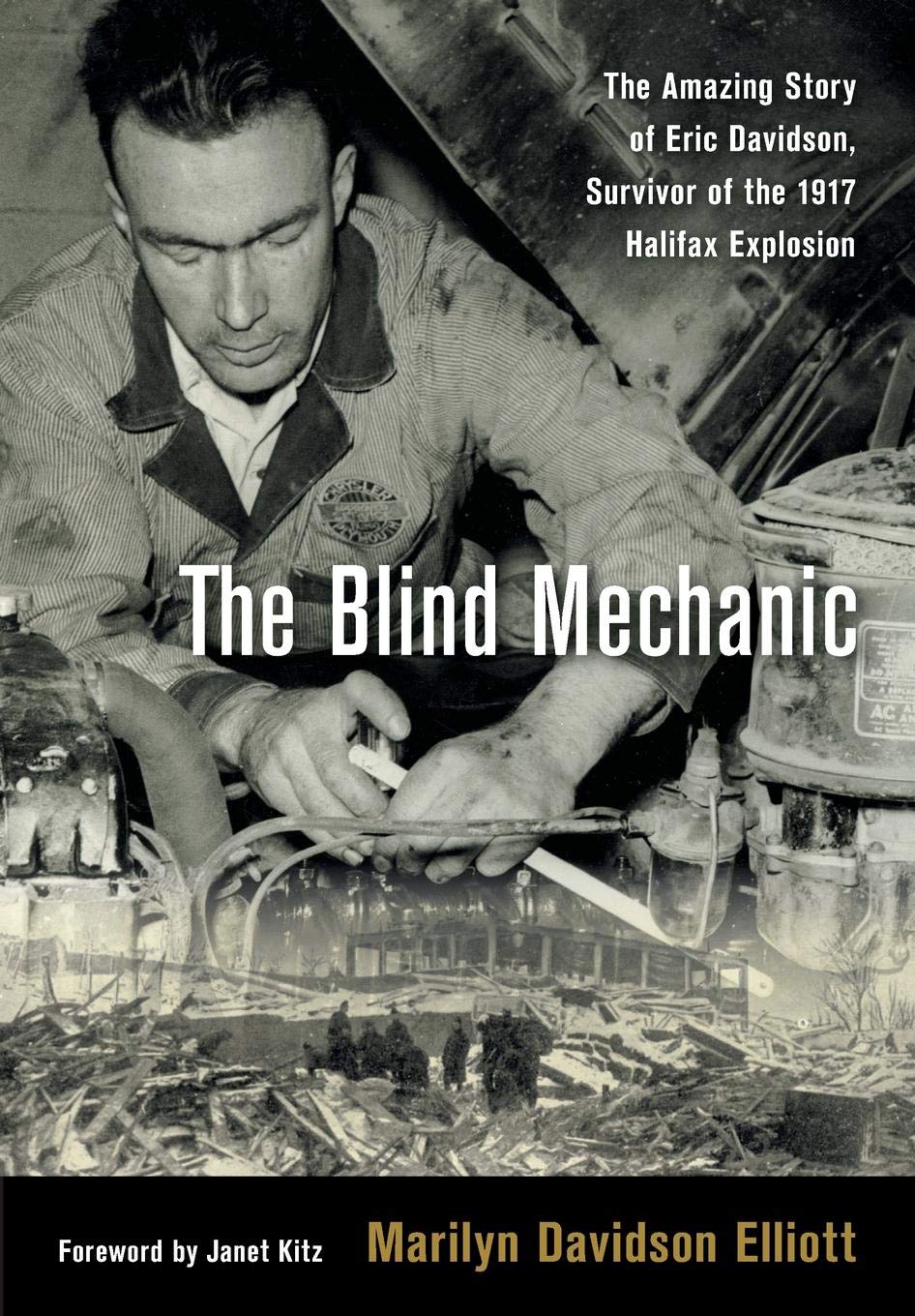
The Blind Mechanic: The Amazing Story of Eric Davidson, Survivor of the 1917 Halifax Explosion
$19.95
by Marilyn Davidson Elliott



Eric Davidson lost both eyes in the Halifax Explosion when he was two years old. Against all odds, he taught himself to become an auto mechanic and had a successful decades-long career as "one of the boys." Eric Davidson was a beautiful, fair-haired toddler when the Halifax Explosion struck, killing almost 2,000 people and seriously injuring thousands of others. Eric lost both eyes―a tragedy that his mother never fully recovered from. Eric, however, was positive and energetic. He also developed a fascination with cars and how they worked, and he later decided, against all likelihood, to become a mechanic. Assisted by his brothers who read to him from manuals, he worked hard, passed examinations, and carved out a decades-long career. Once the subject of a National Film Board documentary, Eric Davidson was, until his death, a much-admired figure in Halifax. This book does not gloss over the challenges faced by Eric and by his parents. Written by his daughter Marilyn, it gives new insights into the story of the 1917 Halifax Explosion and contains never-before-seen documents and photographs. While Eric Davidson has been mentioned in previous Explosion accounts, his story has never been told in such fascinating detail. Davidson overcame such odds that his life story might not seem believable if it had not happened. Marilyn Davidson Elliott is the daughter of Eric Davidson. She was born in Halifax in 1955 and grew up in the North End of Halifax. Marilyn's commitment to her parents blessed her with a lifetime of cherished memories. While raising her family, she held a variety of jobs. In 1993, she acquired her Certified Insurance Professional designation and worked with the provincial government as a claims adjuster until retirement in 2011. Marilyn served as a member of the Halifax Explosion 100th Anniversary Advisory Committee. Marilyn enjoys spending time with her granddaughters and summers at the cottage in Lunenburg County. The Blind Mechanic The Amazing Story of Eric Davidson, Survivor of the 1917 Halifax Explosion By Marilyn Davidson Elliott Nimbus Publishing Limited Copyright © 2018 Marilyn Davidson Elliott All rights reserved. ISBN: 978-1-77108-676-9 Contents Foreword, 6, Preface, 8, The Halifax Explosion, 14, And Then It Happened, 27, Recovery and Transition, 36, School Days, 50, Defying the Odds, 60, A Love Match, 69, One of the Boys, 77, Raising a Family, 83, Vacations, 96, Shopping with Dad, 101, Family Life, 108, Grandma Georgina, 119, Peepers and Croakers, 132, A Passion for Antique Autos, 145, The Golden Years, 158, The Halifax Relief Commission Pension Fund, 173, Commemorating the Halifax Explosion, 181, Epilogue, 191, Acknowledgements, 195, Bibliography, 197, CHAPTER 1 The Halifax Explosion Halifax was a robust city in 1917 with a population of roughly fifty thousand. It was thriving industrially and becoming a cultural centre complete with theatres, restaurants, libraries, and more. Government offices and banking institutions were located in the South End along with the more affluent of Halifax society, while industries and the working-class citizens of Halifax were mostly situated in the North End community of Richmond. The name Richmond was given to the area north of the Wellington barracks (now CFB Stadacona) and east of Gottingen Street in the mid-1800s when sugar was brought from Richmond, Virginia, and landed at wharves located near the present shipyards. Originally, Richmond had been a farming village, but by the late 1850s a railway skirted the shoreline and Richmond became industrialized with factories such as the Acadia Sugar Refinery, the Richmond Printing Company, Hillis & Sons Foundry, and the Nova Scotia Cotton Manufacturing Company to name a few. In 1877, the Intercolonial Railway opened the North Street Station at the foot of North Street. Industry workers settled on the Richmond slope, a steep hill that rises up from the harbour. At the top of the hill more than one hundred and twenty metres above the harbour is Fort Needham, which was at one time a strategic naval installation constructed upon a drumlin. The dictionary definition of a drumlin is a glacial formation, an elongated hill that is shaped like an inverted spoon or a half-buried egg. Fort Needham was active during the American and French Revolutions but after the War of 1812, the fort was decommissioned and was left to deteriorate to the point that by 1917 there was little evidence of its existence. Richmond residents were mostly of Scottish and Irish heritage and the predominant religions were Roman Catholic, Anglican, Presbyterian, or Methodist. Four churches served the Richmond community: St. Joseph's Roman Catholic, St. Mark's Anglican, Grove Presbyterian, and Kaye Street Methodist. Churches were the nerve centres of Halifax-area communities in the early 1900s and as such Richmond churches played a major role in the everyday life of the community. Religious an