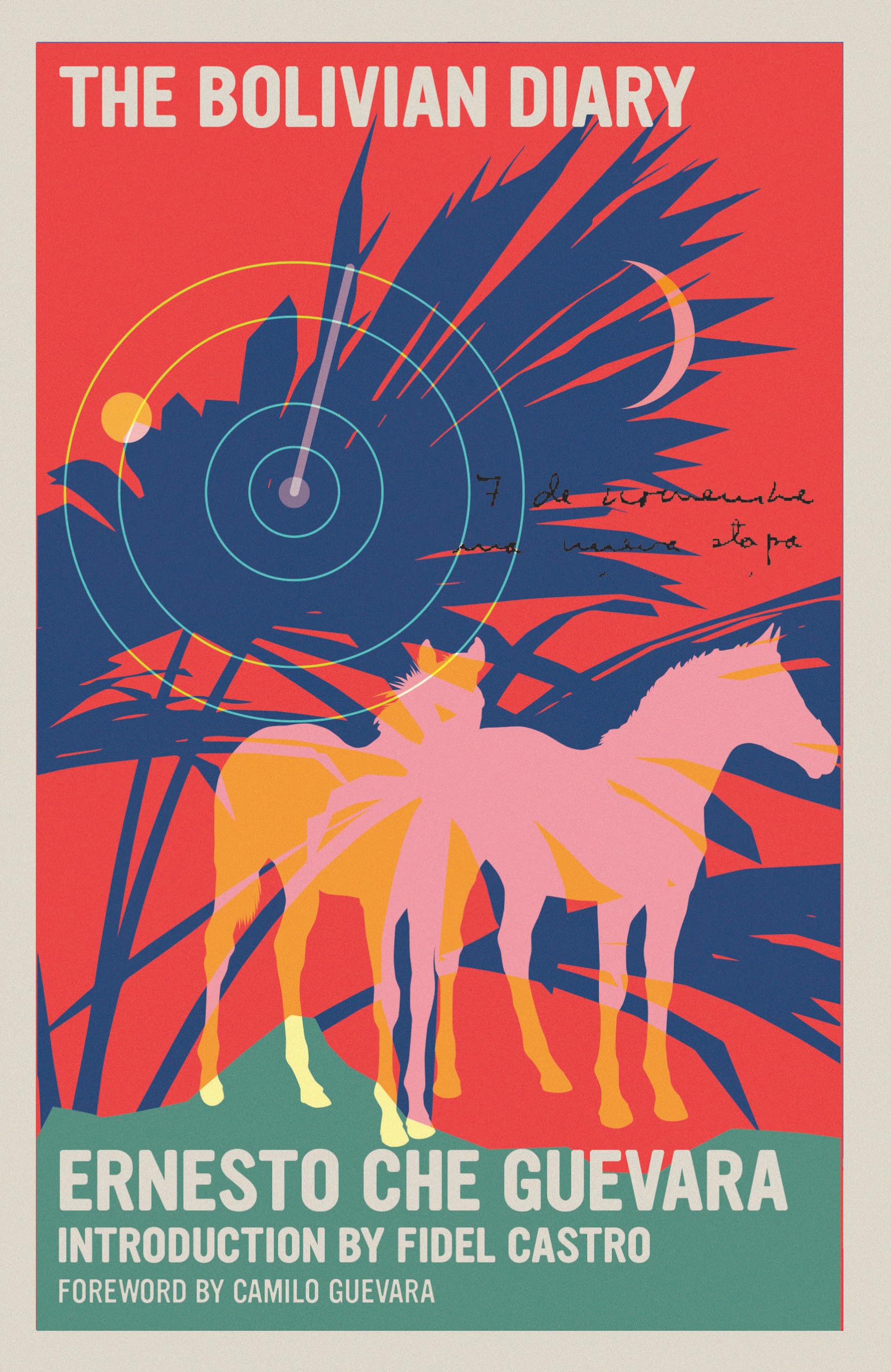



The last diary of revolutionary Che Guevara with entries up until two days before his murder. This new edition of Che Guevara's diary of the last year of his life describes Che's efforts to launch a guerrilla insurrection against the military government of Bolivia. It was found in his backpack when he was captured by the Bolivian Army in October 1967.This edition includes Fidel Castro's "A Necessary Introduction," exposing the lies of an earlier, pre-emptive edition prepared by the C.I.A. to discredit Che and the Bolivian expedition, as well as the Cuban Revolution itself. The Bolivian Diary reveals an older, more time-tested, and health-compromised Che than either the exuberant The Motorcycle Diaries or the mature and implacable Congo Diary. There is rich irony here as he recounts the daily challenges faced by his small guerrilla band, the pronouncements of the military government, and the actions of the large military force attacking them. The last entry describes the day before Che's capture, two days before his murder. ERNESTO GUEVARA DE LA SERNA was born in Rosario, Argentina, on June 14, 1928. While studying for a medical degree in Buenos Aires, he took a trip with his friend Alberto Granado on an old Norton motorcycle through all of Latin America, the basis for The Motorcycle Diaries . During his travels he witnessed the Bolivian revolution in 1953; and, in Guatemala in 1954, the overthrow of the democratically elected government of Jacobo Arbenz by US-backed forces. Forced to leave Guatemala, he went to Mexico City, where he linked up with exiled Cuban revolutionaries and met Fidel Castro in 1955. Che joined their expedition to Cuba, where the revolutionary war began in the Sierra Maestra mountains. At first Che was the troop doctor, and later became Rebel Army commander in July 1957. Following the rebels’ victory on January 1, 1959, he was a key leader of the new revolutionary government and also of the political organization that in 1965 became the Communist Party of Cuba. A NECESSARY INTRODUCTION Fidel Castro It was Che’s custom during his days as a guerrilla [during the 1956–58 Cuban revolutionary war] to carefully record his daily observations in a personal diary. During long marches over rugged and difficult terrain, in the midst of damp woods, when the lines of men, always hunched over from the weight of their packs, ammunition, and weapons, would stop for a moment to rest, or when the column would receive orders to halt and set up camp at the end of an exhausting day’s march, you would see Che—as he was affectionately nicknamed by the Cubans from the beginning—take out a small notebook and, with the tiny and nearly illegible handwriting of a doctor, write his notes. What he was able to save from these notes he later used in writing his magnificent historical narratives of the revolutionary war in Cuba—accounts full of revolutionary, educational, and human content. This time, thanks to his invariable habit of noting the main events of each day, we have at our disposal rigorously exact, priceless, and detailed information on the heroic final months of his life in Bolivia. These notes, not really written for publication, served as a tool in the constant evaluation of events, situations, and people, and at the same time served as an outlet for the expression of his keenly observant and analytical spirit, often laced with a fine sense of humor. They are soberly written and form a coherent whole from beginning to end. It should be kept in mind that they were written during those rare moments of rest in the midst of a heroic and superhuman physical effort, where he bore exhausting obligations as leader of a guerrilla detachment in the difficult first stages of a struggle of this nature, which unfolded under incredibly harsh material conditions. This reveals once more his method of work, his will of steel. The diary, in the course of analyzing in detail the incidents of each day, takes note of the shortcomings, critical assessments, and recriminations that are part of and inevitable in the development of a revolutionary guerrilla struggle. Inside a guerrilla detachment such assessments must take place constantly. This is especially true in the stage in which it consists of a small nucleus facing extremely adverse material conditions and an enemy infinitely superior in number, when the slightest negligence or the most insignificant mistake can be fatal. The leader must be extremely demanding, using each event or episode, no matter how insignificant it may seem, to educate the combatants and future cadres of new guerrilla detachments. The process of training a guerrilla force is a constant appeal to each person’s consciousness and honor. Che knew how to touch the most sensitive fibers in revolutionaries. When Marcos, after being repeatedly admonished by Che, was warned that he could be dishonorably discharged from the guerrilla unit, he replied, “I would rather be shot!” L