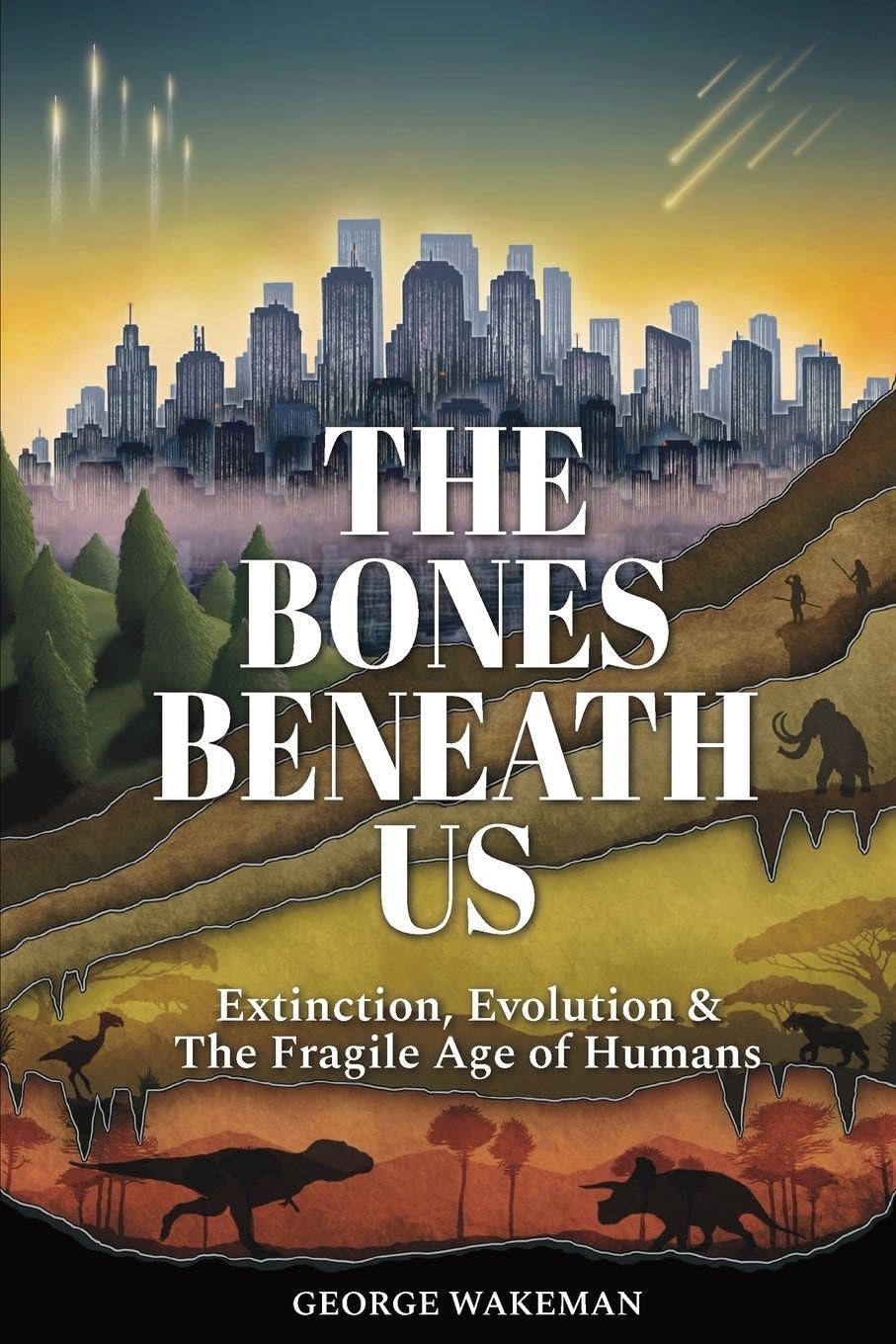
The Bones Beneath Us: Extinction, Evolution & The Fragile Age of Humans
$26.99
by George Wakeman



The Bones Beneath Us traces four billion years of planetary history, following the physical processes that shaped life before any human record and the brief interval in which our own species appeared. The narrative moves through vanished oceans, coal forests, ice-bound continents, and ancient seas where the first food webs took form, guided by evidence preserved in rock, fossil, and chemical signature. Each chapter descends into a different depth of deep time. Extinctions leave distinct markers in stone. Continents part and converge. Atmospheres acquire new compositions. Evolution unfolds across spans of time that exceed any human scale, leaving behind entire worlds that once sustained complex life. The book gathers these transformations into a single narrative grounded in palaeontology, evolutionary biology, and Earth system science. The later sections turn back to the present and to the human species as a geological agent. Industrial expansion, technological growth, and ecological disruption emerge within the same long history that shaped reefs, forests, and past extinction events. Human institutions, belief systems, and scientific practices take shape as recent structures within a planetary story governed by physical limits that predate civilisation. Written as narrative science, The Bones Beneath Us places humanity within the continuity of Earth's history. The book follows the emergence of life, the vulnerability of complex ecosystems, and the compressed span of human time when set against deep time. It situates the present world within the older layers that underlie it, where the record of past worlds remains embedded in the ground itself.