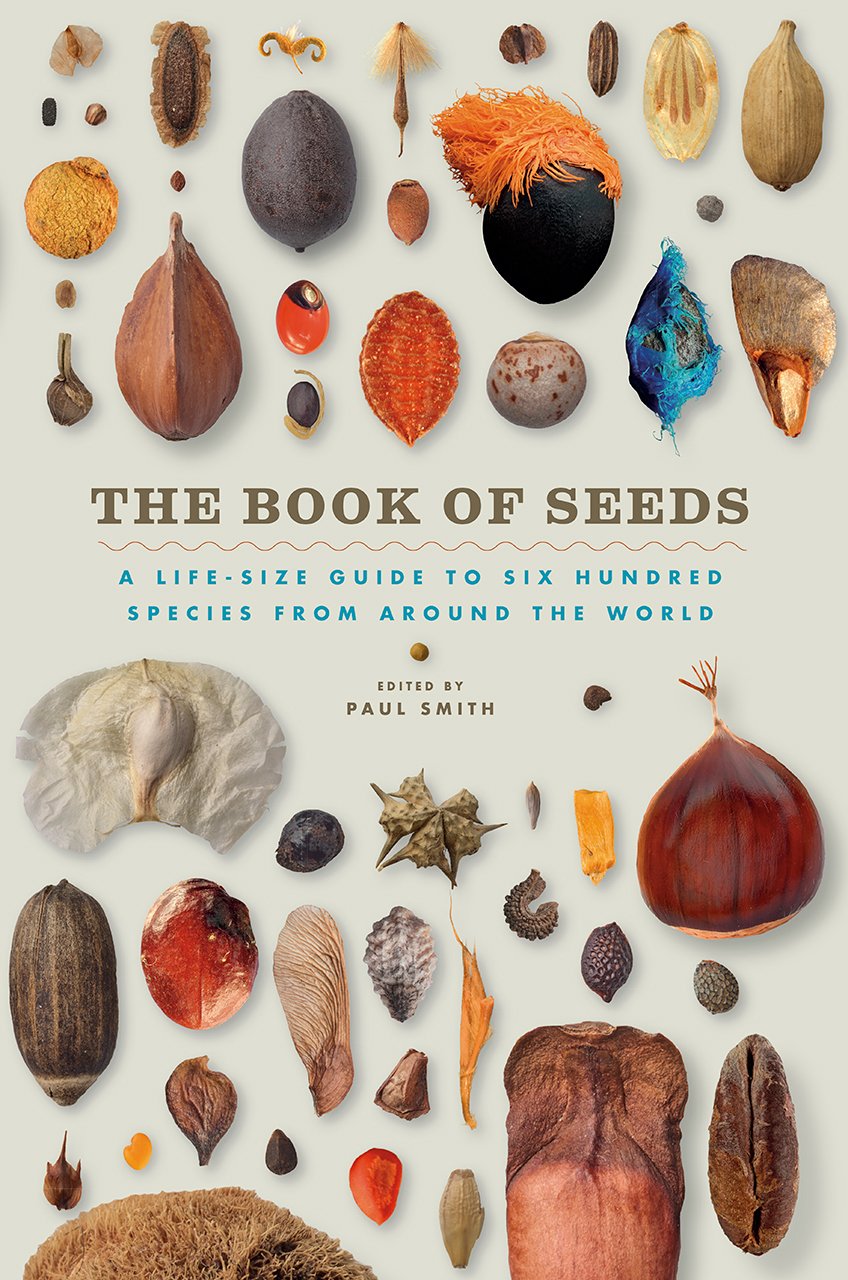
The Book of Seeds: A Life-Size Guide to Six Hundred Species from around the World (Life-Size Guides to the Best of Nature)
$46.75
by Paul Smith



Seeds are nature’s consummate survivors. The next time you admire a field of waving green grassland or a stunning grove of acacia, stop to consider how it got that way—often against incredible odds. Seeds can survive freezing temperatures and drought. They can pass through our digestive systems without damage and weather a trip across the ocean, hitching a ride on marine debris. They can even endure complete desiccation, a feat taken to extraordinary lengths by the date palm, a seed from which was recovered from the palace of Herod the Great was germinated after some two thousand years. The Book of Seeds takes readers through six hundred of the world’s seed species, revealing their extraordinary beauty and rich diversity. Each page pairs a beautifully composed photo of a seed—life-size, and, in some cases, enlarged to display fine detail—with a short description, a map showing distribution, and information on conservation status. The whole spectrum of seeds is covered here. There are prolific species like corn and less widely distributed species, like the brilliant blue seeds of the traveler’s palm or the bird of paradise flower, aptly named for its distinctive orange coiffure. There are tiny seeds and seeds weighing up to forty pounds. And while seeds in all their shapes, sizes, and colors grant us sustenance, there are even some we would be wise to treat with caution, such as the rosary pea, whose seeds are considered more toxic than ricin. The essential guide to these complex plant creations, The Book of Seeds offers readers a rare, up-close look that will inspire scientists and nature lovers alike. “Handsome and handy. . . . Learn here about achenes like rhubarb seeds, which are dispersed by the wind. Or samaras, like the seeds of the English elm, found in the middle of two transparent green wings.” ― New York Times Published On: 2018-06-05 "A well-written primer on seed anatomy, evolution, and use, including conservation. . . . It will be useful to both the professional botanist and amateur, as well as anyone curious about how nature looks and works." ― Huntia “Handsome and handy. . . . Learn here about achenes like rhubarb seeds, which are dispersed by the wind. Or samaras, like the seeds of the English elm, found in the middle of two transparent green wings.” ― New York Times Published On: 2018-06-05 "A well-written primer on seed anatomy, evolution, and use, including conservation. . . . It will be useful to both the professional botanist and amateur, as well as anyone curious about how nature looks and works." ― Huntia Paul Smith is secretary general of Botanic Gardens Conservation International, a nonprofit organization that promotes plant conservation in botanic gardens. He is a former head of the Millennium Seed Bank at the Royal Botanic Gardens, Kew, the largest and most diverse seed bank in the world. The Book Of Seeds A Life-Size Guide To Six Hundred Species From Around The World By Paul Smith The University of Chicago Press Copyright © 2018 Quarto Publishing plc All rights reserved. ISBN: 978-0-226-36223-6 Contents Introduction, What is a seed?, How did seed plants evolve?, Seeds & humans, Seed conservation, Plant diversity & why it matters, Seed-bearing plants, CYCADOPHYTA, GINKGOPHYTA & GNETOPHYTA, PINOPHYTA, MAGNOLIOPHYTA, Appendices, Glossary, Resources, Abbreviations in author names, Notes on contributors, Index of common names, Index of scientific names, Acknowledgments, CHAPTER 1 WHAT IS A SEED? Seeds are travelers in space and time — small packages of DNA, protein, and starch that can move over long distances and remain viable for hundreds of years. These packages have everything they need not only to survive, but also to grow into a plant when they encounter the right conditions. SEED ANATOMY The seed is a reproductive unit that develops from an ovule, usually after fertilization. Ovules are borne by both the angiosperms (flowering plants) and the gymnosperms (conifers and cycads). In the angiosperms, the ovules are totally enclosed within the ovary, while in the gymnosperms the ovules are "naked," typically borne near the base of each scale in a female cone. Since the cone scales remain tightly closed except at the time of pollination and later at seed shed, the term "naked" is a relative one. All seeds have three basic structures in common: the seed coat (often referred to as the testa), a food source (the endosperm), and the embryo. As the embryo develops, it differentiates into the cotyledon (seed leaf or leaves), the epicotyl (the embryonic axis at the point of attachment of the cotyledon(s)), the plumule (shoot), the hypocotyl (stem), and the radicle (root). Some seeds have appendages such as arils that attract birds and animals (see top right). These are often brightly colored and nutritious, and their consumption doesn't damage the seed. SEED MORPHOLOGY Seeds have developed a wide range of shapes and s